

Honghe
Honghe Overview
Chinese Name: 红河哈尼族彝族自治州 English IPA: Hong He Location: Southeast of Yunnan Population (city): 4,587,300 Language: Southwest Dialect, Hani & Yi Language Zip code: Tel code: Time zone:
At the southern feet of the high and precipitous Ailao Mountains, there extends a vast stretch of beautiful, richly-endowed and mystical land. This is Honghe Hani and Yi Autonomous Prefecture, much alike a piece of green precious stone inlaid at the southernmost end of China. Honghe Hani and Yi Autonomous Prefecture(红河哈尼族彝族自治州) is located in the southeast of Yunnan province, China. It is a frontier ethnic minority autonomous prefecture where multi-ethnic groups live in. And there are 10 indigenous ethnic groups. Honghe Prefecture is connected with Kunming in the north, Wenshan(文山) in the east, Yuxi(玉溪) in the west, Socialist Republic of Vietnam in the south and the tropic of cancer runs through east-west. There are also abundant tourism resources in Honghe prefecture, like Yuanyang terrace and Jianshui Confucius Temple(建水孔庙) etc.
Highlights of Honghe
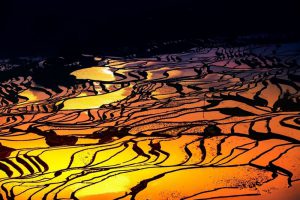
▪ Yuanyang Hani Rice Terraces: Yuanyang Hani Rice Terraces is marked by spectacular terraces that cascade down the slopes of the towering Ailao Mountains to the banks of the Honghe River.
▪ Jianshui Old Town: As an ancient town with a long history of more than 1200 years, tourists can feel the profound cultural deposits and strong vitality of the combination of the past and present.
▪ Ethnic Minority Market: Many ethnic minorities live in Honghe Prefecture, such as Hani, Yi, Dai, Miao and Zhuang. During the market day, you can see different ethnic customs and costumes, experience the true life of these minorities and buy featured products.
Hot Destinations in Honghe
Other Destinations in Honghe
Honghe Attractions
Located in the southeast of Yunnan province, Honghe is an ancient and mysterious land with a very long history. Nowadays, Honghe has become a famous tourist destination with abundant scenic spots, numerous historic places of interest and profound terraced culture, in particular, Yuanyang county and Jianshui county in Honghe prefecture. More and more tourists from home and abroad visit Yuanyang Hani Rice Terrace and Jianshui Ancient Town. Tourist attractions like Jianshui Confucius Temple(建水孔庙), Longshuba Rice Terrace(龙树坝梯田), Laohuzui Rice Terraces in Yuanyang County(元阳老虎嘴梯田), Duoyishu Rice Terrace(多依树梯田), Bada Rice [...]
Honghe Tours
There are political, economic, military and cultural center of south Yunnan, Mengzi(蒙自); the capital of Tin in the world, Gejiu(个旧); National historic and cultural ancient town, Jianshui(建水); Two national level entry ports, Hekou(河口) and Jinshuihe(金水河); Tin culture, ceramic culture and terraced culture in Honghe Hani and Yi Autonomous County. Honghe is the epitome of Yunnan’s economy, society, humanity and nature, is the birthplace of Yunnan’s modern industry, as well as China’s the landway passage and bridgehead towards asean. In order to [...]
- More City Tours Including Honghe >>
- More China Provinces Tours Including Honghe >>
- More Multi-City Tours Including Honghe >>
- All Tours Including Honghe >>
Climate & When to Go
Honghe Prefecture lies in subtropical plateau humid monsoon climate area with a low latitude. Types of climate are diverse because of the atmospheric circulation and complex terrain conditions. It features a unique plateau three-dimensional climate. In the Prefecture, the four seasons are not very clear, but the difference between dry and rainy season is notable. The rainfall in rainy season from May to October each year accounts for more than 80% of annual rainfall. The period of heavy rainfall intensity [...]
More Honghe Climate & When to Go >>
Transportation
Transportation in Honghe prefecture is connvenient, there are national highway 326 running through the whole prefecture and national highway 323 running through the central part of the prefecture. There are highways such as Tongjian expressway(通建高速), Jishi expressway(鸡石高速), Pingsuo expressway(平锁高速), Shimeng high-grade highway(石蒙高等级公路) and Getun high-grade highway(个屯高等级公路). In the coming years, Shimeng expressway, Mengxin expressway and Xinhe expressway will be constructed. The railways are mainly narrow tracks like Kunhe railway(昆河铁路), Jige railway(鸡个线), Mengbao railway(蒙宝线) and Caoguan railway(草官线). In the future, standard [...]
Festivals and Activities
There are 10 ethnic groups have lived there for generations, including Han, Yi, Hani, Miao, Zhuang, Dai, Yao, Hui, Lahu, Bai and other minorities. Yi and Hani are two main ethnic minority groups, accounting for more than 40% of total population. Therefore, many ethnic festivals and entertainments are celebrated in Honghe Prefecture. 1. Kuzhazha Festival(矻扎扎节) Celebrated in the middle of the 6th lunar month, Kuzhazha Festival is also called June New Year. It is the grandest traditional festival of Hani people as [...]
More Honghe Festivals and Activities >>
Travel Tips
As one of popular tourist destinations in Yunnan Province, there are increasingly foreign and domestic travelers in Honghe Prefecture, especially Yuanyang and Jianshui. Then it is necessary to know something about travel tips, like what to notice while traveling in Honghe and the best time to visit Honghe. Useful Numbers Fire: 119 Police: 110 Ambulance: 120 Area code: 0873 Zip Code: 661100 Tourist Consultant: 12301 Telephone Number Inquiry: 141 Tourism complaint: 0873-3727548 Weather Forecast Inquiry: 12121/96121 Notes 1. Dressing Honghe is not very hot in summer and not so cold in winter, the rainy [...]
Useful Maps
Honghe is located in the southeast of Yunnan province. It’s nearly 265 kilometers from Kunming, the capital city of Yunnan province. To have a better understanding about Honghe Prefecture, know how to get to there and help tourists plan a better tour, we have posted some useful Honghe maps. Maps include region maps, tourist attractions maps, location maps, tour routes maps and transportation maps of Honghe prefecture. [...]
Honghe Accommodation
Honghe is the fourth largest economy in Yunnan province, ranking first among the 30 Ethnic Minority autonomous prefectures in terms of economic aggregate and some socio-economic indicators. With increasing economic and tourism development, there are more and more hotels in Honghe. Therefore, it is quite convenient to find ideal hotels of your own favorite. Among so many Honghe hotels, you can choose to stay around scenic spots for the convenience of sightseeing, or stay around railway station and bus station for [...]