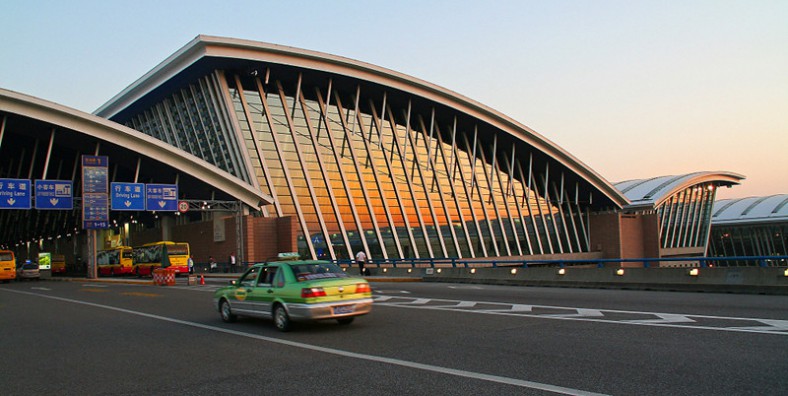


Shanghai Pudong International Airport
Shanghai Pudong International Airport (IATA: PVG, ICAO: ZSPD) is one of two international airports of Shanghai and a major aviation hub of China. Pudong Airport mainly serves international flights, while the city’s other major airport Shanghai Hongqiao International Airport mainly serves domestic and regional flights. Located about 30 kilometres (19 mi) east of the city center, Pudong Airport occupies a 40-square-kilometre (10,000-acre) site adjacent to the coastline in eastern Pudong. The airport is operated by Shanghai Airport Authority (Chinese: 上海机场集团公司, SSE: 600009).
The airport is the main hub for China Eastern Airlines and Shanghai Airlines, and a major international hub for Air China, as well as secondary hub of China Southern Airlines. It is also the hub for privately owned Juneyao Airlines and Spring Airlines, and an Asia-Pacific cargo hub for UPS[1] and DHL. The DHL hub, opened in July 2012, is said to be the biggest express hub in Asia.[2]
Pudong Airport has two main passenger terminals, flanked on both sides by four operational parallel runways.[3] A third passenger terminal has been planned since 2015, in addition to a satellite terminal and two additional runways, which will raise its annual capacity from 60 million passengers to 80 million, along with the ability to handle six million tons of freight.[4]
Pudong Airport is a fast-growing hub for both passenger and cargo traffic. With 3,703,431 metric tons handled in 2017, the airport is the world’s third-busiest airport by cargo traffic. Pudong Airport also served a total of 70,001,237 passengers in 2017, making it the second-busiest airport in China, fifth-busiest in Asia, and the ninth-busiest in the world. It is also the busiest international gateway of mainland China, with 35.25 million international passengers.[5] By the end of 2016, Pudong Airport hosted 104 airlines serving more than 210 destinations.[6]
Shanghai Pudong is the busiest international hub of China, and about half of its total passenger traffic is international.[7]Pudong Airport is connected to Shanghai Hongqiao Airport by Shanghai Metro Line 2 and the Shanghai Maglev Train via Pudong International Airport Station. There are also airport buses connecting it with the rest of the city.
History
Early development
Prior to the establishment of Pudong International Airport, Shanghai Hongqiao International Airport was the primary airport of Shanghai. During the 1990s, the expansion of Hongqiao Airport to meet growing demand became impossible as the surrounding urban area was developing significantly, and an alternative to assume all international flights had to be sought.[citation needed]
After deliberation, the municipal government decided to adopt the suggestion from Professor Chen Jiyu of East China Normal University, who wrote a letter to the Mayor of Shanghai Xu Kuangdi[citation needed] suggesting that the new airport should be constructed on the tidal flats of the south bank of the Yangtze River estuary, on the coast of the Pudongdevelopment zone to the east of Shanghai.
Construction of the first phase of the new Shanghai Pudong International Airport began in October 1997, took two years to build at a cost of RMB 12 billion (1.67 billion USD), and was opened on October 1, 1999[citation needed] It covers an area of 40 square kilometres (15 sq mi) and is 30 kilometres (19 mi) from downtown Shanghai. The first phase of the airport has one 4E category runway (4000 m x 60 m) along with two parallel taxiways, an 800,000-square-metre (8,600,000 sq ft) apron, seventy-six aircraft positions and a 50,000 m2 (540,000 sq ft) cargo warehouse.[citation needed]
A second runway was opened on March 17, 2005,[citation needed] and construction of phase two (including a second terminal, a third runway and a cargo terminal) began in December 2005 and started operation on March 26, 2008, in time for the Beijing 2008 Summer Olympics.
In November 2011, Pudong Airport received approval from the national government for a new round of expansion which includes two runways. The 3,800-metre fourth runway, along with an auxiliary taxiway and traffic control facilities, is projected to cost 2.58 billion yuan (USD 403 million). The 3,400-metre fifth runway, along with a new traffic tower, will cost 4.65 billion yuan (USD 726.6 million). Construction was completed in 2015 and has doubled the capacity of the airport.[8][9]
Ongoing expansion
Pudong International Airport officially started the third phase of the Pudong International Airport expansion with the construction on a new south satellite terminal on December 29, 2015. The new satellite terminal will be the world’s largest single satellite terminal with a total construction area of 622,000 square meters, which is larger than the Pudong International Airport T2 terminal building (485,500 square meters). The satellite terminal is composed of two halls, S1 and S2, forming an H-shaped structure. It will have an annual design capacity of 38 million passengers, The total cost of the project is estimated to be about 20.6 billion yuan. Halls S1 and S2 will have 83 gates.[10] A high capacity People mover connecting T1 to SI and T2 to S2 will be constructed. After the completion of the satellite terminal in 2019, Pudong International Airport will have an annual passenger capacity of 80 million passengers, ranking among the top ten airports in the world.[11]
Composition
The airport has 70 boarding bridges along with 218 parking positions. Five runways are parallel to the terminals (four operational): one 4,000-metre (13,000 ft) runway with 4E rating (capable of accommodating aircraft up to Boeing 747-400) , two 3,800-metre (12,500 ft) runways with 4F rating (capable of accommodating aircraft up to Airbus A380, Boeing 747-8, and Antonov An-225) , and two 3,400-metre (11,200 ft) runways with 4F rating .
Pudong airport currently has 5 runways. Rwy 35L/17R and Rwy 34R/16L are mostly used for landing while Rwy 35R/17L and Rwy 34L/16R are mostly used for takeoff. Runway 15/33 is not in operation.
Terminal 1
Terminal 1 was opened on October 1, 1999 along with a 4000-metre runway and a cargo hub.[citation needed] It was built to handle the demand for traffic and to relieve Shanghai Hongqiao International Airport’s traffic. The exterior of Terminal 1 is shaped like a seagull, and has 28 gates, 13 of which are double-decker gates. The capacity of Terminal 1 is 20 million passengers. It currently has 204 check-in counters, thirteen luggage conveying belts and covers an area of 280,000 square metres.[citation needed]
The gates for Terminal 1 is 1–12, 14–29 (linked with jetway), while the remote gates are 201–211, 533–543, 115–117, 201–211, 251–255, 256–258, and 511–521.
Terminal 2
Terminal 2, opened to public and officially opened on March 26, 2008, along with the third runway, gives a capacity of 60 million passengers and 4.2 million tons of cargo annually. Terminal 2 is shaped like Terminal 1, although it more closely resembles a wave, and is slightly larger than Terminal 1. Terminal 2 also has more levels than Terminal 1. Terminal 2 is primarily used by Air China and other Star Alliance members.[12]
The gates for Terminal 2 is 50–65, 67–79, 80–98 (Note that gates 58–90 is used by both the C gates (used for domestic flights) and the D gates (used for international flights). The gates between gates 65–79 is only odd numbers (65, 67, 69, 71, 73, 75, 77, 79). Gates 50–57 and gates 92–98 is used for C gates only. The remote gates for Terminal 2 is 581–586, 589–590, 593–600, 801–816.
Satellite concourses
An additional satellite concourse facility to provide further gates and terminal space started construction on December 29, 2015 and was expected to be completed in late 2018. This project will support 38 million passengers annually through 83 departure gates across two S1 and S2 concourses. These will be connected by an underground automated people mover to the current T1 and T2 terminals.[13] It is now set to open in the second half of 2019.[14]
A-CDM implementation
The airport has been using the Airport Collaborative Decision Making system (A-CDM) developed by the aviation data service company VariFlight since January 2017. The system is aimed to improve on-time performance and safety of the airport’s operations. By June 2017, Shanghai Pudong airport recorded 62.7% punctuality rate, which was a 15% increase compared to the same period previous year.[15]
Airlines and destinations
Passenger
| Airlines | Destinations |
|---|---|
| Aeroflot | Moscow–Sheremetyevo |
| Aeroméxico | Mexico City (ends 14 December 2019)[16] |
| AirAsia X | Kuala Lumpur–International |
| Air Canada | Montréal–Trudeau, Toronto–Pearson, Vancouver |
| Air China | Bangkok–Suvarnabhumi, Barcelona,[17] Beijing–Capital, Changchun, Chengdu, Chongqing, Dalian, Frankfurt, Fukuoka, Fuyuan, Guangzhou, Guilin, Guiyang, Haikou, Harbin, Hohhot, Kunming, Lanzhou, Milan–Malpensa, Munich, Nagoya–Centrair, Nanning, Osaka–Kansai, Paris–Charles de Gaulle, Sendai, Shenzhen, Taipei–Taoyuan, Tianjin, Tokyo–Narita, Wenzhou, Xi’an, Xichang, Yinchuan |
| Air China operated by Dalian Airlines |
Dalian |
| Air France | Paris–Charles de Gaulle |
| Air India | Delhi, Mumbai |
| Air Koryo | Pyongyang |
| Air Macau | Macau |
| Air Mauritius | Mauritius |
| Air New Zealand | Auckland |
| All Nippon Airways | Nagoya–Centrair, Osaka–Kansai, Tokyo–Haneda, Tokyo–Narita |
| American Airlines | Dallas/Fort Worth, Los Angeles |
| Asiana Airlines | Busan, Seoul–Incheon |
| Austrian Airlines | Vienna |
| Beijing Capital Airlines | Lijiang |
| British Airways | London–Heathrow |
| Cambodia Angkor Air | Phnom Penh, Siem Reap |
| Cathay Dragon | Hong Kong |
| Cathay Pacific | Hong Kong |
| Cebu Pacific | Cebu,[18] Kalibo, Manila |
| Chengdu Airlines | Chengdu |
| China Airlines | Kaohsiung, Taipei–Taoyuan |
| China Eastern Airlines | Amsterdam, Auckland, Baise, Bangkok–Suvarnabhumi, Beihai, Beijing–Capital, Brisbane, Busan, Cebu, Changchun, Changsha, Chaoyang, Chengdu, Chiang Mai, Chicago–O’Hare, Chifeng, Chongqing, Clark,[19] Daegu, Dalian, Datong, Dazhou, Delhi, Denpasar/Bali, Dubai–International, Frankfurt, Fukuoka, Fuzhou, Ganzhou, Guangyuan, Guiyang, Hami, Handan, Hanamaki,[20] Harbin, Hefei, Heihe, Hiroshima, Ho Chi Minh City, Hong Kong, Honolulu, Huai’an, Jakarta–Soekarno-Hatta, Jeju, Jiagedaqi,[21] Jiamusi,[22] Jieyang, Jinan, Jinggangshan,[23]Jinzhou, Kagoshima, Kashgar, Kathmandu, Komatsu, Kunming, Lanzhou, Lhasa, Linyi, Liping, Liupanshui, Liuzhou, London–Gatwick,[24]London–Heathrow, Los Angeles, Lüliang, Luzhou, Macau, Madrid, Malé, Mandalay,[25] Manila, Matsuyama, Melbourne, Moscow–Sheremetyevo, Muan, Mudanjiang, Nagasaki, Nagoya–Centrair, Naha, Nanchang, Nanchong, Nanjing, New York–JFK, Niigata, Ningbo, Okayama, Osaka–Kansai, Panzhihua, Paris–Charles de Gaulle, Phnom Penh, Prague, Qingdao, Qiqihar, Rome–Fiumicino, Saint Petersburg, San Francisco, Sanya, Sapporo–Chitose, Seoul–Incheon, Shennongjia, Shenyang, Shenzhen, Shigatse, Shizuoka, Siem Reap, Singapore, Stockholm–Arlanda,[26] Sydney, Taipei–Taoyuan, Taiyuan, Tianjin, Tokyo–Haneda, Tokyo–Narita, Tonghua, Tongren,[27] Toronto–Pearson, Urumqi, Vancouver, Wenzhou, Wuhan, Xiamen, Xi’an, Xichang,[28] Xingyi,[27] Xining, Xishuangbanna,[29] Yangon,[30] Yanji, Yantai, Yibin, Yichang, Yichun, Yingkou, Yongzhou, Yuncheng, Zhangjiajie, Zhangjiakou, Zhanjiang, Zhengzhou, Zhoushan, Zhuhai, Zunyi–Xinzhou Seasonal: Asahikawa, Cairns |
| China Southern Airlines | Bangkok–Suvarnabhumi,[31] Changbaishan, Changchun, Changsha, Chengdu, Dalian, Dandong, Daqing, Fukuoka, Guangzhou, Guilin, Guiyang, Haikou, Harbin, Ho Chi Minh City, Jiamusi, Jieyang, Kunming, Mangshi, Nagoya–Centrair, Nanning, Nanyang, Osaka–Kansai, Pattaya–U-Tapao, Qingdao, Quanzhou, Sanya, Seoul–Incheon, Shenyang, Shenzhen, Taipei–Taoyuan, Urumqi, Wuhan, Xining, Yanji, Yinchuan, Zhengzhou, Zhuhai Seasonal: Aksu |
| China Southern Airlines operated by Chongqing Airlines |
Chongqing |
| China United Airlines | Beijing–Nanyuan, Shijiazhuang, Tianjin |
| Delta Air Lines | Atlanta, Detroit, Los Angeles, Seattle/Tacoma |
| Donghai Airlines | Quanzhou |
| Eastar Jet | Cheongju (suspended from 13 July 2019 to 26 October 2019), Seoul–Incheon[32] |
| Emirates | Dubai–International |
| Ethiopian Airlines | Addis Ababa |
| Etihad Airways | Abu Dhabi |
| EVA Air | Kaohsiung, Taipei–Taoyuan |
| Finnair | Helsinki |
| Fuzhou Airlines | Fuzhou |
| Garuda Indonesia | Denpasar/Bali, Jakarta–Soekarno-Hatta |
| Hainan Airlines | Beijing–Capital, Boston, Brussels,[33] Changsha, Chongqing, Dalian, Guangzhou, Haikou, Hohhot, Seattle/Tacoma, Shenzhen, Taiyuan, Tel Aviv,[34] Weifang, Xi’an |
| Hebei Airlines | Shijiazhuang |
| Hong Kong Airlines | Hong Kong |
| Iberia | Madrid |
| Japan Airlines | Nagoya–Centrair, Osaka–Kansai, Tokyo–Haneda, Tokyo–Narita |
| Jetstar Japan | Tokyo–Narita |
| Jin Air | Jeju |
| Juneyao Airlines | Bangkok–Suvarnabhumi, Bayannur, Beihai, Cebu, Changbaishan, Changchun, Changsha, Changzhi, Cheongju, Chiang Mai, Chongqing, Dalian, Dongying, Fuzhou, Guilin, Guiyang, Guyuan, Haikou, Hailar, Hanzhong, Harbin, Helsinki,[35] Hohhot, Hong Kong, Huizhou, Jeju, Jinchang, Kalibo, Kaohsiung, Krabi, Kunming, Lanzhou, Lijiang, Linfen, Longyan, Macau, Mianyang, Nagoya–Centrair, Naha, Nanning, Obihiro, Osaka–Kansai, Penghu, Phuket, Qianjiang, Qingdao, Sanming, Sanya, Sapporo–Chitose, Shenyang, Shenzhen, Sihanoukville,[36] Singapore, Songyuan, Taipei–Taoyuan, Tianjin, Tokyo–Haneda, Tongliao, Tongren, Ulanqab, Urumqi, Vladivostok,[37] Wuhan, Xi’an, Xiamen, Xiangyang, Xining, Yangyang, Yinchuan, Yueyang, Zhangjiajie, Zhangye, Zhengzhou, Zhongwei Seasonal: Irkutsk |
| KLM | Amsterdam |
| Korean Air | Busan, Seoul–Incheon |
| Kunming Airlines | Kunming |
| Lao Airlines | Vientiane[38] |
| Lion Air | Denpasar/Bali, Manado |
| Lucky Air | Kunming |
| Lufthansa | Frankfurt, Munich |
| Mahan Air | Tehran–Imam Khomeini |
| Malaysia Airlines | Kota Kinabalu, Kuala Lumpur–International |
| NokScoot | Bangkok–Don Mueang[39] |
| Peach | Osaka–Kansai, Tokyo–Haneda |
| Philippine Airlines | Manila |
| Philippine Airlines operated by PAL Express |
Kalibo[40] |
| Philippines AirAsia | Kalibo, Manila |
| Qantas | Sydney |
| Qatar Airways | Doha |
| Qingdao Airlines | Qingdao |
| Royal Brunei Airlines | Bandar Seri Begawan |
| S7 Airlines | Vladivostok Seasonal: Novosibirsk |
| Scandinavian Airlines | Copenhagen |
| Shandong Airlines | Harbin, Qingdao, Xiamen, Zhuhai |
| Shanghai Airlines | Anshan, Bangkok–Suvarnabhumi, Baotou, Budapest, Busan, Changchun, Changsha, Chiang Mai, Dalian, Denpasar/Bali, Guangzhou, Guilin, Guiyang, Haikou, Harbin, Hengyang, Hong Kong, Jieyang, Jining, Jinzhou, Karamay, Kota Kinabalu, Kuala Lumpur–International, Kunming, Lanzhou, Lianyungang, Linfen, Linyi, Macau,[41] Melbourne, Mianyang, Nanning, Osaka–Kansai, Ordos, Phuket, Qinhuangdao, Qionghai, Rizhao, Sanya, Seoul–Incheon, Shenyang, Taipei–Songshan, Tangshan, Tianjin, Tokyo–Haneda, Tongliao, Toyama, Turpan, Urumqi, Wanzhou, Weihai, Wenzhou, Xinzhou, Yichang, Yinchuan, Yuncheng, Zhangjiajie, Zhanjiang, Zhengzhou Seasonal: Krabi, Malé |
| Shenzhen Airlines | Nanchang, Quanzhou, Shenyang, Shenzhen |
| Sichuan Airlines | Chengdu, Chongqing, Harbin, Kunming, Saipan, Sanya, Xi’an |
| Singapore Airlines | Singapore |
| Spring Airlines | Anshun, Bangkok–Suvarnabhumi, Beihai, Changbaishan, Changchun, Changsha, Chiang Mai, Chongqing, Dalian, Guilin, Harbin, Hong Kong, Ibaraki, Jeju, Jieyang, Kaohsiung, Kota Kinabalu, Krabi, Lanzhou, Macau, Mianyang, Nagoya–Centrair, Nanning, Nha Trang, Osaka–Kansai, Phuket, Phnom Penh, Qingyang, Saga, Sanya, Sapporo–Chitose, Seoul–Incheon, Shenyang, Shijiazhuang, Shiyan, Singapore, Surat Thani, Taipei–Taoyuan, Taiyuan, Takamatsu, Tianjin, Tokyo–Haneda, Yangon,[42] Zhangjiajie, Zhangye |
| SriLankan Airlines | Colombo |
| Sriwijaya Air | Charter: Denpasar/Bali, Jakarta-Soekarno-Hatta |
| Suparna Airlines | Guilin, Guiyang, Harbin, Sanya, Quanzhou, Zhuhai |
| Swiss International Air Lines | Zürich |
| Thai AirAsia X | Bangkok–Don Mueang |
| Thai Airways | Bangkok–Suvarnabhumi |
| Thai Lion Air | Bangkok–Don Mueang,[43] Phuket |
| Tianjin Airlines | Dalian, Haikou, Meixian, Tianjin, Weihai |
| Turkish Airlines | Istanbul[44] |
| T’way Air | Daegu |
| United Airlines | Chicago–O’Hare, Los Angeles, Newark, San Francisco |
| Vietnam Airlines | Da Nang, Hanoi, Ho Chi Minh City, Nha Trang,[45] Phu Quoc |
| Virgin Atlantic | London–Heathrow |
| West Air | Chongqing, Quanzhou |
| XiamenAir | Dalian, Quanzhou, Tianjin |
Cargo
| Airlines | Destinations |
|---|---|
| AirBridgeCargo | Amsterdam, Anchorage, Chennai, Chicago–O’Hare, Los Angeles, Moscow–Domodedovo, Moscow–Sheremetyevo, Sochi, Yekaterinburg |
| Air China Cargo | Amsterdam, Anchorage, Beijing–Capital, Chengdu, Chicago–O’Hare, Chongqing, Copenhagen, Dallas/Fort Worth, Frankfurt, Los Angeles, Liège,[47] New York–JFK, Novosibirsk, Osaka–Kansai, Quito, Taipei–Taoyuan, Tianjin, Tokyo–Narita, Zaragoza, Zhengzhou |
| ANA Cargo | Naha, Osaka–Kansai, Tokyo–Narita |
| Asiana Cargo | Seoul–Incheon |
| ASL Airlines Belgium | Chongqing, Liège, Singapore |
| Cargolux | Luxembourg |
| Cathay Pacific Cargo | Chengdu, Chongqing, Hong Kong, Xiamen, Zhengzhou |
| China Airlines Cargo | Taipei–Taoyuan |
| China Cargo Airlines | Amsterdam, Anchorage, Atlanta, Bangkok–Suvarnabhumi, Chengdu, Chicago–O’Hare, Chongqing, Copenhagen, Dallas/Fort Worth, Dhaka, Frankfurt,[48] Hong Kong, Los Angeles, Milan–Malpensa, Osaka–Kansai, Paris–Charles de Gaulle, Seoul–Incheon, Shenzhen, Singapore, St. Louis, Taipei–Taoyuan, Tianjin, Tokyo–Narita, Zaragoza |
| China Postal Airlines | Beijing–Capital, Guangzhou, Nanjing, Osaka–Kansai, Tianjin, Xiamen |
| China Southern Cargo | Amsterdam, Anchorage, Chicago–O’Hare, Frankfurt, Los Angeles, Osaka–Kansai, Vancouver, Vienna, Zhengzhou |
| DHL Aviation operated by Air Hong Kong |
Hong Kong |
| DHL Aviation operated by AeroLogic |
Leipzig/Halle |
| DHL Aviation operated by Atlas Air |
Anchorage, Baku, Dubai–International, Zhengzhou |
| DHL Aviation operated by Kalitta Air |
Anchorage, Chicago–O’Hare |
| DHL Aviation operated by Polar Air Cargo |
Anchorage, Cincinnati, Los Angeles, Nagoya–Centrair, Seoul–Incheon, Tokyo–Narita |
| DHL Aviation operated by Southern Air |
Anchorage, Chicago–O’Hare |
| Emirates SkyCargo | Dubai–Al Maktoum, Kabul |
| Ethiopian Airlines Cargo | Addis Ababa, Bangalore |
| Etihad Cargo | Abu Dhabi, Chennai, Delhi, Karachi, Lahore, Mumbai |
| EVA Air Cargo | Taipei–Taoyuan |
| FedEx Express | Anchorage, Beijing–Capital, Delhi, Dubai–International, Guangzhou, Manila, Memphis, Oakland, Osaka–Kansai, Tokyo–Narita |
| Hong Kong Airlines Cargo | Hong Kong, Xiamen |
| Iran Air Cargo | Tehran–Imam Khomeini |
| Korean Air Cargo | Anchorage, Atlanta, New York–JFK, Seoul–Incheon, Toronto–Pearson |
| Lufthansa Cargo | Frankfurt, Krasnoyarsk, Novosibirsk, Seoul–Incheon |
| MASkargo | Kota Kinabalu, Kuala Lumpur–International, Kuching, Penang, Sydney |
| MNG Airlines | Almaty, Istanbul–Atatürk |
| National Airlines (N8) | Anchorage, Los Angeles |
| Nippon Cargo Airlines | Tokyo–Narita |
| Qantas Cargo | Anchorage, Bangkok–Suvarnabhumi, Chicago–O’Hare, Chongqing, New York–JFK, Sydney |
| Qatar Airways Cargo | Doha |
| Saudia Cargo | Bangkok–Suvarnabhumi, Jeddah, Riyadh |
| SF Airlines | Beijing–Capital, Harbin, Shenzhen |
| Singapore Airlines Cargo | Singapore |
| Silk Way Airlines | Baku |
| Suparna Airlines | Aktobe, Anchorage, Bangkok–Suvarnabhumi, Beijing–Capital, Chengdu, Chicago–O’Hare, Chongqing, Dhaka, Guangzhou, Hahn, Hangzhou, Hong Kong, Luxembourg, Munich, Nagoya–Centrair, Novosibirsk, Osaka–Kansai, Prague, Shenzhen, Shijiazhuang, Singapore, Wuxi |
| Turkish Airlines | Almaty, Bishkek, Istanbul–Atatürk |
| UPS Airlines | Anchorage, Cologne, Louisville, Osaka–Kansai, Seoul–Incheon, Tokyo–Narita, Warsaw–Chopin |
| Volga-Dnepr Airlines | Novosibirsk |
Statistics
| Year | Passengers | % change | Aircraft movements | Cargo (tons) |
|---|---|---|---|---|
| 2006[49] | 26,788,586 | 231,994 | ||
| 2007[50] | 28,920,432 |  8.0%
8.0% |
253,532 | 2,559,098 |
| 2008[50] | 28,235,691 |  2.4%
2.4% |
265,735 | 2,603,027 |
| 2009[51] | 31,921,009 |
13.1% |
287,916 | 2,543,394 |
| 2010[52] | 40,578,621 |
27.1% |
332,126 | 3,228,081 |
| 2011[53] | 41,447,730 |
2.1% |
344,086 | 3,085,268 |
| 2012[54] | 44,880,164 |
8.3% |
361,720 | 2,938,157 |
| 2013[55] | 47,189,849 |
5.1% |
371,190 | 2,928,527 |
| 2014[56] | 51,687,894 |
9.5% |
402,105 | 3,181,654 |
| 2015 | 60,098,073 |
16.3% |
449,171 | 3,275,231 |
| 2016[57] | 66,002,414 |
9.8% |
479,902 | 3,440,280 |
| 2017[58] | 70,001,237 |
6.1% |
496,774 | 3,835,600 |
| 2018[59] | 74,006,331 |
5.7% |
504,794 | 3,768,573 |
Ground transportation
Highway
- North: S1 Yingbin Expressway and Huaxia Elevated Road
- South: Shanghai–Jiaxing–Huzhou Expressway and G1501 Shanghai Ring Expressway
Maglev train
Starting service on January 29, 2004, as the first commercial high-speed maglev railway in the world, Shanghai Maglev Train links Pudong International Airport with Longyang Road Metro Station, where transfer to Line 2, Line 7, and Line 16 is possible. The 30 km (19 mi) ride from Longyang Road Metro station to Pudong International Airport typically takes less than eight minutes, with the maximum speed reaching 431 km/h (268 mph). Trains operate every 15 minutes; therefore passengers can expect to arrive in less than 25 minutes, waiting time included.
All cars are equipped with racks and space designated for luggage.
Shanghai Metro Line 2
Shanghai Metro Line 2 also provides service between Pudong International Airport and Longyang Road, Lujiazui, People’s Square, and Hongqiao International Airport, Shanghai’s primary domestic airport as well as Shanghai Hongqiao Railway Station. Line 2 is part of the Shanghai Metro system; therefore unlike the Maglev, free in-system transfer to other lines are possible.
Prices are substantially lower than the Maglev. A casual ride to People’s Square, the city center, typically takes just over one hour. It is wise to allow more than five hours for a safe flight transfer at Hongqiao International Airport using public transportation.
Line 2 operates in two sections: trains from Pudong International Airport terminate at Guanglan Road, where passengers wishing to travel on change trains across the platform. In addition, not all trains go to Hongqiao International Airport.
Future plan
The plan for building a new commuter railway line connecting the airport with Hongqiao Airport, Airport Link, has been formally established in 2015 and approved in December 2018 by National Development and Reform Commission. This railway starts from Shanghai East railway station under planning, via Disneyland, Zhangjiang and Sanlin in Pudong, Xujing in Xuhui and Qibao in Minhang. It will use the unused area in Hongqiao Railway Station originally for Maglev for its station at Hongqiao Transportation Hub.
Airport buses
Eight airport bus lines serve the airport, providing rapid links to various destinations.
- Airport Bus Route 1: To Shanghai Hongqiao Railway Station via Shanghai Hongqiao International Airport
- Airport Bus Route 2: To Jing’an Temple (City Terminal Hub)
- Airport Bus Route 4: To Hongkou Stadium Hub (Huayuan Road), via Deping Road at Pudong Avenue, Wujiaochang and Dabaishu
- Airport Bus Route 5: To Shanghai Railway Station, via Longyang Road Metro Station, Century Avenue at South Pudong Road (Lujiazui) and East Yan’an Road at Middle Zhejiang Road (People’s Square)
- Airport Bus Route 7: To Shanghai South Railway Station, via West Huaxia Road at Shangnan Road and East Huaxia Road at Chuansha Road (Chuansha)
- Airport Bus Route 8: To Nanhui Coach and Bus Station
- Airport Bus Route 9: To Xinzhuang Metro Station
- Airport Bus Ring Route 1: To Hangchengyuan (Shiwan), via stops in Airport Workplace
Accidents and incidents
- On November 28, 2009, Avient Aviation Flight 324, an Avient Aviation McDonnell Douglas MD-11F cargo plane registered to Zimbabwe (registration: Z-BAV) departing for Kyrgyzstan crashed into a warehouse near the runway of the airport due to a tailstrike that caught fire during takeoff and broke into several pieces with seven people on board. Three people died and four were injured.[60][61][62]





10 thoughts on “Shanghai Pudong International Airport”