China Travel Agency, China Tours 2026/2027 | Yaso Trip
Theme Tours
View All China Theme Tours by Interest
Travel Guide
  • Travel Guide
  • Travel Tips
  • Tour Planning
  • Ethnic Culture
  • China Climate
  • Golf Courses
  • Yangtze Cruise
  • Travel Articles
  • Yunnan Motorcycle Loop: Kunming, Dali, Lijiang, Shangri-La 2026/2027

    2026-08-19•Xu Yang Fan•26803 words•About 90 minutes

    Quick Answer: Can Foreigners Ride a Motorcycle in Yunnan?

    Yes. A Yunnan motorcycle tour is the most accessible ride in China for foreign motorcyclists — no Tibet Travel Permit, no Alien's Travel Permit, and no mandatory Nepal border-crossing. You fly into Kunming (昆明), swap your home motorcycle licence for a temporary Chinese driving licence at the local Vehicle Management Office (same-day, roughly one hour of counter time), pick up a Chinese-plated bike from your operator, and ride the northwest Yunnan loop — Kunming, Dali (大理), Lijiang (丽江) and Shangri-La (香格里拉) — with a licensed guide and a support vehicle behind you. Passport-visa validity of 90 days or more is required to be issued the temporary licence.

    Key Takeaways

    Yunnan motorbike loop through Tiger Leaping GorgeYunnan motorbike loop through Tiger Leaping Gorge
    Motorcycle at Yulong Snow Mountain golden summitMotorcycle at Yulong Snow Mountain golden summit

    ✔ Yunnan (云南) is the friendliest Chinese province for foreign motorcyclists — no Tibet Travel Permit or Alien's Travel Permit is required to ride the classic Kunming → Dali → Lijiang → Shangri-La loop.

    ✔ Motorcycles are legally allowed on Yunnan expressways (right-hand lane, 80 km/h speed cap), which cuts long transit days almost in half compared with prefectural routes.

    ✔ Fly & Ride is now the dominant model in Yunnan: fly into Kunming Changshui (KMG), collect a temporary Chinese driving licence at the Kunming Vehicle Management Office (same-day), and start riding on a Chinese-plated bike your operator supplies.

    ✔ Altitude climbs in disciplined steps — Kunming ~2,000 m (6,562 ft), Dali/Lijiang ~2,400 m (7,874 ft), Shangri-La ~3,300 m (10,827 ft) — nothing like the 4,500 m Tibet single-day jumps that catch first-time high-altitude riders out.

    ✔ The old Baima Snow Mountain (白马雪山) pass on G214 is closed to through traffic; riders now use the tunnel system, which is faster but hides black-ice curves in winter and early spring.

    ✔ Realistic pace: 8–10 days for the full loop with rest days in Dali and Shangri-La; a 6–7-day cut is possible but tight.

    ✔ Your International Driving Permit does not work in China — plan for the temporary Chinese licence, and start the paperwork with your operator well before you buy the flight.

    About This Guide

    The Kunming Fly & Ride loop is the ride most foreign motorcyclists reach for once they've read the Tibet paperwork chain and looked at the map twice. Yaso Trip is a China-based travel operator founded in Kunming that runs motorcycle tours across the country and has hosted a large volume of international riders through the northwest Yunnan corridor. This guide walks the loop day by day, explains what the Chinese driving licence swap actually looks like when you land at Kunming Changshui, covers the road-condition reality on G214 and the Hu-Xiang east-loop (虎香公路) that our guides watch closely, and notes the altitude, weather and hidden-village details we pass on to riders after we meet them at the airport. It sits alongside the wider Complete Guide to Motorcycle Tours in China and complements the Yunnan motorbike tours guide, which covers every Yunnan and Southeast-Asia-border ride together.

    Why Ride the Kunming → Shangri-La Yunnan Loop

    Northwest Yunnan is the one corner of China where a foreign rider gets scenery of Tibet-grade drama without the permits, the guide-escort law, or the altitude jump that ends other trips on day two.

    • No Tibet Travel Permit, no Alien's Travel Permit. Yunnan has no permit stack for foreigners on the Kunming/Dali/Lijiang/Shangri-La corridor. You do carry a passport, temporary Chinese licence and licence-translation set on you while riding, and you register at your hotel or the local派出所 (police station) within 24 hours of entry — but there is no application chain to endure before the ride begins.
    • Stepped altitude. Kunming sits around 2,000 m (6,562 ft). Dali and Lijiang add 400 m and change (~2,400 m / 7,874 ft). Shangri-La lands you at ~3,300 m (10,827 ft). Your body has three or four days to adjust, which is the opposite of the G318 profile where riders climb from Chengdu-plateau to 4,500 m (14,764 ft) in twenty-four hours.
    • Legal expressway use. Yunnan permits motorcycles on the expressway in the right-hand lane at a hard 80 km/h. That is not universal in China. On the Kunming → Dali stretch alone this saves half a riding day and keeps you off truck-heavy provincial roads.
    • Three cultural transitions on one road. Han Kunming → Bai Dali → Naxi Lijiang → Tibetan Shangri-La. The change is architectural, linguistic, culinary and religious, and it happens over about 700 km (435 mi) of riding.
    • A dense support envelope. Towns are close together, fuel is common (with one honest gap north of Shangri-La — more on that below), hospitals exist in every prefectural seat, and cellular data covers almost the entire loop. This is not the Tibet or Xinjiang wilderness envelope.
    • Fly & Ride works here. Kunming Changshui airport (KMG) is a two- or three-hour flight from most Chinese hubs and a straightforward international connection. Our operations team meets you, drives you out to a safe rally point at the city edge, and puts you on a Chinese-plated bike — you don't ride out of Kunming's rush-hour traffic on day one.

    The Route at a Glance

    The full loop is roughly 1,200 km (746 mi) of riding, split naturally into a southern half (Kunming ↔ Dali/Lijiang, low altitude, expressway-eligible) and a northern half (Lijiang ↔ Shangri-La ↔ Feilaisi, higher altitude, G214 country). The table below shows a typical 8-day plan; a 10-day version adds a rest day in Dali and a Shaxi (沙溪) old-town detour between Dali and Lijiang.

    Yunnan motorcycle loop at a glance (Kunming → Shangri-La → Kunming)

    LegDistanceElevationRiding TimeNotes
    Kunming → Dali~330 km (205 mi)~2,000 → 2,090 m (6,562 → 6,857 ft)~4–5 hrs on G56 expresswayMotorcycles allowed, right lane, 80 km/h cap
    Dali (Erhai Lake ring)~125 km (78 mi)~1,970 m (6,463 ft) lakeside~4 hrs rest-day loopOptional; clockwise on the west-shore road is more scenic
    Dali → Lijiang~157 km (98 mi)~2,090 → 2,400 m (6,857 → 7,874 ft)~3 hrsAdd half-day Shaxi detour if time
    Lijiang → Shangri-La~180 km (112 mi) via G214, ~260 km (162 mi) via Hu-Xiang east loop2,400 → 3,300 m (7,874 → 10,827 ft)~3–4 hrs G214, ~6 hrs east loopHu-Xiang east loop crosses ~3,700 m passes; weather-gated
    Shangri-La → Feilaisi (飞来寺)~200 km (124 mi)3,300 → 3,470 m (10,827 → 11,385 ft)~5 hrs G214Baima Snow Mountain tunnel section; Meili Snow Mountain sunrise viewpoint
    Feilaisi → Lijiang~380 km (236 mi)3,470 → 2,400 m (11,385 → 7,874 ft)~7 hrs G214 southboundLong descent day; brake checks essential
    Lijiang → Dali → Kunming~490 km (305 mi)2,400 → 2,000 m (7,874 → 6,562 ft)1–2 days on expresswayReturn leg, can be combined or split

    Ride the full northwest Yunnan corridor with our team

    17 Days Yunnan Motorbike Riding Tour from Laos (Mohan Border)

    17 Days Yunnan Motorbike Riding Tour from Laos (Mohan Border)

    Tour Route:Yuanyang-Jianshui-Kunming-Dali-Lijiang-Shangri-La-Baoshan-Lincang-Jinghong
  • Yunnan Motorcycle Loop: Kunming, Dali, Lijiang, Shangri-La 2026/2027 17 Days
  • Yunnan Motorcycle Loop: Kunming, Dali, Lijiang, Shangri-La 2026/2027 14 Places
  • View Detail

    1. Kunming to Dali — Off the Plane and Onto the Expressway

    Green Lake Park Kunming23Green Lake Park Kunming
    Kunming Dianchi LakeKunming Dianchi Lake

    The plane lands, the humidity of home falls off you at 1,900 m, and the first thing that isn't a queue is your operator's van pulling up outside Terminal 2 at Kunming Changshui (昆明长水国际机场). We do not put a jet-lagged rider on a bike in downtown Kunming — the city's e-bike-and-cab mix is where the loop's only real urban-driving stress lives — so the day begins with a transfer to a rally point at the western edge of town, near the expressway on-ramp. From there, the G56 Hangzhou–Ruili expressway (杭瑞高速) carries you west toward Chuxiong (楚雄), then Dali.

    Route Fact Panel:

    • Route / Location: Kunming (昆明) → Chuxiong (楚雄) → Dali (大理)
    • Length: ~330 km (205 mi)
    • Elevation: 2,000 → 2,090 m (6,562 → 6,857 ft)
    • Duration: ~4–5 hours moving time on expressway
    • Best Time: March–early June, September–early November
    • Difficulty: Low — flat-to-rolling expressway, no altitude issue yet
    • Highlights: First look at the Dali basin from the eastern descent, Erhai Lake (洱海) approach at dusk
    • Accommodation & Supplies: Dali Old Town outskirts or Haidong (海东) lakeside guesthouses are the preferred base — parking, lake-view rooms and a short ride to the old town without the cobble-street penalty of staying inside the walls

    Two rules on the expressway matter more than any other. First, motorcycles ride in the rightmost lane only. Camera enforcement on the Chuxiong-Lufeng section in particular has stepped up since 2025, and lane-change violations for bikes are captured by gantry cameras and fined heavily. Second, the speed limit is 80 km/h and interval-speed cameras enforce it end-to-end. There is no discreet 10-percent grace with motorcycle enforcement anymore — the fine and points scale is punitive, and it does not distinguish foreign licences from Chinese ones once the bike is on Chinese plates. The habit our guides drill into new riders on this leg is simple: hold 80 km/h, hold the right lane, hold hundreds of metres of clear road ahead of you, and never carry a truck's mist through a corner.

    Chuxiong is a coffee stop, not an overnight. The provincial capital-to-Dali run is comfortable in a single day, and stopping short of the lake wastes a night. Aim for Dali by early evening and take the long way in — the eastern approach lets Erhai open up in front of you.

    2. Dali — Erhai Lake, and a Hidden Village Everyone Else Misses

    Motorcycle at Erhai Dali, YunnanMotorcycle at Erhai Dali, Yunnan
    dali ancient townDali Ancient Town Bai community

    Dali smells of eucalyptus and lake water. In the early morning, before the tour buses reach the S-curve at Panxi Wharf, the western shore road (环海西路) is quiet enough to hear the water lift under bike weight on the bridge over the Xier River outlet. This is the day the trip stops being about arriving anywhere and becomes about riding for its own sake.

    Route Fact Panel:

    • Route / Location: Dali Old Town (大理古城) → Xizhou (喜洲) → Erhai Lake (洱海) western-shore ring → Haidong (海东)
    • Length: ~125 km (78 mi) full ring; ~40 km (25 mi) west-shore-only loop
    • Elevation: ~1,970 m (6,463 ft) lakeside; Cangshan (苍山) peaks tower above at 4,122 m (13,524 ft)
    • Duration: Half to full rest day
    • Best Time: March–June, September–November
    • Difficulty: Low — flat lakeside road with a handful of village-through segments
    • Highlights: Xizhou Bai (白族) architecture, Cangshan cable-car base for a non-riding half day, sunset over the lake from Haidong
    • Accommodation & Supplies: Second night in the same Dali base; laundry, hot water and a proper meal all easy to find

    The Erhai ring divides opinion. The full clockwise loop is a lovely four-hour ride if the weather cooperates; the western half is the highlight, the eastern half is quieter and has fewer photo stops. Neither half is difficult riding — the reason to spend a rest day here is not to challenge yourself but to let the altitude adjust another 400 m for the days that follow.

    The village worth turning off for is Chongyi (崇邑村), a small Erhai-side hamlet north of Xizhou. It sits about half an hour from Dali Old Town on well-paved lakeside road, and it is what the more famous stops looked like a decade before. There are no bars and no shopping streets — there is an ecological boardwalk, red-hued trees along the water, and grebes on the lake surface. If you have a rest day and want the Erhai photo without the crowd, this is where the guides send our people.

    ⚠️Avoid the Tourist Trap
    Skip the evening "traditional Bai cultural show" packages sold outside Dali Old Town and again outside Lijiang Old Town. These are choreographed tour-bus performances, priced at tourist rates, that bear little resemblance to actual Bai or Naxi village life. If you want the real thing, ride a half-day out to Xizhou (喜洲) or Shaxi (沙溪) — the courtyard architecture, the market, and the food are the show.

    3. Dali to Lijiang — And the Shaxi Detour Worth Adding

    The Ancient Stage in Shaxi Old Town, DaliThe Ancient Stage in Shaxi Old Town, Dali
    Motorcycle at Lugu Lake close LijiangMotorcycle at Lugu Lake close Lijiang

    North of Dali the road climbs gently through pine and buckwheat country. The G56 continues to carry the direct riding line — expressway again, right lane, 80 km/h — and if you take it straight through, Lijiang is on your handlebars by early afternoon. But there is a case for turning off at Jianchuan and riding the provincial road to Shaxi (沙溪), an old caravan stop on the Tea Horse Road that never became a resort town.

    Route Fact Panel:

    • Route / Location: Dali (大理) → Jianchuan (剑川) → (optional Shaxi 沙溪 detour) → Lijiang (丽江)
    • Length: ~157 km (98 mi) direct; ~200 km (124 mi) with Shaxi loop
    • Elevation: 2,090 → 2,400 m (6,857 → 7,874 ft), Shaxi at ~2,100 m (6,890 ft)
    • Duration: 3 hours direct; add 3–4 hours for the Shaxi detour
    • Best Time: Year-round on this section
    • Difficulty: Low — good pavement all the way; a few winding-village kilometres near Shaxi
    • Highlights: Shaxi's Sifang Street market square, Xingjiao Temple, Shibaoshan carvings on the ridge above, Naxi Old Town in Lijiang
    • Accommodation & Supplies: Lijiang outskirts (near the Yushui Village or Xiangshan district), not inside the Old Town walls — the cobbled streets there beat up a heavy adventure bike and there is no parking

    Shaxi is one of the few Tea Horse Road towns that avoided being sanitised into a theme park. It is quiet in the middle afternoon; the courtyards and the wooden theatre building have not been rebuilt for a mass-tourist camera. Riders who add the detour typically spend a night — the old-town accommodation runs from restored courtyards to simple guesthouses. If you have time and want a further step deeper, thirty minutes north of Shaxi is Shilong (石龙村), a 600-year-old Bai village at 2,600 m (8,530 ft) that still runs on the rhythm of goats and slate roofs. Neither Shilong nor Shaxi is on the major guide routes, and both consistently rate higher on rider debriefs than the busier old towns closer to the highway.

    Lijiang itself deserves the visit but does not deserve to be your riding base. Park outside the walls, walk in for dinner in the Old Town, and stay somewhere your bike can be alarmed and level overnight.

    4. Lijiang to Shangri-La — G214 or the Hu-Xiang East Loop

    Motorcycle on G214 approaching Shangri-La snow mountainsMotorcycle on G214 approaching Shangri-La snow mountains
    Motorcycle ar Tiger Leaping Gorge from Lijiang to Shangri-LaMotorcycle ar Tiger Leaping Gorge from Lijiang to Shangri-La

    The road stops being flat somewhere north of Lijiang. Yulong Snow Mountain (玉龙雪山) rises on your right, the Jinsha River (金沙江) starts carving a canyon on your left, and the ride tilts up toward the Tibetan plateau proper. This is the day your guide checks weather twice before rolling out.

    Route Fact Panel:

    • Route / Location: Lijiang (丽江) → Tiger Leaping Gorge (虎跳峡) → Shangri-La (香格里拉, also called Zhongdian 中甸)
    • Length: ~180 km (112 mi) via G214; ~260 km (162 mi) via the Hu-Xiang east loop (虎香公路)
    • Elevation: 2,400 → 3,300 m (7,874 → 10,827 ft) — a 900 m gain in one day
    • Duration: 3–4 hrs G214; 5–6 hrs east loop
    • Best Time: April–June, September–October (avoid July–August rain; late-October snow risk on the east loop)
    • Difficulty: Medium on G214 (well-paved, some switchbacks); High on the east loop (~3,700 m pass, cliff-edge segments, rockfall risk when wet)
    • Highlights: Tiger Leaping Gorge upper viewpoint, Haba Snow Mountain (哈巴雪山) viewpoint, first sight of Dukezong Old Town (独克宗古城) at dusk
    • Accommodation & Supplies: Shangri-La central town or Dukezong Old Town area; book an oxygen-supplied room — most mid- and high-end hotels here now offer diffusion oxygen as standard

    The choice between the two roads is a weather decision, not a preference. On a dry, clear day the Hu-Xiang east loop (also called the Tiger Leaping east-loop line) is the more dramatic ride — it strings together the Tiger Leaping Gorge upper viewpoint and the Haba Snow Mountain viewpoint, tops a pass close to 3,700 m (12,139 ft), and delivers you into Shangri-La from a direction most riders never see. On a wet or foggy day it is a different road: the cliff sections have real rockfall risk, the pass is above the freezing line more months of the year than the map suggests, and there is no realistic bail-out once you are committed. When the forecast is unfriendly, our guides route back to G214, which is longer only in willpower — it's a shorter, safer, and still-beautiful line to the same destination.

    Whichever road you take, the arrival is what matters. Shangri-La sits at about 3,300 m (10,827 ft). Your first night's hotel should have supplemental oxygen (a fixture in most Shangri-La accommodation since 2024), and the standing rule from every guide on this route is the same: do not shower and do not drink alcohol on the first night. Both accelerate altitude symptoms, and the marginal gain of a hot shower is not worth an ambulance ride at 3 a.m.

    Ride into Shangri-La with a support vehicle and guide

    17 Days Yunnan Motorbike Riding Tour from Laos (Mohan Border)

    17 Days Yunnan Motorbike Riding Tour from Laos (Mohan Border)

    Tour Route:Yuanyang-Jianshui-Kunming-Dali-Lijiang-Shangri-La-Baoshan-Lincang-Jinghong
  • Yunnan Motorcycle Loop: Kunming, Dali, Lijiang, Shangri-La 2026/2027 17 Days
  • Yunnan Motorcycle Loop: Kunming, Dali, Lijiang, Shangri-La 2026/2027 14 Places
  • View Detail

    5. Shangri-La & the Feilaisi Extension

    Shangri la songzanlin monasteSumzanlin Monastery Shangri-La Tibetan Buddhist
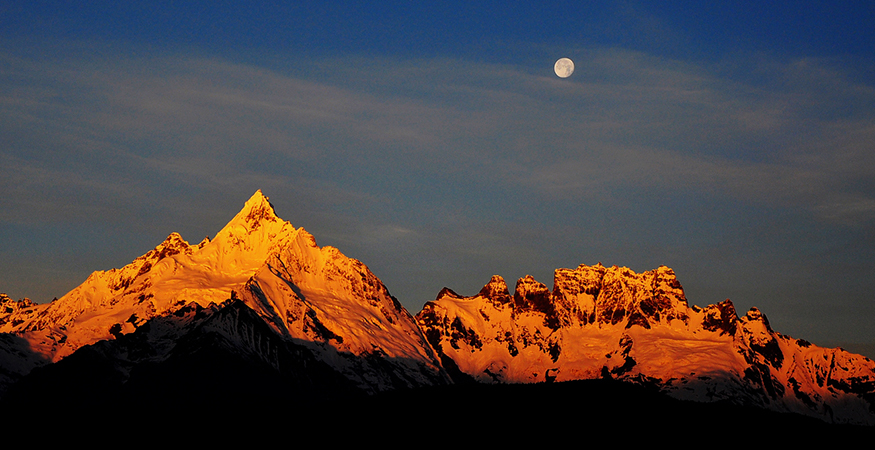
    meili snow mountain diqingMeili Snow Mountain sunrise gold Feilaisi viewpoint

    Shangri-La feels less like the end of Yunnan and more like the start of somewhere else. The prayer wheels at Dukezong Old Town spin at hip height. The air is thin enough to notice on a flight of stairs. Sumzanlin Monastery (松赞林寺), sometimes called Yunnan's Potala for its scale, sits fifteen minutes north of town on a hillside that looks out over the Napa Grassland. The town itself is a rest day; the ride worth adding onto it is the northbound extension to Feilaisi (飞来寺).

    Route Fact Panel:

    • Route / Location: Shangri-La (香格里拉) → Benzilan (奔子栏) → Baima Snow Mountain tunnels (白马雪山) → Deqin (德钦) → Feilaisi (飞来寺)
    • Length: ~200 km (124 mi) each way
    • Elevation: 3,300 → 3,470 m (10,827 → 11,385 ft), with a Baima tunnel high point around 3,900 m (12,795 ft)
    • Duration: 5 hours northbound, overnight at Feilaisi, 5–7 hours southbound
    • Best Time: April–June, September–October
    • Difficulty: Medium — well-paved G214, but long consecutive downhills southbound and shaded curves that hold ice in cold months
    • Highlights: Jinsha River Great Bend (金沙江大拐弯), Baima Snow Mountain tunnel corridor, Wumingding viewpoint (雾浓顶), Meili Snow Mountain (梅里雪山) sunrise gold from Feilaisi
    • Accommodation & Supplies: Book a north-facing view room at Feilaisi in advance for the Meili sunrise; fuel up at the Benzilan (奔子栏) Sinopec — stations are sparse north of there

    The single reason riders push north to Feilaisi is the dawn light on Meili Snow Mountain — the "sunrise gold" (日照金山) that hits the Kawagarbo main peak for a few minutes at first light and, on a clear morning, is genuinely one of the great mountain views in Asia. Rooms with the view sell out; book ahead.

    The riding fact of this leg is Baima Snow Mountain. The old G214 pass road that older travelogues describe — the one where riders posed at the pass sign — is closed. Since 2025 the through route is the tunnel system, which is faster and safer in good weather but comes with its own hazards: the shaded exits and north-facing tunnel-mouth curves hold black ice on cold, dry mornings well into spring, and the truck brake-water spray glazes the pavement in the same spots. Space out from the truck ahead, don't lean into the tunnel-mouth turns, and never assume the road is dry because the sky is clear.

    Sample Itinerary

    8-Day Yunnan Motorcycle Loop Itinerary

    ✈️
    Day 1
    Arrive Kunming, transfer, licence prep
    Land at Kunming Changshui (KMG). Team pickup, transfer to city hotel, Vehicle Management Office paperwork start, welcome dinner.
    🏍️
    Day 2
    Kunming → Dali
    G56 expressway west via Chuxiong; ~330 km on Chinese plates. Evening arrival at Erhai Lake, base outside the old town walls.
    🏔️
    Day 3
    Dali rest day + Erhai ring
    Half-day west-shore loop, optional Xizhou and Chongyi Village detour. Cangshan viewpoint in the afternoon.
    🏛️
    Day 4
    Dali → Lijiang (via Shaxi option)
    Provincial road via Jianchuan; add a Shaxi detour if time permits. Overnight outside Lijiang Old Town.
    🏔️
    Day 5
    Lijiang → Tiger Leaping Gorge → Shangri-La
    G214 or Hu-Xiang east loop depending on weather. 900 m altitude gain; first night on supplemental-oxygen room.
    🛕
    Day 6
    Shangri-La rest day
    Sumzanlin Monastery, Dukezong Old Town, Napa Grassland outer road. No hard riding — altitude acclimatisation day.
    🌄
    Day 7
    Shangri-La → Feilaisi → return
    Northbound G214 to Feilaisi via Jinsha Great Bend and Baima tunnels. Meili sunrise on Day 8 morning.
    ✈️
    Day 8
    Feilaisi → Lijiang → transfer to Kunming
    Long southbound descent to Lijiang; onward transfer to Kunming or Lijiang airport departure.

    How the Ride Works — Licence, Plate, Guide

    Yunnan is legal to ride, but not on the paperwork you brought from home. The three moving parts are the temporary Chinese driving licence, the bike registration, and the guide-plus-support-vehicle setup you ride behind.

    The licence swap happens in Kunming, on your first day. The Kunming Public Security Bureau's Vehicle Management Office (车管所, chē guǎn suǒ) is in the Guandu District Economic Development Zone on Jingkai Road (经开路) — not on Wujing Road, despite what an older search result may tell you. There is no appointment: our team walks you in during business hours, submits your document pack (passport with 90-day-or-more valid visa, entry stamp, original home motorcycle licence not on probationary status, and a properly certified Chinese translation of that licence — this is one of the details a lot of independent riders lose a day on, because the office no longer accepts self-translated or unaccredited-agency translations). You take a short vision-and-colour test, watch a thirty-minute traffic-safety video, and leave with a temporary Chinese driving licence valid for three months. The whole visit is a matter of about an hour once your papers are in order.

    The bike is easier. Our team provides a Chinese-plated motorcycle with the vehicle registration and compulsory insurance already sorted — the same document set a Chinese rider would carry. That solves the plating question that catches most independent foreign riders: you cannot ride a foreign-plated bike on China's public roads without a temporary import registration, and that is a customs-office project you don't want on top of everything else on day one. For the rules on bringing your own bike in — the temporary import route, the accessory-parts constraints, and why the Carnet de Passages is not accepted here — see our guide to China motorcycle permits and the temporary licence and the ownership-vs-rental primer .

    The guide is not a legal requirement in Yunnan the way it is in Tibet — a licensed rider on a Chinese-plated bike is technically legal to ride solo. In practice, every operator worth booking with runs a lead-and-tail formation with a support vehicle. The vehicle carries spare fuel, an oxygen bottle, a first-aid kit, and whatever the day's road-hazard call requires. The guide handles any police interaction and, more usefully, watches the weather and the road ahead in real time — the reason our guides can offer a Hu-Xiang east-loop or a G214 choice at Lijiang breakfast is that they have a call-in network on both roads and know what the surface looks like that morning. For the wider reason the guide model is standard rather than optional in China, see our explanation of the guide-escort convention .

    For an accurate cost breakdown tailored to your group size, dates, and preferences, contact the Yaso Trip team for a custom quote.

    When to Ride Yunnan

    Northwest Yunnan has two shoulder seasons that outperform everything else, one comfortable summer window with a rain caveat, and one winter that is beautiful but selective.

    Best time to ride the Yunnan loop

    SeasonMonthsRiding ConditionsNotes
    Spring shoulder (best)Mid-March to early JuneDry, mild, wildflowers on the Dali basin, clear Meili Snow Mountain morningsPeak season for oxygen-hotel bookings in Shangri-La; book early
    SummerMid-June to late AugustWarm, green, occasional heavy afternoon rain in the highlandsHu-Xiang east loop weather-gated; rockfall risk after storms
    Autumn shoulder (best)Early September to late OctoberDry, high visibility, cool nights at altitudeSecond peak booking window; Meili viewing best in this window
    WinterLate November to FebruaryCold, snow risk on the Baima tunnel curves and G214 north of Shangri-LaBeautiful but only for riders with cold-weather kit and a flexible itinerary; some Feilaisi extensions cancel

    Rain is not the enemy on this loop the way it is on G318 — the Yunnan monsoon is short, mostly afternoon, and the expressway drainage in the southern half handles it well. Cold is the harder call in winter, and the Hu-Xiang east loop closes to sensible riding for weeks at a time. If a rider has one holiday window and asks which month, our team's default answer is early October: dry, comfortable, and the mountains at their clearest.

    Bike Options and the Fly & Ride Model

    Foreign riders in Yunnan divide into two camps. The larger group flies in, rides a bike we supply, and flies home — the Fly & Ride model. The smaller group ships or rides in a personal bike from Southeast Asia or Central Asia. Both work; the operational overhead and time cost differ sharply.

    Fly & Ride is the default because Kunming Changshui is a well-connected airport, the temporary licence is done in a day, and our fleet is already registered and insured on Chinese plates. You land with your gear bag and helmet — nothing else needs to have cleared customs on a bike carnet — and the ride starts within 24 hours. The typical bike is a 400–650 cc adventure-tourer suited to expressway distance and mountain switchbacks. Absolute beginners are not a fit; the 900 m altitude gain on the Lijiang → Shangri-La day rewards riders who are comfortable at speed on wet pavement and confident enough to hold a lane in a truck-heavy corner. For a full comparison of the Fly & Ride model against bringing your own bike from a neighbouring country, see our own bike vs rent primer .

    Riding your own bike in makes sense only if the loop is one leg of a longer overland ride — for example, entering from the Karakoram Highway crossing at Khunjerab and continuing across China. That is a different trip, planned differently, and the Pakistan-to-Xinjiang Karakoram guide is where that starts, not here.

    Tips, Cautions & the Baima Snow Mountain Reality

    The loop's real hazards are altitude, ice and the expressway-camera network. Everything else is small.

    • Book an oxygen room for your first Shangri-La night. Most mid- and high-end Shangri-La hotels now offer diffusion oxygen; it is worth ninety minutes of research and a slightly higher room rate to get it.
    • Take Rhodiola (红景天) for a week before you fly. It is not a miracle drug, but it is the accepted preparatory supplement and it does no harm.
    • First night at 3,300 m: no shower, no alcohol. This is the single most common piece of advice our guides give at Shangri-La check-in.
    • Hold 80 km/h on the expressway and hold the right lane. Interval-speed and gantry cameras enforce both. This is not a suggestion.
    • Fill up at Benzilan Sinopec on the way to Feilaisi. Fuel stations north of Shangri-La are thin and inconsistent.
    • Pack layered technical clothing. You start the day at 2,400 m and eight hours later you're at 3,300 m with a 15°C temperature drop — the same jacket needs to work in both.
    • Wet-weather bailout is real. If your guide waves off the Hu-Xiang east loop at breakfast, they are not being cautious for its own sake. Take G214 and enjoy the day.
    • Do not photograph while riding pillion on the Tiger Leaping Gorge cliff sections. The road is narrow enough that a small movement changes weight distribution more than the rider expects.
    ⚠️Winter black ice on the Baima tunnel corridor
    On the G214 tunnel section through Baima Snow Mountain (白马雪山), the shaded curves at tunnel mouths and any north-facing exit hold black ice from late November into March, and truck brake-water spray glazes the same spots on clear days. Ride wide, brake early, and increase following distance from any truck to hundreds of metres — do not tuck in behind one through a tunnel. In heavy snow the sensible call is to overnight in Shangri-La and wait it out. 
    ⚠️Ticket enforcement at Sumzanlin Monastery
    Riding a bike up to the Sumzanlin Monastery (松赞林寺) main gate will get you stopped and asked for a ticket. Park in the outer lot below the monastery, walk up to the outer plaza, and photograph the complex from there — the wide view is more impressive than the close-in one anyway.

    Extending the Ride — Southern Yunnan Tea Country or the Trans-Asia Line

    Riders with more than ten days often add a southern leg. Two options are worth flagging.

    The first is Yunnan's southern tea country: Xishuangbanna (西双版纳), the Pu'er (普洱) tea belt, and the Yuanyang rice terraces. Entered from the Vietnam or Laos side and ridden north through subtropical Yunnan, this is a shorter, warmer, tea-culture-angled ride with its own distinct rhythm. It runs about a week and is a good pairing for riders who want the Kunming loop plus something completely different in the same trip.

    Combine the northern loop with a short tea-country southern ride

    8 Days Yunnan Motorbike Riding and Tea Culture Tour from Vietnam

    8 Days Yunnan Motorbike Riding and Tea Culture Tour from Vietnam

    Tour Route:Hekou-Yuanyang-Yuanjiang-Mojiag-Ninger-Puer-Laodabao-Jingmai-Menghai-Jinghong-Menglun-Jiangcheng-Daheishan-Lvchun-Xinjie-Duoyishu-Yuanyang-Hekou
    Tour Type:Motorbike Tours
  • Yunnan Motorcycle Loop: Kunming, Dali, Lijiang, Shangri-La 2026/2027 8 Days
  • Yunnan Motorcycle Loop: Kunming, Dali, Lijiang, Shangri-La 2026/2027 7 Places
  • View Detail

    The second is the longer overland option: entering from Laos at the Mohan (磨憨) border and riding the full 17-day Yunnan corridor south-to-north, or continuing beyond Yunnan into Tibet as one leg of a trans-Asia line. That is a different scale of trip — see our Laos-border Yunnan route spoke for the full ride, or the Karakoram Highway crossing for the western entry that continues across the country.

    Ride Yunnan with Yaso Trip

    Yaso Trip has been organising international travel to China from a Kunming base since 2005, with additional offices in Lijiang, Xishuangbanna, Chengdu, Beijing, Shanghai and abroad. The northwest Yunnan corridor is our home ground. Four things matter operationally:

    1. Local team, local roads. Our guides ride these roads year-round and switch the Lijiang → Shangri-La route between G214 and the Hu-Xiang east loop based on the morning's actual weather rather than the general forecast — this is the difference between an on-time arrival and a rockfall wait.
    2. Paperwork handled end-to-end. The temporary Chinese driving licence, the certified translation, the bike registration and insurance, the accommodation registration form — all of it is done on your behalf, in the right offices, with the right stamps.
    3. A real support vehicle behind you. Support vehicle carries reserve fuel for the Benzilan-north stretch, a medical oxygen bottle for Shangri-La, first aid, and a bike tool set. This is the safety envelope that lets the ride feel light instead of exposed.
    4. A route we run often. Northwest Yunnan is a repeat itinerary for our team, not a bespoke one. That means known hotels with oxygen rooms in Shangri-La, known parking-friendly bases in Dali and Lijiang, and known Bai and Naxi guides at the cultural stops.

    Ready to Ride?

    The Kunming loop is the shortest path from "I want to ride in China" to "I am riding in China." No permit stack, no Nepal border, no altitude jump that ends the trip on day two — just a ninety-minute counter visit at the Vehicle Management Office and a bike waiting at the rally point. If you have 8–10 days and want scenery on the scale of Tibet without the paperwork, this is the ride to plan.

    Expand All
    1. Can foreigners ride a motorcycle in Yunnan?

    Yes. Yunnan has no Tibet Travel Permit or Alien's Travel Permit requirement for foreign motorcyclists on the Kunming/Dali/Lijiang/Shangri-La corridor. Foreign riders need a valid passport with a 90-day-or-more visa, a temporary Chinese driving licence obtained same-day at the Kunming Vehicle Management Office, and a Chinese-plated motorcycle. A licensed guide and support vehicle are strongly recommended for safety but are not legally mandatory the way they are in Tibet.

    2. Do I need a permit to ride a motorbike in Yunnan?

    No special travel permit is required on the classic northwest Yunnan loop. You do need the temporary Chinese driving licence, the certified translation of your home licence, and your accommodation registration form on you while riding. A small number of sensitive border sections near Myanmar have separate permit stacks, but the Kunming → Dali → Lijiang → Shangri-La route does not touch any of them.

    3. How many days do I need for a Yunnan motorcycle tour?

    Eight to ten days is the comfortable Yunnan motorcycle tour length for the northwest loop, including a rest day in Dali and a rest day in Shangri-La. A six- or seven-day version is possible but leaves no margin for weather delays or altitude adjustment. Extending south into Xishuangbanna or the Pu'er tea country adds another week.

    4. When is the best time to ride a motorcycle in Yunnan?

    Mid-March through early June and early September through late October are the two best windows for a Yunnan motorbike tour — dry, mild, and clear at altitude. Early October is the single best month if you have one week to pick. July and August ride well below Lijiang but bring afternoon rain in the highlands. Late November through February is cold with snow risk on the Baima Snow Mountain tunnel corridor and G214 north of Shangri-La.

    5. Can I fly into Kunming and ride from there?

    Yes — the Fly & Ride model is now the dominant way to ride a Yunnan motorcycle tour. You fly into Kunming Changshui (KMG), your operator meets you, the temporary Chinese licence is done on day one, and you start riding on a Chinese-plated bike from a rally point at the city edge. This bypasses the far more complex process of bringing a personal motorcycle across a land border. Most riders on our Yunnan tours use this model.

    6. Do I need a guide to ride a motorcycle in Yunnan?

    A licensed guide is not legally required in Yunnan the way it is in Tibet, but in practice every reputable operator provides one. The reason is safety, not law: the Lijiang-to-Shangri-La altitude gain, the weather-dependent Hu-Xiang east loop, the black-ice pattern on the Baima tunnel section, and the expressway-camera enforcement all reward local knowledge. A guide and support vehicle are the difference between a ride you enjoy and one where a small problem becomes a big one.

    7. What's the difference between the Yunnan loop and the Laos-border Yunnan ride?

    The Yunnan loop is a 7–10-day fly-in ride through the northwest — Kunming, Dali, Lijiang, Shangri-La — anchored on the high scenery and Tibetan-fringe culture. The Laos-border ride is a 17-day full-length Yunnan tour that enters at the Mohan (磨憨) border and rides north through Xishuangbanna, the Yuanyang rice terraces, Jianshui, Kunming and onward into the northern loop. If you have the holiday time and want the full length of the province, the Laos-border ride does it in one continuous trip.

    8. Is Shangri-La too high for riders who haven't been to altitude?

    Shangri-La at 3,300 m (10,827 ft) is manageable for most riders because the Kunming loop climbs to it in stages over three or four days. The people who struggle are those who fly directly into Shangri-La airport or push from Lijiang to Shangri-La and then straight onward to Feilaisi without an adjustment night. A rest day in Shangri-La before the Feilaisi extension, an oxygen-supplied hotel room, and the standing rule of no shower and no alcohol on the first night resolve most cases. Riders with known altitude issues, cardiovascular conditions, or recent respiratory illness should discuss the trip with a physician first.

    More About

    •Why You Can't Ride a Motorcycle Solo in China: The Rule •G318 Motorcycle Travel: Chengdu to Lhasa Sichuan-Tibet Guide •Cross-Border Motorbike Travel Across China: 2026/2027 Guide •Silk Road Motorcycle Travel: Xinjiang, Gansu & Northwest 2026/2027 •Xinjiang Motorbike Loop: Duku Highway & the Pamirsa •Yunnan Motorbike Ride from Laos: Xishuangbanna to Shangri-La 2026/2027 •Best Time for a Motorcycle Travel in China: Month-by-Month •Motorcycle Touring in China: A First-Timer's Guide (2026/2027) •Kathmandu to Lhasa Motorbike: Everest Route Guide (2026/2027) •Everest Base Camp Motorcycle: The Rider's Guide 2026/2027 •Kailash Motorcycle Guide: Nepal-Tibet via Ngari 2026/2027 •Karakoram Highway Motorbike: Pakistan to Xinjiang (2026/2027) •Bring Own Motorcycle to China vs Rent: 2026/2027 Tour Options •How to Plan Your China Motorcycle Tour: 2026/2027 Complete Guide •Tibet Himalayan Motorcycle Adventure: the best guide to riding your motorbike to Tibet •China Motorcycle Permits & Temporary Licence: 2026/2027 Guide •How to Plan China Motorcycle Tour from Laos? •How to Plan China Motorcycle Tour from Myanmar? •How to Plan China Motorcycle Tour from Singapore •How to Plan China Motorcycle Tour from Malaysia 2026/2027 •How to Plan China Motorcycle Tour from Thailand •How to Plan China Motorcycle Tour from Vietnam (2026/2027) •What is a Motorcycle? •China International Motorcycle Exhibition •Top Motorcycle Rental Clubs and Companies in China •Top China Motorcycles Manufacturers and Brands in China •China Motorcycle Riding Travel Tips •How to Obtain a Motorcycle License for Foreigners in China •China Policy for Motorcycling for Foreigners
    ENQUIRY
    Have a question before booking? Message us to learn more.
    Click to change

    Share Your Trip Experience

    Help future travelers by reviewing your journey with Yaso Trip.