Quick Answer: Can I ride a motorcycle from Laos into China?
Yes. Foreign motorcyclists can enter China from Laos through the Mohan (磨憨) border crossing in southern Yunnan, and Mohan is the only Laos land border currently open to foreign-plated motorbikes. Riding on the Chinese side is legal only with a Yaso-Trip-arranged temporary Chinese driving licence, temporary Chinese plates, a self-driving permit, and a licensed guide-escort. Paperwork takes around sixty working days to file, and there is a short administrative pause in Xishuangbanna on arrival for the licence and plate to be issued — usually one working day, occasionally two if translation notarisations need to be redone. Once cleared, the standard product is a seventeen-day Yunnan loop returning to Mohan.
Key Takeaways
✔ Mohan (磨憨) is the working Laos land border for foreign motorcycles into China; Xishuangbanna is your first Chinese province.
✔ Yunnan does not require Tibet Travel Permit, Alien's Travel Permit, or Military Permit — the paperwork is lighter than any other major China motorbike route.
✔ The Nov–Mar dry season is the sweet spot; late November through December is the golden window for a clear "sunlit gold" view of Meili Snow Mountain.
✔ The route peaks at around 3,400 m (11,155 ft) near the Meili viewpoint and roughly 4,000 m (13,123 ft) at the White Horse Snow Mountain (白马雪山) tunnel entrance — moderate compared with Tibet, but real if you rode in from tropical Laos the same week.
✔ Chinese-side paperwork must be filed around sixty working days ahead; the on-arrival Xishuangbanna licence-and-plate step usually finishes in a working day, not the two often quoted.
✔ Winter's real killer is not snow but black ice on shaded corners and tunnel exits between Shangri-La (香格里拉) and Dechen (德钦); the survival rule is depart no earlier than midday and use engine braking on descents.
✔ The Tea Horse Road belt (Baoshan, Fengqing, Lincang) is not filler mileage — it is the loop's most relaxed motorcycle riding and one of the best reasons to book the full seventeen days.
Why Yunnan Is the Easiest China Entry on a Motorcycle
Of all the ways foreign riders enter China on a motorcycle, the Yunnan motorbike route from the Laos border is the most forgiving. There is no Tibet Travel Permit stack to negotiate, no 5,000-metre passes to acclimatise for, and — because the corridor is winter-rideable — no narrow summer-only weather window. You cross at Mohan (磨憨), take a short break in Xishuangbanna while your Chinese licence and plates are printed, and ride a seventeen-day loop that pulls you from tropical rainforest to Tibetan-plateau edge and back through the tea belt of the old caravan road. This guide covers what actually happens at the border, how the loop unfolds day by day, the specific winter and altitude risks nobody warns you about, and the paperwork realities the Yaso Trip team files for every foreign-plated rider.
- No Tibet permits. Yunnan sits outside the Tibet Autonomous Region. The standard Chinese temporary licence, temporary plate, self-driving permit and guide-escort package are the whole paperwork story — no Tibet Travel Permit, no Alien's Travel Permit, no Military Permit for restricted zones.
- Winter-rideable. Xishuangbanna is tropical year-round; Kunming is the "City of Eternal Spring" (春城). Only the Shangri-La to Dechen leg carries a real cold-season risk, and even that is manageable with sensible daily departure timing.
- The cleanest own-bike entry in the theme. The Mohan crossing is a single land border, not the two-border customs relay demanded by the Karakoram Highway or the Nepal-Tibet corridor. Chinese customs is handled by the tour operator; the rider walks through with the passport.
- Real altitude, honest gradient. The loop climbs from near sea level in Xishuangbanna to about 3,400 m (11,155 ft) at the Meili viewpoint and 4,000 m (13,123 ft) at the White Horse Snow Mountain tunnel — enough to be spectacular, not enough to demand a Tibet-scale acclimatisation plan.
- Five ethnic-minority corridors in one loop. Dai (傣族) in Xishuangbanna, Hani (哈尼族) at the Yuanyang Rice Terraces, Bai (白族) around Dali, Naxi (纳西族) in Lijiang, and Tibetan (藏族) at Shangri-La and Dechen. No other Chinese motorcycle route stacks that much cultural variety in seventeen days.
The Route at a Glance
The seventeen-day loop breaks naturally into six phases. The table below is the working operator view — distances, altitude ranges, and what dominates each leg.
Yunnan motorbike riding loop from Laos map
Yunnan Motorbike Loop from Mohan: Route Overview
Ride the full seventeen-day Yunnan loop from the Laos border with Yaso Trip
Tour Route:Yuanyang-Jianshui-Kunming-Dali-Lijiang-Shangri-La-Baoshan-Lincang-Jinghong
17 Days
14 Places View Detail
Phase 1: Xishuangbanna and the Licence Rest Days (Days 1–2)
Motorcycle at Boten checkpoint Yunnan(China)-Laos
Motorcycle in Xishuangbanna tropical South Yunnan
The first sensation crossing Mohan is heat. The customs building is set into rubber plantations and rainforest foothills, and the road out toward Mengla (勐腊) is smooth, flat, and lined with banana trees. From the border to the hotel is barely 45 km (28 mi) — deliberately short, because the day is dominated by paperwork, not riding.
Route Fact Panel:
- Route / Location: Mohan border (磨憨口岸) → Mengla (勐腊) → local rest for Chinese licence and plates
- Length: ~75 km (47 mi) across two days
- Elevation: Roughly 600 m (1,969 ft), tropical throughout
- Duration: Day 1 border transit + short ride; Day 2 administrative rest
- Best Time: Nov–Mar; Xishuangbanna is comfortable year-round
- Difficulty: Low — the shortest riding day of the trip
- Highlights: First Chinese customs, tropical scenery, Mengla local markets
- Accommodation & Supplies: Mid-range Mengla hotels with secure parking
The Mohan crossing, honestly
Two things separate the actual Mohan experience from what generic route pages describe. First, Chinese vehicle exit-and-return paperwork must be pre-filed online. The current process runs through the "Mohan-Moding Cooperation Zone" (磨憨磨丁合作区) WeChat account, is valid for six months, and — for individually owned foreign-registered bikes — requires a business-entity guarantee that most solo riders cannot supply themselves. Riders who arrive without pre-filing usually spend a half day at the border finding a licensed intermediary; riders who arrive with the Yaso Trip operations team have the file lodged weeks in advance.
Second, do not carry drones or electronic cigarettes across this border in either direction. Both are red-line items at Mohan customs. The X-ray finds them, and consequences run from confiscation through fines to a visa flag.
The Laos-side formalities on the return trip involve a temporary Laos driving licence, a vehicle customs form (D53) that must be kept on the rider's person for the entire Laos leg, and a small on-arrival visa. The single most important detail: the D53 form cannot be lost. Lao police check it at highway stops; Lao customs collects it at exit.
The "two rest days" — how long they actually take
Almost every guide claims a two-day pause in Xishuangbanna for Chinese licence and plate processing. In practice, with a complete file (passport, visa, notarised Chinese translation of the vehicle title, valid compulsory third-party insurance), the local traffic police desk usually issues the plate and temporary driving permit in a single working day. The reason the itinerary still shows two nights: the border closes in the late afternoon and morning arrivals wait until the next business day for the office to open. Riders arriving with a mid-morning border transit can often ride Day 2 rather than resting.
Phase 2: Rice Terraces to Kunming (Days 3–6)
Yunnan Rice Terrance motorcycle
Green Lake Park Kunming
Day 3 is the long one — roughly 550 km (342 mi) north from Mengla through Mojiang (墨江) to Yuanyang (元阳), climbing steadily out of the tropics into the Ailao Shan mountains. The last hour is narrow, hilly and sometimes potholed; you arrive in Yuanyang the way most riders do, at dusk, with the rice terraces catching low light across the valley.
Route Fact Panel:
- Route / Location: Mengla → Yuanyang Rice Terraces (元阳梯田) → Jianshui (建水) → Kunming (昆明)
- Length: ~990 km (615 mi) across four days
- Elevation: 600–1,890 m (1,969–6,201 ft)
- Duration: 4 days including a full rest day at Yuanyang
- Best Time: Rice terraces reflect best Dec–Feb when the paddies are flooded and pre-planting
- Difficulty: Medium — Day 3 is a long ride; the rest of the phase is short-hop
- Highlights: Yuanyang Rice Terraces UNESCO landscape, Hani minority villages, Jianshui Old Town, Kunming Stone Forest (石林)
- Accommodation & Supplies: Two nights Yuanyang, one Jianshui, one Kunming
The Yuanyang Rice Terraces (元阳梯田) are photographed most often at sunrise from Laohuzui (老虎嘴) and at sunset from Duoyishu (多依树) — a full rest day here lets you catch both windows and see the terraces from Bada (坝达) at midday when the light is flat and the geometry reads best from above. Jianshui, one riding day north, gives you the Zhu Family Garden (朱家花园) and the second-largest Confucius Temple in China, and Kunming closes the phase with a paved-road day and a first taste of urban Yunnan.
Phase 3: Dali, Lijiang and the Naxi Highland (Days 7–8)
Motorcycle at Erhai Dali, Yunnan
Motorcycle Yulong Snow Mountain Lijiang
West of Kunming the road climbs onto the Yunnan Plateau proper. Erhai Lake (洱海) appears on your right; Dali (大理) sits at 1,970 m (6,463 ft) between the lake and the Cangshan Mountains (苍山), a Bai (白族) town whose Three Pagodas (三塔) are the most photographed landmark in the province.
Route Fact Panel:
- Route / Location: Kunming → Dali (大理) → Lijiang (丽江)
- Length: ~520 km (323 mi) across two days
- Elevation: 1,890–2,410 m (6,201–7,907 ft) — moderate altitude ramp
- Duration: 2 days
- Best Time: Year-round; Dec–Feb crisp and clear, Apr–May flower season
- Difficulty: Low to medium — flat highway sections, mild curves near Lijiang
- Highlights: Erhai Lake, Three Pagodas, Dali Old Town, Lijiang UNESCO Old Town, Dongba Culture Museum, Black Dragon Pool
- Accommodation & Supplies: Mid-range Dali and Lijiang hotels with secure motorcycle parking
The one-day hop north to Lijiang (丽江) climbs another 470 m to 2,410 m (7,907 ft) — the start of the real altitude ramp. Lijiang's Naxi (纳西族) old town is a UNESCO World Heritage site, and its Dongba Culture Museum (东巴文化博物馆) holds the world's only still-used hieroglyphic script. This is also the last night at moderate altitude before the ride to Shangri-La begins the plateau climb.
Phase 4: Shangri-La, Meili Snow Mountain and the Plateau Edge (Days 9–12)
Yunnan motorbike loop through Tiger Leaping Gorge
Motorcycle on the G214 approach to Shangri-La
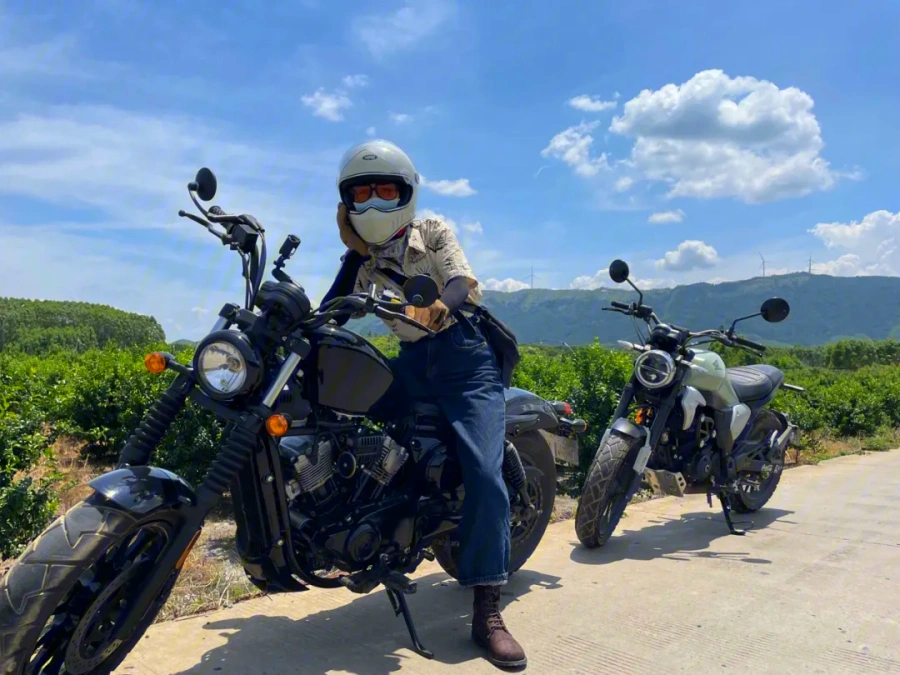
The G214 north out of Lijiang crosses the First Bend of the Yangtze (金沙江第一湾), skirts Tiger Leaping Gorge (虎跳峡), and climbs to Shangri-La (香格里拉) at about 3,300 m (10,827 ft). The Sumzanlin Monastery (松赞林寺) — the largest Tibetan Buddhist monastery in Yunnan and often called the "Little Potala Palace" — sits just north of town. From here, one long day carries you through the White Horse Snow Mountain (白马雪山) tunnel, past Nixi (尼西), to the Meili Snow Mountain (梅里雪山) viewpoint at Feilai Temple (飞来寺) in Dechen (德钦).
Route Fact Panel:
- Route / Location: Lijiang → Shangri-La (香格里拉) → Dechen (德钦) → Feilai Temple viewpoint
- Length: ~570 km (354 mi) across four days including local exploration
- Elevation: 2,410–4,000 m (7,907–13,123 ft); White Horse Snow Mountain tunnel entrance ~4,000 m
- Duration: 4 days including at least one Shangri-La acclimatisation night
- Best Time: Late Nov to mid-Dec for the clearest Meili views
- Difficulty: High — cold, altitude, ice risk in winter
- Highlights: Sumzanlin Monastery, First Bend of the Yangtze, Meili Snow Mountain viewpoints
- Accommodation & Supplies: Shangri-La and Feilai Temple hotels with heating and oxygen availability
The Meili viewpoint decision
Two viewpoints face Meili Snow Mountain. Feilai Temple (飞来寺) is closer to the peak, has hotels and food, and gets crowded at dawn. Wunongding (雾浓顶, sometimes navigated as "Wunongding yikeshu / 雾浓顶一棵树") is a wider panorama of the whole Thirteen Peaks massif with fewer people. If clear weather is holding, one viewing at each is worth the extra ride time.
The famous "sunlit gold" (日照金山) event — first light hitting the summit — is a weather lottery. As a rule of thumb from the team: if Windy or Mountain Forecast shows less than 20% low-and-mid cloud cover through the three hours before sunrise, the odds are strong.
On the G214 between Shangri-La and Dechen in autumn and winter, the invisible killer is not snow — it is black ice on shaded corners and tunnel exits after the White Horse Snow Mountain tunnel. A four-wheeled car shudders through it. A motorcycle goes down. Depart no earlier than midday when the sun has burnt off the shaded ice; do not lean into shaded corners; do not touch the front brake at tunnel exits; use engine braking (downshift) on descents; and, if the previous evening brought snow, do not set out at all — wait for full sun. Carry portable oxygen and glucose for the White Horse Snow Mountain tunnel entrance at roughly 4,000 m (13,123 ft).
Extend Yunnan westward into Tibet and Nepal on the Laos-to-Kathmandu overland
Tour Route:Jinghong-Yuanyang-Jianshui-Kunming-Dali-Shangri-La-Chamdo-Nyingchi-Lhasa-Shigatse-Mount Everest-Gyirong
22 Days
11 Places View Detail
Phase 5: The Tea Horse Road and Pu'er Country (Days 13–14)
Tea Mountains in Shuangjiang County, Lincang
Baisha Holiday Resort in Baisha Ancient Town Lijiang
Descending south from Dechen the temperature climbs about a degree per hundred metres. In two riding days you go from down jacket to shirtsleeves, from Tibetan monastery country to Wa (佤族) and Dai (傣族) tea villages. This is the loop's quietest, most technically enjoyable riding — mountains many, cars few, curves flat and constant, pavement good. Riders who thought Days 13 and 14 would be filler mileage almost always list them as favourites afterwards.
Route Fact Panel:
- Route / Location: Weixi (维西) → Tacheng (塔城) → Baoshan (保山) → Fengqing (凤庆) → Lincang (临沧)
- Length: ~630 km (391 mi) across two days
- Elevation: 900–2,400 m (2,953–7,874 ft) — descending most of the way
- Duration: 2 days plus optional detours
- Best Time: All dry-season months; tea harvest is spring
- Difficulty: Medium — long distances, mountain roads, one heavy-truck national highway stretch
- Highlights: Fengqing Jinxiu Chazun (锦绣茶尊) 3,200-year-old tea tree, Lushi Ancient Town (鲁史古镇), Lincang tea plantations
- Accommodation & Supplies: Local guesthouses; ask ahead about secure motorcycle parking
The stops the Yaso Trip team recommends most:
- Fengqing Jinxiu Chazun (凤庆锦绣茶尊) — the world's oldest cultivated tea tree, roughly 3,200 years old. Drinking a fresh Dianhong (滇红) under it is a rare moment. This is the Tea Horse Road's spiritual landmark.
- Lushi Ancient Town (鲁史古镇) — "the first town of the Western Yunnan Tea Horse Road", 700 years of cobblestone streets and preserved horseshoe prints. Quieter than Dali or Lijiang by an order of magnitude, and the best place on the loop to sleep inside caravan-era architecture.
- Naquli (那柯里) near Pu'er — a caravan staging post preserved as a small ancient scenic town, with old stone caravan paths in walking distance.
- The Lincang mountain-running roads (临沧 → 沧源 → 双江) — county and township roads through the border tea country that many China-based motorcyclists rate as the province's best pure ride. Curves plentiful, gradients gentle, sight lines open.
Skip the marketing-heavy tea-shop touts around Lincang's Bingdao Village (冰岛村). Genuine ancient-tree Bingdao Pu'er is scarce and priced accordingly; roadside "Bingdao" pushed at bulk tourist prices almost never is. If you want to taste real Pu'er, ask your Yaso Trip guide to arrange a stop at a small teahouse in Fengqing or Lushi where the family grows the leaf themselves. In Lijiang, similarly, walk out of the Ancient Town's main lanes to the quieter Baisha (白沙) and Shuhe (束河) old towns nearby — same Naxi architecture, a fraction of the tour-bus crowd.
Phase 6: Return to Xishuangbanna and Exit at Mohan (Days 15–17)
Manting Park in Jinghong, XishuangBanna
Menglun Tropical Botanic Garden
The final phase closes the loop through Lancang (澜沧), Jinghong (景洪), and back to Mengla and Mohan. Jinghong, the Xishuangbanna capital, gets an evening for the night market and Dai temple architecture; a short optional stop at the Menglun Tropical Botanic Garden (勐仑热带植物园) or Wild Elephant Valley (野象谷) sits well the morning of Day 16. Day 17 is the shortest ride on the loop — thirty minutes back to the Mohan customs yard — and closes with the exit-side paperwork. If the vehicle-customs form (D53) has been kept clean and dry, the exit is quiet.
Sample Itinerary — 17 Days from the Mohan Border
The featured seventeen-day loop:
17-Day Yunnan Motorbike Loop from the Laos Border
Day 1
Mohan Border → Mengla
Customs formalities at Mohan, short tropical ride into Xishuangbanna and overnight in Mengla.
Day 2
Mengla Rest & Licence
Chinese temporary licence and plates issued; optional local market walk in Mengla.
Day 3
Mengla → Yuanyang
Long ride north through Mojiang; arrive Yuanyang at rice-terrace golden hour.
Day 4
Yuanyang Rice Terraces
Sunrise at Laohuzui, sunset at Duoyishu; Hani minority village visit.
Day 5
Yuanyang → Jianshui
Short ride to Jianshui Old Town, Zhu Family Garden, Confucius Temple.
Day 6
Jianshui → Kunming
Ride to Kunming via Stone Forest UNESCO karst landscape.
Day 7
Kunming → Dali
West to Dali, Three Pagodas, Erhai Lake, Bai ancient town.
Day 8
Dali → Lijiang
North to Lijiang's Naxi old town, Dongba Culture Museum, Black Dragon Pool.
Day 9
Lijiang → Shangri-La
Ride via Tiger Leaping Gorge; arrive Shangri-La at 3,300 m.
Day 10
Shangri-La
Sumzanlin Monastery, Napahai Lake, altitude acclimatisation.
Day 11
Shangri-La → Feilai Temple
Cross White Horse Snow Mountain tunnel to Meili Snow Mountain viewpoint.
Day 12
Feilai Temple → Weixi/Tacheng
Descend along the Mekong Grand Canyon (澜沧江大峡谷).
Day 13
Weixi → Baoshan
Longer ride south into the Tea Horse Road belt.
Day 14
Baoshan → Fengqing → Lincang
3,200-year tea tree at Jinxiu Chazun, Lushi Old Town, Lincang tea plantations.
Day 15
Lincang → Jinghong
Long descent back to tropical Xishuangbanna and Dai country.
Day 16
Jinghong → Mengla
Short day with Wild Elephant Valley or Menglun Botanic Garden stop.
Day 17
Mengla → Mohan Border
Final short ride to the Laos border; exit customs formalities.
Best Time of Year to Ride Yunnan from the Laos Border
Yunnan's marketing line is that the loop is rideable year-round, and that is broadly true — Xishuangbanna and Kunming rarely close weather windows. The finer picture, from the team's experience running the route:
Yunnan loop season & weather (northern leg emphasis)
Altitude on This Route
Yunnan's altitude story is honest but different from Tibet. The loop's high points sit around 3,300 m (10,827 ft) at Shangri-La, 3,400 m (11,155 ft) near the Meili viewpoint at Feilai Temple , and roughly 4,000 m (13,123 ft) at the White Horse Snow Mountain tunnel entrance (the Baima Snow Mountain pass itself is 4,292 m / 14,081 ft; the tunnel cuts beneath it). The gradient of gain — from tropical Xishuangbanna to the plateau across roughly a week — is slow enough that most riders acclimatise naturally through Dali and Lijiang and reach Shangri-La without symptoms. What causes trouble is rider behaviour: exertion at the Meili viewpoint before adjusting, or a decision to push straight through the Shangri-La rest day to reach Dechen faster.
The team's operating rules: one full acclimatisation night in Shangri-La before continuing to Feilai Temple; portable oxygen and glucose available on the Dechen leg; no strenuous activity above 3,000 m for the first twenty-four hours; and hydrated departures on cold mornings. Paperwork Reality: The Mohan Crossing, the Licence Days, and the Guide-Escort Rule
The single largest planning constraint on this route is the Chinese-side paperwork lead time. The Yaso Trip operations team files the package around sixty working days ahead: a self-driving permit application; a temporary Chinese driving licence application (an International Driving Permit is not valid for on-road use in mainland China); a temporary Chinese plate for the imported motorcycle; a customs deposit against temporary vehicle import; the online vehicle pre-filing through the Mohan-Moding Cooperation Zone system; and the guide-escort assignment. See our China motorcycle permits and temporary licence guide for the mechanics.
Once at Mohan, the customs day itself is administrative rather than physical: Chinese exit-and-return paperwork is presented against the pre-filing, the temporary Laos driving licence and D53 vehicle customs form are issued at the Laos side of the border for the return direction, and the temporary Laos vehicle insurance is bought at the exit hall. Cloud-backup every document photographed as you go — the border hall is busy, and passports have been left at windows.
Riders sometimes ask whether the Chinese guide-escort is a real requirement or a suggestion. It is a real requirement. Foreign-plated motorcycles cannot be legally ridden solo on Chinese roads; this is enforced at highway checkpoints throughout Yunnan. See our Why You Can't Ride China Solo guide for the underlying regulation.
The good news on the Xishuangbanna side is administrative pacing: with a complete file, the local traffic police office issues the temporary Chinese plate and licence in a single working day, not the two often quoted. The itinerary shows two nights in Mengla because Mohan customs closes in the late afternoon, and morning arrivals wait until the next business day for the office to open.
Practical Preparation
- Bike choice. An ADV or dual-sport bike is the strong recommendation. The tropical Laos-side roads on the way to Mohan include stretches of shell-hole potholes and washboard sections that punish small street bikes and scooters; chains and sprockets take the hardest use on this route, and the team's most-common non-border mechanical issue for own-bike riders is a chain replacement somewhere in Xishuangbanna or northern Laos.
- Tyres and spares. All-terrain or puncture-resistant tyres are worth fitting before departure. Carry a spare clutch cable, spare brake cable, a portable air pump (foot pumps are common in remote Laos), and — critically — a spare key.
- Fuel considerations. Most Chinese pumps carry 92 and 95 octane throughout Yunnan. On the Laos approach, northern Laos frequently offers only 91 octane and can have long station gaps; if you are riding a high-octane-tuned bike into China, carry an octane-booster fuel additive for the Laos leg.
- Winter gear layering. The Shangri-La to Dechen days demand fleece base layers, wind-resistant shell over the top, a down jacket for the highest passes, insulated waterproof gloves, high-top boots with cover, and knee protectors. Yunnan wind chill above 3,000 m is severe even in bright sun.
- Communication and payments. Alipay (支付宝) and WeChat Pay (微信支付) work across Yunnan for hotels, meals and fuel; foreign-passport onboarding for Alipay Tour Card is now the smoothest cash-free route for foreign riders. Google Maps does not work in mainland China; download offline navigation before you cross the border. Your guide handles primary navigation.
- Do not carry drones or e-cigarettes across Mohan. Both are red-line items at customs in either direction.
Why Ride Yunnan with Yaso Trip
- The full sixty-day paperwork package handled end-to-end. Vehicle pre-filing, self-driving permit, temporary licence, temporary plate, customs deposit, guide-escort assignment. Riders arrive with a clean file rather than an anxious to-do list.
- English-speaking guides on the road. Yunnan's Chinese-only signage and phone-based Chinese-only navigation are not obstacles when your guide is doing them for you.
- A support vehicle throughout the loop. Luggage carriage on long days, mechanical backup on the northern Laos approach, spare-part transport, and oxygen for the Shangri-La to Dechen leg.
- A route the team has run in every season. The winter black-ice window, the March refreeze, the March-April sandstorm risk on the Tea Horse Road descent, the September landslide window — these are not marketing warnings; they are why the itinerary is timed the way it is.
- Route extensions on request. Riders wanting to continue west into Tibet and out via the Nepal border, ride the reverse direction of a longer trans-Asia epic, or head north from Yunnan across the grasslands into Mongolia can convert this seventeen-day booking into a longer itinerary during planning.
A trans-Asia epic that finishes in Yunnan and exits at Mohan
Tour Route:Kashgar-Lhasa-Shangri-La-Lijiang-Dali-Yuanyang-Kunming
31 Days
12 Places View Detail
A Yunnan-to-Mongolia grassland extension for riders continuing north
Tour Route:Jinghong-Yuanyang-Kunming-Zhaotong-Leshan-Chengdu-Guangyuan-Xian-Pingyao-Taiyuan-Datong-Hohhot-Erenhot
20 Days
19 Places View Detail
Book Your Yunnan Motorbike Tour from the Laos Border
The Yunnan loop is the theme's most flexible booking window — the dry season runs November through March, the shoulder holds into April and again from September, and the paperwork lead time is the only real hard constraint. Riders planning a Southeast-Asia overland into China should confirm dates now and start the sixty-day permit sequence.