Quick Answer: What Is Worth Seeing in Turpan?
A Turpan travel guide covers three anchor sites and a cluster of Silk Road ruins in the surrounding desert. The three anchors are Jiaohe Ruins (交河故城) — a 2,000-year-old earthen city on a leaf-shaped plateau, listed by UNESCO in 2014; the Karez Well System (坎儿井) — around 1,100 underground channels totalling roughly 5,000 km (3,100 mi) that still irrigate the Turpan oasis; and the Flaming Mountains (火焰山) — a 100 km (62 mi) red sandstone range where summer ground temperatures pass 70°C. Add Bezeklik Thousand Buddha Caves, Gaochang Ancient City, Emin Minaret, Tuyoq Valley, and the Kumtag Desert, and you have a 2 to 4-day Silk Road stop that most travellers combine with Urumqi.
Key Takeaways
✔ Turpan (吐鲁番) is the eastern gateway to Xinjiang and the Silk Road's most vivid oasis — home to several UNESCO-inscribed sites on the Silk Road Chang'an–Tianshan Corridor and China's lowest point below sea level.
✔ The three must-see sites are Jiaohe Ruins, the Karez Well System, and the Flaming Mountains — each teaches a different part of Silk Road history when a proper guide interprets them.
✔ Summer heat is the trip's defining logistical challenge. July–August ground temperatures pass 70°C at midday; itineraries have to be paced around a strict "morning-outdoor / midday-indoor / evening-outdoor" rhythm.
✔ Turpan runs on Beijing time officially, but the working day starts and ends roughly two hours later than in eastern China — restaurants stay open past 22:00 and sunset arrives after 21:00 in summer.
✔ Hotel registration is the biggest foreign-traveler pain point. Only 5–8 properties in Turpan city hold current foreign-guest licenses; many travellers base in Urumqi and day-trip in by high-speed rail (~1 hr).
✔ Best months are April–June and September–October. Late July to mid-August catches the seedless-white grape harvest; late September catches wine-grape harvest at working vineyards near Putaogou.
✔ A Turpan trip pairs naturally with 2–3 nights in Urumqi, or extends into a 10-day East Xinjiang loop through Kumul (Hami), Barkol, and the Kumtag Desert.
Why Visit Turpan on the Silk Road?
 Tuyuq Mazar Village, Turpan
 Karez underground water system Turpan
Turpan sits in a basin whose lowest point, Aydingkol Lake (艾丁湖, also transliterated Ayding Lake), drops to 154 m (505 ft) below sea level — the lowest point in China and the third-lowest land surface on Earth, after the Dead Sea and Djibouti's Lake Assal. The basin's geology, hydrology, and history all interlock. The Karez system exists because snowmelt from the Bogda Mountains would evaporate on the surface, so 2,000 years ago Turpan's inhabitants dug it underground. The vineyards exist because that same water reaches the oasis intact. The ancient cities exist because Silk Road caravans stopped at the oasis. And the Flaming Mountains exist because tectonic uplift exposed red Cretaceous sandstone that heats the surrounding desert to some of the hottest recorded temperatures in China.
- Silk Road density in one basin. Jiaohe, Gaochang, Bezeklik, Tuyoq, Emin Minaret, Astana Tombs — six major Silk Road sites within a 60 km radius. No other Chinese oasis compresses this much history into a single-city visit.
- Working ancient technology. The Karez isn't a museum piece. Around 1,100 channels are still in use today, still irrigating vineyards and fields without electricity, still fed by the same gravity flow the Han engineers designed.
- Layered religious history. Bezeklik and Shengjinkou caves preserve Buddhist murals painted over earlier Manichaean scenes — literal visual evidence of the Silk Road's religious transitions.
- A real vineyard culture, not a costume set. Turpan is China's premier wine-grape region alongside Ningxia. Working vineyards around Putaogou host tastings and harvest visits from late August through September that have nothing to do with the tour-bus "grape valley" version.
- The Silk Road's most accessible Silk Road stop. Turpan sits 190 km (118 mi) from Urumqi with hourly high-speed trains — the easiest single-city introduction to Xinjiang for travellers who only have 2–4 days.
The Sites: What to See in Turpan
1. Jiaohe Ruins (交河故城)
The taxi drops you at the visitor gate and the plateau extends ahead like a beached, weather-carved ship. Two river valleys have cut steep cliffs on either side of a leaf-shaped bluff, and 2,000-year-old earthen walls, temple foundations, and street grids sit exposed on top. In the late afternoon, low sun rakes across the packed loess and the whole city glows amber. This is what a Silk Road capital looked like when the caravans were still moving.
 The Ruins of Ancienty City of Jiaohe
 The Ruins of Ancienty City of Jiaohe
Fact Panel — Jiaohe Ruins
- Location: ~10 km (6 mi) west of Turpan city, between the Yarnaz Valley's two river branches
- Built / Abandoned: 2nd century BC (Han dynasty Cheshi Kingdom) — abandoned 14th century after Mongol wars
- UNESCO status: Inscribed 2014 as part of "Silk Roads: The Routes Network of Chang'an-Tianshan Corridor"
- Ticket / Hours: ¥70; 08:30–20:00 summer, shorter in winter
- Best Time to Visit: Before 10:00 or after 16:30 — the plateau has almost no shade
- Highlights: Central Buddhist temple, government quarter, monastic caves, southeast necropolis, the "child-burial well" of infant graves
- Time Needed: 90 minutes with a proper interpreter; 30 minutes if you only walk the main avenue
Most day-tour operators drop visitors at the entrance, herd them onto the shuttle, and read from the Journey to the West script for half an hour. The real story is architectural: Jiaohe was not built by piling bricks upward — the residents carved downward, cutting streets and rooms out of the loess so the walls that remain are the earth that wasn't dug away. That "subtractive" construction is why the walls have survived 2,000 years of desert weathering. A guide who can point out the tool marks and take you through the shrine-monastery-residence-office layout of a Silk Road capital turns 40 minutes of ruins into an hour and a half of city.
Explore Turpan's Silk Road sites with Yaso Trip
2. Karez Well System (坎儿井)
You descend a flight of stairs into a stone-walled chamber, and the temperature drops 20°C in ten seconds. A channel of clear water runs past your feet, moving downhill under its own weight from the Bogda Mountains 30 km away. Above ground, the desert is 45°C and the air is dry enough to make your eyes ache. Down here, the water is 18°C and everything is quiet. This is not a museum — it is a living piece of Silk Road engineering that still irrigates roughly one-third of Turpan's fields.
 Karez vertical shafts underground
 Karez underground water system
Fact Panel — Karez Well System
- Location: Two main visitor sites in Turpan city — Karez Folk Custom Park (坎儿井民俗园) and Karez Paradise (坎儿井乐园)
- Scale: ~1,100 channels currently in use, roughly 5,000 km (3,100 mi) of underground galleries — longer than the Great Wall
- Age: Han-dynasty origin (~2,000 years); most surviving channels rebuilt or extended during Qing dynasty
- Ticket / Hours: ¥40; 09:00–19:00 summer
- Underground Temperature: ~18–20°C (64–68°F) year-round — a natural refuge from midday heat
- Highlights: The descent into an active water gallery, the vertical-shaft field model, cross-section diagrams of shaft-and-tunnel construction
Behind the "one of the three great engineering projects in China" line (Great Wall, Grand Canal, Karez) sits a piece of hydraulics most guides don't explain properly. Vertical shafts are spaced 20–70 m apart along the surface — from the air they look like a line of dark dots stretching across the desert. Their purpose is not to draw water; they are ventilation and dredging access for the underground gallery below. That gallery follows the natural gradient from the aquifer at the mountain base down to the oasis, and the tunnels never cross each other because crossing would disturb the flow. The whole system runs entirely on gravity — no pumps, no electricity, no evaporation losses. If your guide can walk you through the shaft-spacing math, the aquifer selection logic, and why the tunnels stay separate, you'll leave with a better sense of Silk Road hydraulic engineering than you'd get from a museum.
Skip Jiaohe Post Station (交河驿·坎儿井源) if you only have time for one Karez visit. It's a modern reconstruction — the "descent into the ancient water source" is a lift ride down to a short section of freshly-dug tunnel with fake-Tang architecture and interpretive panels. Book the Karez Folk Custom Park or Karez Paradise instead, where the tunnels you walk are original and still carrying water.
3. The Flaming Mountains (火焰山)
The bus pulls off the highway and the temperature gauge on the dashboard climbs past 48°C. Red sandstone cliffs, gullied by wind and rain, run 100 km along the northern edge of the Turpan Depression. At the main entrance a 12-metre steel thermometer records the surface temperature — on peak summer days it reads 70°C+ — and beside it stands a giant golden statue of the Monkey King's magic staff. This is the Journey to the West photo stop where every domestic tour bus stops for 15 minutes and then leaves.
 Flaming Mountains Journey to the West
 Flaming Mountains red sandstone range
Fact Panel — Flaming Mountains
- Location: ~40 km (25 mi) east of Turpan city along G312 highway
- Length / Highest Peak: ~100 km (62 mi) long; highest point ~831 m (2,726 ft)
- Surface Temperature (Summer): Regularly 70°C+ at midday June–August — highest recorded surface temperature in China
- Best Time to Visit: Before 09:00 for cool light and cool air; after 18:30 for sunset colour
- Ticket / Hours: Main entrance ¥40; rear-valley viewpoints free
- Highlights: Rear-valley oasis contrast at Wanfo Palace / Dàmò Túyì road, sand-baked eggs sold by roadside vendors, sunset light on the sandstone
The main entrance is a photo stop, not an experience. The real Flaming Mountains view is on the back side: drive around to the vicinity of Wanfo Palace (万佛宫) or the Dàmò Túyì Museum (大漠土艺馆) and park at the roadside pullouts. From there you get the classic split-frame Silk Road view — red sandstone gully on one side, green vineyard oasis on the other, running down into the Turpan basin. The contrast between desert geology and irrigated agriculture is what the Silk Road actually looked like to a caravan traveller cresting the range. Try a sand-baked egg from a roadside stall on the way out; they're cooked in 50°C surface sand and taste like slightly smoky hard-boiled eggs.
4. Bezeklik Thousand Buddha Caves (柏孜克里克千佛洞)
Bezeklik is cut into a cliff above the Mutou Valley, roughly 45 km east of Turpan. 83 caves survive; most are shuttered. The ones that open contain Buddhist wall paintings from the 6th to 14th century — the peak was under the High Uyghur Kingdom of Gaochang, when the kingdom's royal patrons commissioned some of the Silk Road's finest religious art. Between 1902 and 1914, the German expedition led by Albert von Le Coq sawed dozens of murals out of these walls and shipped them to Berlin, where many were destroyed in Allied bombing during World War II. What remains at Bezeklik is important. What is missing is even more important.
 Bezeklik Thousand Buddha Caves cliff face
 Bezeklik Buddhist mural remnants
Fact Panel — Bezeklik Thousand Buddha Caves
- Location: Mutou Valley (木头沟) cliff face, ~45 km (28 mi) east of Turpan city
- Surviving Caves: 83 (originally ~200); a small number open to visitors
- Mural Period: 6th–14th century, with High Uyghur Gaochang Kingdom (9th–14th c.) as artistic peak
- Ticket / Hours: ¥40i; interpretation strongly recommended
- Best Combined With: Tuyoq Valley (10 km away) and Astana Tombs
- Highlights: Uyghur donor portraits with textile detail, remnants of gilt work, Buddhist–Manichaean mural stratigraphy
Without an interpreter Bezeklik looks like broken plaster on empty walls — most tour operators race through in 30 minutes. With one, it becomes a compressed lecture on Silk Road religious history. The Uyghur donor portraits show textiles that trace directly to Sogdian and Persian trade patterns. In several caves you can see where Buddhist images were painted over earlier Manichaean scenes — a rare visual record of how the Silk Road's religions succeeded and displaced each other. Yaso Trip guides layer in the looting history because it matters: knowing that these panels once existed and where they went changes how you look at the fragments that stayed behind.
Add a Bezeklik-to-Kumul photography extension
Tour Route:Urumqi-Hami-Urumqi
 10 Days
 3 Places
5. Gaochang Ancient City (高昌故城)
Gaochang sprawls across the desert floor south of the Flaming Mountains — 46 km southeast of Turpan and, at its peak, roughly the size of central Xi'an. It was the capital of a series of Silk Road kingdoms across nearly 1,500 years, from Han-dynasty garrison to the High Uyghur Kingdom of Gaochang. In 629 AD, the Buddhist monk Xuanzang stopped here on his westward journey and was received by King Qu Wentai, who insisted on hosting him for a month and equipped his onward journey to India.
 The Ruins of Ancient City of Gaochang
 Gaochang Ancient City ruins Silk Road capital
Fact Panel — Gaochang Ancient City
- Location: ~46 km (29 mi) southeast of Turpan city
- Founded / Abandoned: 1st century BC — abandoned 14th century after Mongol-era wars
- Site Size: ~2 sq km — outer city, inner city, and palace zones still traceable
- Ticket / Hours: ¥70; electric shuttle ¥40
- Xuanzang Connection: Stayed here in 629 AD; the "preaching platform" is the reconstruction focal point
- Best Time to Visit: Early morning or after 17:00 (site is fully exposed to sun)
Gaochang is enormous — walking the whole site in July is a heat-stroke risk. The electric shuttle takes you to three or four preserved cores: the outer ramparts, the Buddhist temple complex, the palace zone, and Xuanzang's preaching platform. The Xuanzang story matters more than the Journey to the West fiction the tour buses recite. King Qu Wentai's month-long detention of the monk (out of religious devotion, not hostility) and their sworn-brother oath is documented in Xuanzang's own travelogue Great Tang Records on the Western Regions, and it's a rare human moment from Silk Road diplomacy.
6. Emin Minaret / Sugong Tower (苏公塔)
Standing 44 m tall on the southeast edge of Turpan city, Emin Minaret is the tallest ancient tower in Xinjiang and one of the finest surviving works of Uyghur-Islamic brick architecture in China. It was completed in 1778 (Qianlong 43rd year) by Emin Khoja's son Suleiman as a filial tribute — hence the local name "Sugong Ta" (苏公塔), "Duke Su's Tower." Fifteen distinct brick-laid geometric patterns spiral up the shaft. In late afternoon, low sun catches the ochre brick and the whole tower turns copper.
 Emin Minaret
 Emin Minaret
Fact Panel — Emin Minaret
- Location: ~2 km (1.2 mi) southeast of Turpan city center
- Height: 44 m (144 ft) — tallest ancient minaret in China
- Built: 1777–1778 by Suleiman in memory of his father Emin Khoja
- Ticket / Hours: ¥50; ascending the shaft is not allowed
- Best Time to Visit: 60–90 minutes before sunset for photography
- Combined With: Turpan Museum + Grand Bazaar for an afternoon in the city
30 minutes on-site is enough. Photograph the tower from the outer wall of the adjacent mosque courtyard, walk the brick patterns close-up, and pair with an early dinner in the old-town lanes nearby.
7. Tuyoq Valley & Mazha Village (吐峪沟麻扎村)
A gorge cuts north-south through the eastern Flaming Mountains and, near its mouth, an old Uyghur village of packed-earth houses stacks up against the gully walls. Some houses are close to 800 years old. Elderly residents still sit outside in the late afternoon and roll dough on wooden boards. This is what Silk Road oasis life looked like before the tourism trade arrived, and it is still — mostly — what it looks like now.
 Tuyoq Valley Mazha Village
 Tuyoq Valley Mazha Village
Fact Panel — Tuyoq Valley
- Location: ~55 km (34 mi) east of Turpan, north of Shanshan county
- Village: Mazha Village — home to the tomb of Ashabu Kahaifu, a major Muslim pilgrimage site
- Also Contains: Tuyoq Caves (Silk Road Buddhist cave art, earlier than Bezeklik) — currently very limited visitor access
- Best Time to Visit: Late afternoon — soft light on packed-earth houses
- Combined With: Bezeklik Caves (10 km away) and the Flaming Mountains rear valley
Yaso Trip guides prefer Tuyoq to the reconstructed "Uyghur Culture Village" locations on the OTA day-tour circuit. The photography is stronger, the village is genuinely inhabited, and there is no scripted song-and-dance performance. Enter respectfully; this is people's home.
 Turpan Museum
 Kumtag Desert
8. Turpan Museum (吐鲁番博物馆)
Air-conditioned to a steady 22°C, the Turpan Museum is where a well-planned itinerary spends the hottest hour of the afternoon. The collection is small but concentrated: the giant rhino fossil that anchors the entrance hall; the Astana mummies (the "Beauty of Yingpan" among them); Silk Road textile fragments; and manuscripts in Chinese, Uyghur, Sogdian, Sanskrit, Tibetan, and even a fragment of Latin — the material evidence of Gaochang's multilingual international character.
Fact Panel — Turpan Museum
- Location: Central Turpan city
- Ticket / Hours: Free (bring passport for entry); closed Mondays; 10:30–18:00
- Highlights: Astana mummies, Fuxi-Nüwa silk painting reproduction (the original is now in the Xinjiang Museum in Urumqi), rhino fossils, multilingual documents
- Time Needed: 90 minutes to 2 hours
- Best Time to Visit: 13:00–16:00 — the hottest hours
Pair this with the Xinjiang Museum in Urumqi (which holds most of the original Fuxi-Nüwa silk paintings and mummies from Astana) for a two-museum arc that makes the whole Silk Road corridor legible.
9. Kumtag Desert (库木塔格沙漠)
The Kumtag Desert sits directly against the southern edge of Shanshan county — the town ends, the last streetlight ends, and the dunes begin. It is often described as "the closest desert to a city center in the world" . The dunes reach 50–100 m in height and glow copper at sunset. Camel rides, sand-boarding, and four-wheel-drive excursions run out of the visitor center.
Fact Panel — Kumtag Desert
- Location: Southern edge of Shanshan county (鄯善县), ~90 km (56 mi) east of Turpan city; ~2 km from Shanshan center
- Dune Height: 50–100 m (165–330 ft)
- Ticket / Hours: ¥60; 09:00–20:00 summer
- Best Time to Visit: Sunrise (very early) or the 90 minutes before sunset
- Combined With: A drive back to Turpan through the Flaming Mountains rear valley
Kumtag is worth adding to a 3-day itinerary or an East Xinjiang extension. If you only have 2 days in Turpan, prioritise the anchor sites and skip the desert — you can catch better dune experiences on the Dunhuang leg of the Silk Road or on a Southern Xinjiang loop through the Taklamakan.
A 5-day Urumqi + Turpan + Kumtag combination
Tour Route:Urumqi-Urumqi-Urumqi
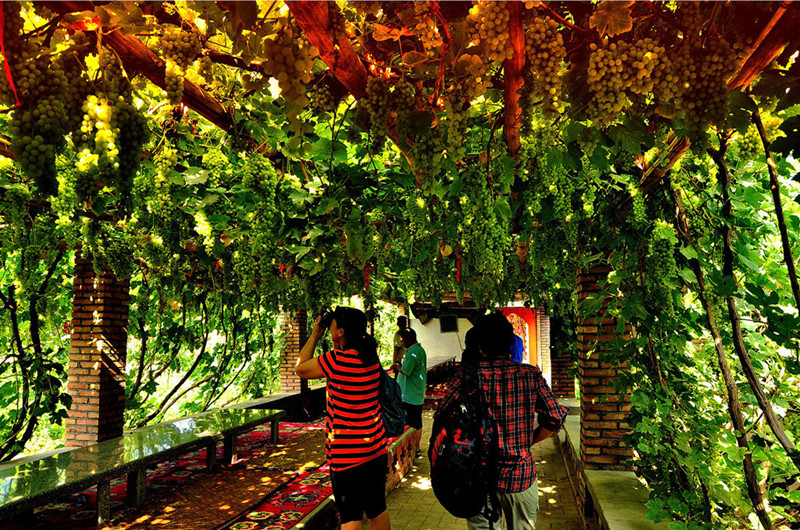
5 Days 2 Places View Detail10. Putaogou (Grape Valley, 葡萄沟) — Read Carefully
 Grape Valley in Turpan
 Grape Valley in Turpan
Putaogou is the Silk Road's most famous grape-growing valley — 8 km of vineyards north of Turpan city where the ripening season fills every trellis with fruit. It is also the single most heavily commercialised spot in Turpan, and the OTA-package version of the visit — the one that lands most first-time foreign travellers — is almost entirely staged.
Skip the packaged Grape Valley + "Uyghur family homestay" day tours sold on Ctrip and Qunar. The "family visit" is usually a hard-sell for overpriced dried fruits, wolf-berries, and dietary supplements, with a scripted song-and-dance opener designed to soften you up for the sale. There are also documented cases of adulterated products (raisin bags with foreign seeds mixed in) at these stops. Instead: (1) go directly to Qingwa Xiang (青蛙巷) inside the valley — a real residential lane where a roadside restaurant owner will often let you eat and pick grapes for a modest fee; (2) visit a working commercial vineyard like Puchang Wine (蒲昌酒业) for a tasting; (3) buy raisins by weight at Lingzhi Agricultural Market (凌志农贸市场) in Turpan city, not at Grape Valley shops.
Best time for grape experiences: seedless-white eating grapes ripen mid-to-late July into August; wine-grape harvest (Muscat and Cabernet) runs late September. September visits catch working vineyards during actual harvest — a different experience from the summer photo-stop version.
At-a-Glance: When to Visit Each Site
Turpan Site Timing Cheat Sheet
Sample 4-Day Turpan + Urumqi Itinerary
4-Day Turpan + Urumqi Silk Road Itinerary
Day 1
Arrive Urumqi — Xinjiang Museum + Grand Bazaar
Fly into Urumqi (URC). Afternoon at the Xinjiang Museum to establish the Silk Road framework (mummies, textiles, Fuxi-Nüwa painting). Evening at the International Grand Bazaar for lamb skewers, naan, and dried fruit.
Day 2
Urumqi → Turpan via High-Speed Rail
Morning HSR (~1 hr) to Turpan North. Afternoon at Karez Folk Custom Park and Emin Minaret (both indoor/shaded). Sunset at the Flaming Mountains rear-valley viewpoint. Overnight Turpan.
Day 3
Turpan Silk Road Deep Day
Sunrise at Jiaohe Ruins with proper interpretation. Late morning at Bezeklik Thousand Buddha Caves and Tuyoq Valley. Midday break at Turpan Museum. Evening tasting at a working vineyard near Putaogou. Overnight Turpan.
Day 4
Gaochang + Return to Urumqi
Morning at Gaochang Ancient City (Xuanzang platform, palace zone). Lunch in old-town Turpan. Afternoon HSR back to Urumqi for evening departure.
Book the 4-day Urumqi + Turpan itinerary with Yaso Trip
Practical Logistics
Getting to Turpan
Turpan sits 190 km (118 mi) southeast of Urumqi with three main access options. The Lanzhou–Xinjiang high-speed railway connects Turpan North Station to Urumqi in around 1 hour 10 minutes — the standard choice for most itineraries. Driving on G30 expressway takes 2.5–3 hours, useful if combining with Heavenly Lake or eastern extensions. Turpan has a small airport (TLQ) with limited domestic flights; most travellers fly into Urumqi Diwopu (URC) and connect by rail. The high-speed rail station is 60 km (37 mi) north of Turpan city center — 45 minutes by taxi or agency transfer.
The Xinjiang Time Difference
Xinjiang runs on Beijing time officially, but sunrise and sunset arrive about two hours later than in eastern China. In summer, sunrise is around 07:00 and sunset around 21:30–22:00. Restaurants stay open past 22:00; the working day starts around 10:00 and dinner is at 20:00 or later. Plan your day around the local rhythm, not the clock — if you eat dinner at 18:00 you'll be sitting in a nearly empty restaurant.
Heat Management (July–August)
Turpan is the hottest place in China. July and August ground temperatures pass 70°C at midday, and air temperatures routinely hit 45°C+. Underestimating this heat is the single most common foreign-traveler mistake in Turpan.
- Outdoor sites: before 10:00 or after 17:00 only. Jiaohe, Gaochang, and Flaming Mountains front-side are effectively unvisitable at midday in summer.
- Underground and indoor: 11:00–17:00. Karez tunnels stay at 18°C; the Turpan Museum is air-conditioned; vineyard cellars are cool. Sequence these into the midday block.
- Dry heat dehydrates without warning. Sweat evaporates before you notice it. Carry an insulated bottle of iced water and drink on a schedule, not on thirst.
- Dress for physics. Long-sleeved light-coloured cotton is cooler than a T-shirt because it blocks UV and allows sweat evaporation. Add a wide-brim hat, UPF-rated sun sleeves, sunglasses, and SPF 50+ sunscreen.
Foreign travellers routinely book midday outdoor itineraries in July–August and end up with heat exhaustion or worse. If your day tour has you at Jiaohe Ruins between 12:00 and 15:00 in summer without a hydration plan, decline the itinerary and reschedule those sites for early morning. Symptoms of heat exhaustion (headache, dizziness, no sweating despite heat) require immediate air-conditioned rest and rehydration — do not push through.
Hotel Foreign-Guest Registration Reality (2026)
This is the single biggest logistical friction point in Turpan. Under Chinese law, all foreign guests must be registered with the local police within 24 hours of arrival — hotels normally handle this at check-in, but only if the property is licensed to accept foreign guests. In Turpan city (Gaochang District) there are currently around 5–8 properties holding a current foreign-guest license, most of them mid-range international chains and long-standing four-star business hotels. Many mid-price local hotels, new boutique guesthouses, and virtually all rural homestays are not licensed and will refuse foreign travellers at check-in.
In July 2026, China's National Immigration Administration announced a pilot for online foreign-guest registration through the immigration mini-program — but the pilot covers only Hebei, Liaoning, Zhejiang, Hubei, Guangxi, Chongqing, and Sichuan. Xinjiang is not in the pilot. In-person hotel registration remains mandatory, and if you stay at a homestay you (or the host) must go to the local police station within 24 hours to file a Temporary Residence Registration Form for Foreigners.
Two practical approaches:
- Base in Urumqi, day-trip Turpan. Urumqi has 30+ licensed foreigner-friendly hotels, and the 1-hour HSR to Turpan makes a Karez / Jiaohe / museum day-trip realistic. This is what Yaso Trip recommends when travellers have short stays.
- Stay in Turpan city with confirmed booking. Call ahead in Chinese (or have your agency confirm) — verify the property can register foreign passports directly into the police system. Do not rely on OTA "accepts foreign guests" filter labels; they are not reliable.
For the parent-level Xinjiang hotel picture — including the wider Silk Road corridor accommodation strategy — see our Xinjiang travel guide .
Best Time to Visit Turpan
- April–June: Ideal. Warm days (25–35°C), cool nights, dry, no crowds, everything open.
- Mid-July to mid-August: Grape season and peak Silk Road crowd, but severe heat. Only recommended if grape harvest is the trip's purpose and you're willing to run early-morning + late-afternoon itineraries only.
- September: The other ideal window. Wine-grape harvest at working vineyards, temperatures cooling into the low 30s, tour-bus crowds thinning.
- October–early November: Cool, clear, dry. Very good conditions but shorter days.
- December–February: Cold (nights below freezing), some sites reduced hours, but crowd-free. Skiing accessible from Urumqi. Consider only if combining with a broader winter Xinjiang trip.
Tips & Cautions
- Bring your passport everywhere. Turpan sites, hotels, and even some vineyard visits will ask to see it. A photocopy is not sufficient at hotel check-in.
- Cash still helps in small vendors. WeChat Pay and Alipay dominate, but roadside grape and raisin sellers around Putaogou may not accept cards or foreign-registered wallets. Small RMB notes are useful.
- Do not photograph government or security infrastructure. Standard for Xinjiang — obey posted signs and follow guide directions at checkpoints.
- Bargaining is expected at the Grand Bazaar and Putaogou markets — start at 40–60% of asking price.
- Prayer times to be aware of at the mosque and Emin Minaret. Non-Muslim visitors are welcome outside prayer times; entry is limited or closed during prayers on Fridays.
Why Travel Turpan with Yaso Trip
Turpan rewards travellers who can hear the substance behind the sites. The Karez system is a hydraulic-engineering lecture worth an hour; Bezeklik is an art-history lecture worth another; Jiaohe is an urban-architecture lecture worth a third. Domestic day tours skip all three in favour of the Journey to the West photo stops. Yaso Trip's Turpan guides can deconstruct the Karez shaft-spacing math on-site, walk you through the Bezeklik–Le Coq removal history in front of the empty niches, and take you into the leaf-shaped Jiaohe layout by neighbourhood rather than by shuttle bus. Our team also handles the logistics that trip most first-time visitors — the foreign-guest hotel booking, the heat-managed day pacing, the working-vineyard introductions in place of the OTA "grape valley" packages — so the trip delivers Silk Road depth rather than a photo album.
Whether you have two days for the anchor sites, four days for a full Turpan + Urumqi Silk Road introduction, or two weeks for a Xinjiang-panorama loop through Kashgar and the Taklamakan, we can build the itinerary around your dates and interests.
Plan your Silk Road Xinjiang trip on the full 23-day panorama
Tour Route:Urumqi-Kanas Lake-Karamay-Aksu-Kashgar-Korla-Turpan
23 Days 10 Places View DetailReady to Plan Your Turpan Trip?
Every Turpan trip is different — some travellers want the anchor sites in two days, some want a slow Silk Road pilgrimage across a full week, some want to add the Kumtag Desert or a Kumul photography extension. Tell our Silk Road team your dates, interests, and travel style, and we'll build the itinerary — with the vineyard visits, the working-Karez interpretations, and the foreign-registration-cleared hotels — around what actually matters to you.


 View All China Tours




 View All China Theme Tours by Interest


 Home