China cycling tours offer something no other destination matches: a single country where you can pedal a flat tropical island in one season, cross 5,000 m Himalayan passes in the next, and thread through ancient Silk Road oasis towns in between. Routes span every difficulty level from completely beginner-friendly greenways to multi-week high-altitude crossings that fewer than 5,000 foreign riders complete each year. Regardless of your fitness level, available weeks, or appetite for adventure, there is a China cycling tour that fits — the challenge is knowing which one, and how to plan it correctly.
Yaso Trip, your professional local travel agency based in China, has designed and guided cycling tours across every major region in the country. This guide covers the top cycling routes for all levels, how to plan a China cycling tour, and the practical realities — bikes, navigation apps, accommodation, and permit requirements — that most travel guides skim past.
Why China Is the World's Best Cycling Destination
China rewards cyclists with a combination of scale, terrain variety, and genuine cultural depth that no comparable destination delivers. Five reasons it stands apart:
 Cycling the Hainan Island, Sanya
 Cycling G318 Sichuan to Tibet
- Unmatched terrain in one visa — From sea-level Hainan Island (海南) coastal roads to the 5,013 m (16,447 ft) Mila Pass on the Sichuan-Tibet Highway (川藏南线), China's cycling environments span more vertical range and geographic variety than any single country on earth. Plateau desert, subtropical karst, alpine grassland, ancient canal paths — all within a multi-entry visa.
- Routes that genuinely reward foreign riders — China's most famous routes — G318, the Qinghai Lake Loop (青海湖), and Hainan Island Ring (海南环岛) — see growing numbers of Chinese cyclists each year, but foreign riders remain rare enough to be a novelty. Yaso Trip's team consistently reports warm reception and genuine hospitality from communities along these routes.
- Safety that surprises most visitors — China is one of the safest countries in the world for cycling tourists. Bike theft is uncommon even in cities — locals leave quality bikes unlocked in Kunming without a second thought. Remote areas like Nujiang Valley (怒江, bordering Myanmar) see very few foreign tourists, but entry checkpoints are routine and polite, with no friction for foreign cyclists reported.
- Accommodation always within reach — There is always a guesthouse or small hotel within cycling distance on any established route in China. Wild camping carries no tradition in rural areas and can attract landowners — it is not recommended unless you are deep into a truly remote section. The smart approach: use WeChat Pay (微信支付) or Alipay (支付宝) to book accommodation as you go. Both apps now accept foreign bank cards (a significant change since 2024), and locally-owned guesthouses along touring routes typically cost ¥80–120 per night ($11–17 USD). Hostels are rare outside major cities and well-known tourist towns like Dali and Yangshuo — plan for guesthouses.
- Options for every level and every season — Beginner-friendly loops like Yangshuo (阳朔) and Hainan's east coast (海南东线) are accessible year-round. High-altitude routes open May–October. Every fitness level and timeline has a matching circuit.
China Cycling Tours at a Glance
Before the route-by-route breakdowns, use this overview table to shortlist tours by difficulty, distance, and permit requirements.
Top China Cycling Tours 2026 Overview
The 8 Best China Cycling Tours — Route-by-Route Guide
1. G318 Sichuan-Tibet Highway (川藏南线) — China's Legendary High-Altitude Crossing
 G318 Sichuan-Tibet Highway cycling
 Genyen Massif Mountain in Litang Garze
The G318 Sichuan-Tibet Highway (川藏南线) is China's most celebrated cycling route — 2,142 km (1,331 mi) from Chengdu to Lhasa, crossing 14 mountain passes above 4,000 m (13,120 ft). The highway follows the 30°N latitude belt through the Hengduan Mountains (横断山脉), six major river systems including the Yangtze (金沙江) and Mekong (澜沧江), and the final approach to the Potala Palace (布达拉宫) in Lhasa.
- Route: Chengdu (成都) → Ya'an (雅安) → Kangding (康定) → Litang (理塘) → Mangkam (芒康) → Bomi (波密) → Nyingchi (林芝) → Lhasa (拉萨)
- Length: 2,142 km (1,331 mi)
- Elevation: 500 m (1,640 ft) in Chengdu rising to 5,013 m (16,447 ft) at Mila Pass (米拉山口)
- Duration: 20–25 days including 2–3 acclimatization stops
- Best Time: May and September–October; avoid June–July monsoon
- Difficulty: Expert — sustained high altitude, prior multi-week touring experience required
- Highlights: Zheduo Pass, Xinduqiao photographer's paradise, Litang grasslands at 4,014 m, Bomi canyon forest, Lulang national forest, Potala Palace
- Accommodation & Supplies: County guesthouses every 80–120 km; Mangkam and Bomi have foreigner-registered hotels; carry emergency supplies for high-pass sections
Foreign cyclists may cycle the Sichuan section (Chengdu to Mangkam) independently, but entering the Tibet Autonomous Region requires a Tibet Travel Permit, which is only issued to organized tour groups through a licensed agency. Yaso Trip handles all permit applications, support vehicles, and bilingual guides for the full route.
The G318 draws increasing numbers of Chinese cyclists each year — you'll encounter dozens on the Sichuan section alone. The combined elevation gain across the full route exceeds 40,000 m — roughly five ascents to Everest Base Camp. It is not a casual tour.
Cycling the G318 Sichuan-Tibet Highway with Yaso Trip
Tour Route:Chengdu-Ya'an-Kangding-Litang Monastery in Litang County, Garze-Chamdo-Nyingchi-Lhasa
 25 Days
 9 Places
For the full day-by-day stage breakdown, pass elevations, acclimatization schedule, and permit documentation, see our G318 Sichuan-Tibet cycling guide.
2. Qinghai-Tibet Highway (青藏公路, G109) — The High Road from Xining to Lhasa
 Cycling across Tanggula Pass 5231m Qinghai-Tibet border
 Delingha plateau cycling Qinghai
The Qinghai-Tibet Highway (青藏公路, G109) links Xining (西宁) to Lhasa over 1,900 km (1,181 mi) across the world's highest plateau, averaging 4,500 m (14,764 ft) elevation for most of its length. Compared to G318, the route is less technically challenging — no sustained switchback climbs — but more physiologically demanding due to persistent high altitude and biting plateau winds.
- Route: Xining (西宁) → Golmud (格尔木) → Tuotuohe (沱沱河) → Naqu (那曲) → Lhasa (拉萨)
- Length: 1,900 km (1,181 mi)
- Elevation: 2,275 m (7,464 ft) in Xining to 5,231 m (17,162 ft) at Tanggula Pass (唐古拉山口)
- Duration: 18–22 days
- Best Time: May–June, September–October
- Difficulty: Expert — sustained high altitude is the primary challenge
- Highlights: Qinghai Lake dawn views, Kekexili Wildlife Reserve (可可西里, UNESCO), Tuotuohe headwaters of the Yangtze, Tanggula Pass summit at 5,231 m, Nagqu nomadic grasslands
- Accommodation & Supplies: Nomad service stations every 50–100 km; Golmud and Naqu are major resupply points; carry 2–3 day food and water reserves for remote sections
The Qinghai-Tibet route is the classic choice for cyclists who want pure plateau experience — vast open skies, nomadic herder camps, and the world's highest road corridor — without G318's mountain switchbacks. Yaso Trip's guides carry current road status reports before each departure to account for any construction or weather closures on the plateau.
Qinghai-Tibet Cycling Tours with Yaso Trip
Tour Route:Xining-Golmud-Nagqu-Namtso Lake in Lhasa-Lhasa
Full route details and permit documentation: Qinghai-Tibet cycling guide. Also see our Cycling in Tibet guide for a complete overview of all Tibet-region cycling routes, including Lhasa to Everest Base Camp and the Xinjiang-Tibet G219.
3. Xinjiang Duku Highway (独库公路, G217) — Four Seasons in One Day
 Cycling the Duku Highway in Xinjiang
 Heavenly Lake of Tianshan in Xinjiang
The Duku Highway (独库公路, G217) crosses 561 km (349 mi) of the Tianshan Mountains (天山) from Dushanzi in northern Xinjiang to Kuqa in the south, packing glacial peaks, alpine grasslands, and Kazakh herder camps into one of the most concentrated scenic stretches in China. Open only June through early October due to high-altitude snow, this is the standout cycling route for anyone heading to Xinjiang.
- Route: Dushanzi (独山子) → Nalati Grassland (那拉提) → Bayinbuluke (巴音布鲁克) → Tianshan Tunnel → Kuqa (库车)
- Length: 561 km (349 mi)
- Elevation: 600 m (1,970 ft) to 3,700 m (12,140 ft) at Tianshan Tunnel
- Duration: 3–5 days
- Best Time: June to early October (road closed in winter)
- Difficulty: Advanced — high altitude combined with rapidly changing weather
- Highlights: Bayinbuluke wetlands (one of China's largest alpine grasslands), Tianshan snow peaks, Kazakh yurt communities, "four seasons in one day" weather phenomenon, Kuqa ancient Buddhist caves
- Accommodation & Supplies: Limited on high passes; yurts and basic guesthouses in Nalati and Bayinbuluke; carry two-day food reserves; full resupply in Kuqa
One critical rule for Xinjiang cycling: not all roads allow bicycles. Expressways and many major highways ban both bicycles and motorcycles. Stick to 国道 (State Routes), 省道 (Province Routes), and 乡道/县道 (County/Township Routes) — these are always cyclist-legal. When planning with Chinese map apps, use Baidu Maps (百度地图) in 驾车 (driving) mode with the "不走高速 (avoid expressways)" button activated. The dedicated 骑行 (cycling) mode is not well-optimized for touring cyclists and regularly misroutes. Yaso Trip's route planning uses verified road-type data to ensure every stage is legally and safely cyclable.
Duku Highway Cycling with Yaso Trip
Tour Route:Dushanzi Grand Canyon in Karamay-Duku Highway in Xinjiang-The Mystic Grand Canyon of Tianshan in Kuqa, Aksu
4. Silk Road Hexi Corridor (河西走廊) — Cycling the Ancient Trade Route
 Silk Road Lanzhou to Dunhuang Cycling
 Jiayuguan Danxia rainbow mountains
The Hexi Corridor (河西走廊) traces the historic Silk Road over ~1,000 km (621 mi) of Gansu province, from Lanzhou to Dunhuang. The route passes Han Dynasty Great Wall ruins (汉长城), the Mogao Grottoes (莫高窟) UNESCO site, and Gobi Desert oases on the same corridor that camel caravans followed for two thousand years.
- Route: Lanzhou (兰州) → Wuwei (武威) → Zhangye (张掖) → Jiayuguan (嘉峪关) → Dunhuang (敦煌)
- Length: ~1,000 km (621 mi)
- Elevation: 1,200–2,500 m (3,940–8,200 ft)
- Duration: 10–14 days
- Best Time: September–October — harvest season, mild winds, fresh fruit at every stop
- Difficulty: Intermediate — mostly flat asphalt on the G312 highway; exposed desert sections require sun and wind preparation
- Highlights: Mogao Grottoes (492 Buddhist caves spanning the 4th–14th centuries, UNESCO World Heritage), Jiayuguan Pass (western terminus of the Great Wall), Zhangye Danxia rainbow mountains, Crescent Lake oasis in Dunhuang, roadside melon and peach stalls in September
- Accommodation & Supplies: Modern hotels in all major corridor towns; reliable resupply every 30–50 km
The Hexi Corridor is China's most historically rewarding cycling route for travelers interested in trade history and Buddhism. Mogao Grottoes alone justify the trip — 492 cave paintings spanning a thousand years of Buddhist art, most in better condition than anything equivalent in Central Asia. Cycling through in September means arriving at each town alongside the autumn harvest: fresh Dunhuang melons and Gansu grapes at roadside stalls make the logistics sections worthwhile.
Silk Road Cycling Tours with Yaso Trip
Tour Route:Lanzhou-Wuwei-Zhangye-Jiuquan-Jiayuguan-Yumen City-Dunhuang
12 Days 8 Places View Detail5. Qinghai Lake Loop (青海湖环湖) — China's Iconic High-Altitude Circuit
 Qinghai Lake cycling with rapeseed flowers bloom
 Yaks in Heimahe, Qinghai Lake
The Qinghai Lake Loop (青海湖环湖) is a 360 km (224 mi) circuit around China's largest saltwater lake at 3,200 m (10,499 ft) elevation. The route hosts the Tour of Qinghai Lake, an international UCI-sanctioned stage race held each July since 2002 — which has made the loop a pilgrimage for serious recreational cyclists worldwide.
- Route: Heimahe (黑马河) → Bird Island (鸟岛) → Gangcha (刚察) → Xihai Town (西海镇) → Huangyuan (湟源) → Heimahe (clockwise)
- Length: 360 km (224 mi)
- Elevation: 3,190–3,250 m (10,465–10,663 ft) constant plateau; terrain mostly flat with gentle undulations
- Duration: 3–4 days for fit riders, 5–6 at a relaxed pace
- Best Time: June–August; rapeseed bloom peaks early July, coinciding with the UCI race
- Difficulty: Intermediate — altitude is the primary challenge; the terrain itself is gentle
- Highlights: Bird Island sanctuary (migrating flocks May–July), Tibetan Buddhist monasteries, golden rapeseed fields reflecting in the blue lake, Kumbum Monastery near Xining at the start
- Accommodation & Supplies: Lakefront guesthouses every 30–50 km; Xihai Town is the main resupply point with restaurants, bike shops, and pharmacies
Qinghai Lake holds deep significance for Tibetan Buddhists, who consider it one of four sacred lakes of Tibet. For cyclists not yet ready for the Tibet permit and physical demands of G318, this is the ideal first high-altitude tour: 3,200 m is enough to feel the plateau air without the permitting complexity. The rapeseed bloom in early July — golden fields stretching to the horizon around the entire lake — produces the most photographed cycling scenery in China outside of G318.
Qinghai Lake Cycling Tours with Yaso Trip
Tour Route:Xining-Qinghai Lake-Xining
6. Hainan Island Ring (海南环岛) — Tropical Coastal Cycling with Visa-Free Entry
The Hainan Island Ring (海南环岛) circles China's southernmost province over ~800 km (497 mi) of coastal and mountain roads. It's the country's most accessible cycling tour for first-timers: flat coastal terrain, mild winter sunshine when the rest of China is frigid, and — uniquely — visa-free entry for citizens of most Western nationalities, bypassing the standard visa application entirely.
 Cycling the Hainan Island
 Hainan Coastal Scenic Highway
- Route: Haikou (海口) → Wenchang (文昌) → Boao (博鳌) → Sanya (三亚) → Wuzhishan (五指山) → Qiongzhong (琼中) → Haikou
- Length: ~800 km (497 mi)
- Elevation: Sea level to 600 m (1,970 ft) on the inland Wuzhishan section
- Duration: 7–10 days
- Best Time: November–March — tropical winter cycling; avoid the June–October typhoon season
- Difficulty: Beginner–Intermediate
- Highlights: Dongjiao Coconut Plantation, Boao Forum coastline, Sanya beach resorts, Li and Miao minority villages in Wuzhishan, Qionghai canal towns
- Accommodation & Supplies: Hotels in every coastal town; well-stocked convenience stores every 30–50 km; excellent road conditions throughout
Hainan is China's tropical cycling exception — while Beijing cycles in −10°C January air, Hainan riders push through 25°C sunshine in shorts. The route mixes about 80% flat coastal riding with a 20% inland mountain section through Wuzhishan, one of the island's few genuinely non-touristy areas. For cyclists combining Hainan with a subsequent Tibet or Xinjiang trip, the warm-weather warm-up before altitude is practical as well as pleasant.
Hainan Island Cycling Tours with Yaso Trip
Tour Route:Haikou-Fushan Coffee Culture Town in Chengmai County, Hainan-Lingao-Danzhou-Changjiang-Dongfang City-Jianfengling National Forest Park Hainan (Birding Base)-Sanya-Lingshui-Wanning-Boao Shanqin Bay Golf Course-Dongjiao Coconut Plantations in Wenchang City-Haikou
10 Days 3 Places View DetailFull island logistics — east coast vs. west coast comparison, ferry connections, and accommodation guide — in our Hainan island cycling guide.
7. Yangshuo Karst Country (阳朔) — China's Best Beginner Cycling Route
 Yangshuo cycling, Guilin Guangxi
 Ten-Mile Gallery, Yangshuo
Yangshuo (阳朔) offers the most accessible cycling experience in China for first-time visitors: flat terrain, foreigner-ready tourism infrastructure, and the country's most famous karst scenery. The Yulong River (遇龙河) loop winds between 400 m (1,312 ft) limestone spires rising straight from the valley floor — cycling through a landscape that looks literally painted.
- Route: Yangshuo town → Yulong River → Moon Hill → Jiuxian Village → Fuli Ancient Town
- Length: 30–150 km (18–93 mi) depending on loop choice
- Elevation: 100–300 m (330–980 ft); essentially flat
- Duration: Half-day to 5 days
- Best Time: April–May, September–November; avoid July–August heat and humidity
- Difficulty: Beginner
- Highlights: Yulong River bamboo rafting alongside cycling routes, Moon Hill natural arch, Fuli fan-painting workshops, farmhouse lunches with local families, Longji rice terrace day trips
- Accommodation & Supplies: 100+ foreigner-friendly guesthouses in Yangshuo town; wide restaurant options; bike rentals — including e-bikes — widely available
Yangshuo is where most foreign cyclists start in China — and where many return. The tourist infrastructure handles English seamlessly, roads through the villages are genuinely car-light, and the farming communities alongside the routes are real, not stage-sets. For families or cyclists doing their first China trip, it's the lowest-friction entry point into Chinese cycling culture.
Yangshuo Cycling Tours with Yaso Trip
Tour Route:Guilin-Longsheng-Sanjiang-Yangshuo-Guilin
8 Days 6 Places View Detail💡
New to cycling in China?
Our
beginner cycling routes guide compares Yangshuo, Hainan, Qinghai Lake, and Hangzhou–Huangshan in detail — with route-selection advice for first-timers.
8. Hangzhou–Huangshan Tea Country (杭徽古道) — Eastern China's Quiet Cycling Gem
 Yellow Mountain Cycling, Anhui
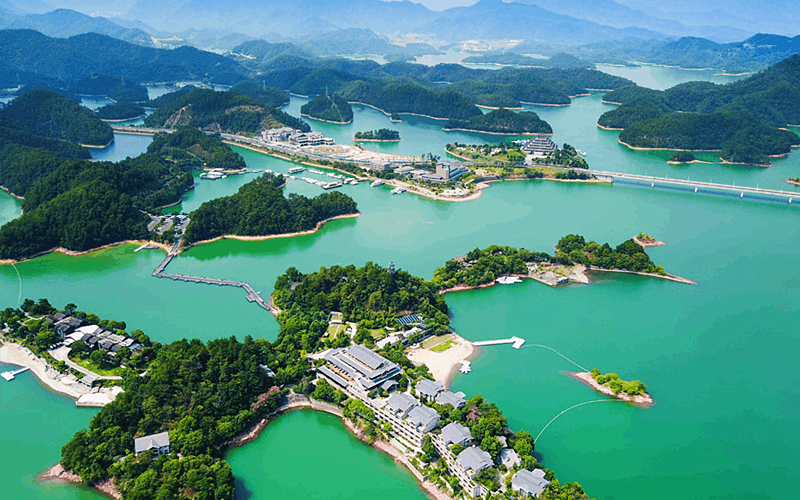 Qiandaohu Lake, Zhejiang
The Hangzhou–Huangshan route (杭徽古道) covers 516 km (321 mi) of quiet tea-country roads through Zhejiang and Anhui provinces, linking West Lake (西湖) to Huangshan (黄山)'s UNESCO peaks. It's the most culturally underrated route on this list — gentle hills, working tea farms, and Hui-style ancient villages with white-walled, black-tiled architecture that exists nowhere outside the Yangtze Delta.
- Route: Hangzhou (杭州) → Tonglu (桐庐) → Qiandao Lake (千岛湖) → Hui-style village belt → Huangshan (黄山)
- Length: ~516 km (321 mi)
- Elevation: 50–1,000 m (165–3,280 ft); gentle rolling hills, no sustained climbs
- Duration: 5–7 days
- Best Time: April–May (tea harvest season), October–November (autumn foliage)
- Difficulty: Beginner–Intermediate
- Highlights: Hangzhou West Lake UNESCO scenic area, Qiandao Lake crystal-clear reservoir, Xidi and Hongcun Hui-style villages (UNESCO), Huangshan granite peaks, Longjing tea terraces
- Accommodation & Supplies: High-quality guesthouses and cultural homestays every 20–50 km; excellent infrastructure throughout Zhejiang and Anhui
For cyclists combining cycling with classical China sightseeing, Hangzhou–Huangshan is unbeatable. The route starts in one UNESCO city, ends in another, and passes through the country's finest collection of Ming-dynasty villages in between. Hangzhou is 1 hour from Shanghai by high-speed train — making this an easy add-on to any China itinerary.
Eastern China Cycling Tours with Yaso Trip
Tour Route:Hangzhou-Thousand Islets Lake (Qiandaohu Lake) in Hangzhou-Huangshan
8 Days 5 Places View DetailPlanning Your China Cycling Tour — Bikes, Permits, Logistics & Apps
Bikes — Rent, Bring, or Buy?
This is the single most common question foreign cyclists ask before booking. The right answer depends on your route and experience level.
Renting in China: Quality touring bikes are available in major cycling cities — Chengdu, Kunming, Lhasa, Xining, Sanya, and Yangshuo. The most widely available international brands are Giant (捷安特) and Merida (美利达); major Chinese brands are XDS (喜德盛) and TRINX (千里达), both widely available outside big cities. Trek and Specialized exist but are uncommon in rural areas. Standard 26-inch and 700c wheel sizes are both well-stocked in any cycling town for tubes and tyres. E-bikes are available in Yangshuo and Hainan.
Bringing your own bike: Most international airlines accept boxed bikes as oversized luggage, typically at $150–300 (approximately ¥1,100–2,200) each way. Major Chinese cities have full-service bike shops for tune-ups and box storage during the tour. Yaso Trip can coordinate box storage at departure-city hotels for guided tour clients.
Critical — carry specialist spare parts: China has roadside repair shops on every major route, but anything beyond a standard inner tube is hard to source in rural areas. Pack any specialist cables, brake pads, derailleur components, or specific tyre sizes you might need. For serious bike work in urban areas, search for Giant, Merida, XDS, or TRINX brand shops — these are most likely to stock components outside Tier-1 cities.
Insurance: Yaso Trip provides travel and medical insurance coverage for all guided cycling clients — including emergency evacuation on remote routes like G318 and the Qinghai-Tibet Highway. This is one of the most significant practical advantages of a guided tour over independent cycling on high-altitude routes.
Visa & Permit Requirements
A standard Chinese tourist visa (L visa) covers most routes, but four specific situations need additional planning:
 Tibet Travel Permit
 Tibet permit checkpoint
- Standard L visa: Sufficient for Yangshuo, Qinghai Lake, Hainan, Hexi Corridor, Yunnan non-Tibet sections, and Hangzhou–Huangshan. Apply via your nearest Chinese embassy.
- Hainan visa-free entry: Most Western nationalities can enter Hainan province for up to 30 days without a visa — the lowest-friction China entry option available.
- 240-hour transit visa-free: Available to nationals of eligible countries transiting through gateway cities including Shanghai, Beijing, Chengdu, and Kunming — useful for short cycling tours.
- Tibet Travel Permit: Mandatory for the Tibet Autonomous Region. Required for the Tibet section of G318, the full Qinghai-Tibet Highway, and any Lhasa-based cycling. Cannot be obtained by individual foreign travelers — only issued to organized tour groups through licensed agencies. Yaso Trip manages the full application.
- Xinjiang restricted-road permits: Some Xinjiang border zones (Khorgos near Kazakhstan, Baihaba near Mongolia) require border permits where foreign travellers may be prohibited, please contact Yaso Trip operators for redirected routes and latest policies. The Duku Highway itself requires no permits.
For complete permit reference including application timelines and common mistakes, see our China cycling visa and permits guide.
Best Time to Cycle in China
High-altitude Tibet and Qinghai routes are best in May and September–October, avoiding the June–July monsoon rains and the November–April pass closures. As of 2026, Xinjiang's Duku Highway opens approximately late May and closes by late October depending on snow at the Tianshan Tunnel.
Best Time to Cycle in China by Season
For an accurate cost breakdown tailored to your group size, dates, and preferred route, contact the Yaso Trip team for a custom quote.
Navigation & Payments
 WeChat Pay & Alipay
 Amap (Gaode Map)
Maps:
- Amap (高德地图) — China's most reliable navigation app. Download offline maps for your full route before entering areas with unreliable signal.
- Baidu Maps (百度地图) — Also reliable; important usage tip: activate 驾车 (driving) mode and the 不走高速 (avoid highways) button. The dedicated 骑行 (cycling) mode is not optimized for touring and frequently misroutes on provincial and county roads.
- Google Maps does not function in mainland China without a VPN.
Payments:
- Alipay (支付宝) and WeChat Pay (微信支付) both accept foreign Visa/Mastercard as of 2024. Link your card before departing — hotels, restaurants, and convenience stores in rural areas increasingly decline cash. Both apps also function as hotel booking platforms, which is essential in areas like Nujiang Valley where international booking sites have no coverage.
Translation:
- Google Translate offline Chinese-English pack — download before arrival; voice mode is essential in rural areas without internet access.
Expert Tips for Cycling in China
Expressways (高速公路) ban bicycles across China — and many Xinjiang highways ban motorcycles and bikes as well. Always confirm road type before a stage. Stick to 国道 (State Routes), 省道 (Province Routes), and 乡道/县道 (County Routes). If uncertain, ask your Yaso Trip guide before departure.
- Use Baidu Maps in driving mode with highways disabled. The cycling navigation mode misroutes touring cyclists repeatedly on provincial roads. Driving mode (驾车) + "不走高速" (Avoid Expressways) is the correct setting.
- Set up Alipay or WeChat Pay before you arrive. Both apps now accept foreign bank cards (this changed in 2024). Hotels, restaurants, and shops in rural areas increasingly do not take cash. Both apps also let you book accommodation on the go — essential in off-the-beaten-track areas.
- Pack your critical spare parts. Roadside shops cover standard inner tubes and basic repairs across China. Anything beyond that — specialist cables, brake pads, specific tyre sizes — is difficult to source in rural areas. Bring it from home.
- Plan acclimatization seriously. For any route above 3,000 m (G318, Qinghai-Tibet, Qinghai Lake), build in 2–3 non-cycling days after your arrival city before the first major climbing stage. AMS (acute mountain sickness) is a real risk on the Tibetan Plateau and not to be underestimated.
- Don't plan for wild camping. There is no tradition of wild camping in rural China, and unexpected camps attract landowners. The good news: there is almost always a guesthouse or small hotel within reach on any established route, typically ¥80–120 per night ($11–17 USD).
- Helmets, reflective vests, and quality lights are non-negotiable. Routes shared with heavy freight trucks — Hexi Corridor, G318 western Sichuan sections, Xinjiang provincial roads — demand full visibility gear. Be specifically aware of trucks' blind spots and vehicles making left turns from opposing traffic without yielding when you're going straight.
- China is safer than most visitors expect. Bike theft is uncommon — locals in Chinese cities leave quality bikes unlocked without concern. On remote routes like Nujiang Valley or the Xinjiang-Tibet corridor, entry checkpoints are routine and polite. You are more likely to be invited for tea than hassled anywhere on these routes.
- Carry a paper map backup. China uses the GCJ-02 coordinate offset system, which can shift GPS position by up to several hundred meters. On remote high-pass sections, have a physical backup.
Why Ride China's Routes With Yaso Trip
Cycling China independently is possible — and genuinely rewarding for experienced self-supported tourers on permit-free routes. But for routes involving Tibet permits, Xinjiang road restrictions, altitude emergencies, or remote logistics, guided support changes the experience from logistics management to actual cycling.
1. Tibet Permit Management. Tibet Travel Permits cannot be obtained by individual foreign cyclists. Yaso Trip handles the full application, coordinates with the Tibet Tourism Bureau, and manages supporting documentation. Without an agency, the Tibet section of G318 and the Qinghai-Tibet route are inaccessible.
2. Insurance Coverage. All Yaso Trip guided cycling clients are covered for travel, medical, and emergency evacuation throughout the tour — a level of protection that independent cycling in remote China does not include by default.
3. Support Vehicle & Mechanical Backup. On G318, the Qinghai-Tibet Highway, and the Duku Highway, Yaso Trip's support van carries gear, delivers meals at high-altitude road points, handles mechanical failures, and provides an evacuation option in the event of altitude sickness or injury. The difference between climbing Mila Pass loaded versus unloaded is not trivial.
4. Bilingual Guides & Road Knowledge. English-speaking guides who navigate Tibetan, Uyghur, and other regional dialects handle hotel registration, restaurant ordering, permit checkpoints, and cultural context in areas where English is effectively nonexistent.
5. Customized Multi-Region Itineraries. Yaso Trip designs combined trips — Hainan warm-up before G318, Yunnan tea country with Tibet extension, Silk Road into Xinjiang loop — that combine routes unavailable on standard itinerary platforms.
Plan Your China Cycling Trip Today
From Yangshuo's karst loops to the legendary G318 Tibet crossing, China offers a cycling route for every level of ambition. Getting the logistics right makes the difference between a frustrating planning exercise and one of the most memorable physical adventures of your life. Yaso Trip handles permits, bikes, guides, insurance, and accommodation so you can focus entirely on the road ahead.


 View All China Tours



 View All China Theme Tours by Interest


 Home


