What Should You Eat on the Silk Road?
The Silk Road runs west from Xi'an (西安) through the Hexi Corridor (河西走廊) and into Xinjiang (新疆), and every 500 kilometres the food changes shape. Start with Xi'an's lamb-and-flatbread paomo (羊肉泡馍) and Muslim Quarter roujiamo (肉夹馍), pull noodles in Lanzhou (兰州), work your way through the Hexi Corridor for the "three-piece set" in Wuwei (武威) and iron-plate chao bola (炒拨拉) in Zhangye (张掖), then hit the desert oasis food of Dunhuang (敦煌), the grape valleys of Turpan (吐鲁番), and the Uyghur heartland in Kashgar (喀什) for polo, samsa, and dozens of naans. It is one of Asia's great overland food journeys.
Tour Route:Beijing-Xian-Lanzhou-Wuwei-Zhangye-Jiayuguan-Dunhuang-Turpan-Urumqi-Kashgar-Shanghai
19 Days
13 Places View Detail
Key Takeaways
✔ The Silk Road decomposes into five distinct food regions — Xi'an, Lanzhou, the Hexi Corridor, Turpan, and Kashgar — each with its own signature dishes, breakfast rituals, and etiquette.
✔ Lamb dominates the reputation but not the reality — beef, chicken (dapanji 大盘鸡), noodle-and-vegetable dishes, and dairy are equally central, and vegetarians do fine with preparation.
✔ Lanzhou beef noodles (兰州牛肉面) follow a strict "one clear, two white, three red, four green, five yellow" formula and must be eaten fresh at the counter — takeaway ruins them.
✔ Turpan's grape season runs mid-July to early September; outside that window, the vineyard-lunch experience does not exist.
✔ Kashgar's Sunday Bazaar (星期天大巴扎), Old Town breakfast alleys, and Uyghur home meals are the most concentrated Uyghur-food experience in China.
✔ Naan (馕), lamb pilaf (抓饭), and hand-pulled noodles (拉条子) appear the length of the corridor, but each city has its own version — noticing the variations is half the pleasure.
✔ Etiquette matters more than tourists realise, especially at Uyghur home meals, Hui halal restaurants, and bazaar stalls where price-per-kilogram and animal-species confusion trip up first-timers.
Why the Silk Road Is One of Asia's Great Food Journeys
Yangrou Chuar lamb kebab silk road food
Kashgar Old Town naan sesame onion pit-fired
- Five distinct regional cuisines in one trip. The corridor crosses Shaanxi Han-Chinese food, Gansu Hui halal cooking, Xinjiang Uyghur cuisine, and desert-oasis specialties — few overland routes in the world change food this dramatically over such a short distance.
- Ingredients that only exist along this route. Turpan's mare's-nipple grapes, Kuqa's thick dried apricots, Yecheng's soft-seed pomegranates, Ili horse meat, Xinjiang cold-water fish — the Silk Road ingredient map is unique in China.
- A living Silk Road exchange. Cumin (originally Persian), naan (originally Central Asian), and pilaf (originally Central Asian) all travel with the road. Eating them where they entered China is a working history lesson.
- Great value. A bowl of Lanzhou beef noodles is about ¥7–10 ($1–1.50 USD). A full lamb skewer dinner at a bazaar rarely tops ¥100 per person. Food is one of the corridor's best-value experiences.
- Approachable for first-timers. Because so much of the food is grilled meat, flatbread, and noodles, the entry curve is lower than for Sichuan or Cantonese cuisine. If you can eat lamb and bread, you can eat the Silk Road.
- Bookable as an experiential trip. Full-corridor guided tours build in the food stops — Uyghur home meals, vineyard lunches, night-market walks — that independent travellers usually miss because they aren't in a guidebook.
Silk Road Food, City by City
The corridor unfolds west to east — this guide follows the same order, so a reader planning a Xi'an → Kashgar itinerary can read straight through in trip order. Each city section includes what to eat, where to eat it, one tourist trap to avoid, and the tour we most often pair with a food-forward version of that stop.
Muslim Quarter Roujiamo in Xi'an
Kashgar Sunday Bazaar baked lamb bun
1. Xi'an (西安) — Where the Silk Road Begins
Steam rises off a copper pot of paomo broth at a corner table in the Muslim Quarter, and the owner slides you a stone bowl and a round of unleavened bread. You tear the bread into fingernail-sized pieces — this is the ritual — and hand it back. Ten minutes later it comes back submerged in lamb broth with glass noodles, cilantro, and pickled garlic.
Fact Panel — Xi'an (西安)
- Regional cuisine: Shaanxi (陕西菜) + Hui halal (回族清真)
- Anchor dishes: roujiamo (肉夹馍 "Chinese hamburger"); yang rou pao mo (羊肉泡馍 lamb soup with hand-torn flatbread); biang biang mian (Biang Biang 面 hand-pulled wide belt noodles); qishan saozi mian (岐山臊子面 Qishan minced-pork noodles); guantang bao (灌汤包 soup dumplings); liangpi (凉皮 cold wheat noodles).
- Best food streets: Sajinqiao (洒金桥) for where locals actually eat; Yongxingfang (永兴坊) for curated Shaanxi intangible-heritage snacks under one roof; Muslim Quarter / Huimin Jie (回民街) for the historic halal old shops.
- Best time: any month — Xi'an food does not have a season.
- Difficulty for first-timers: low. English photo menus are common; portion sizes are manageable.
Xi'an sits at the eastern terminus of the Silk Road and its food has 2,000 years of trade in it. The Muslim Quarter (回民街) grew up around the Great Mosque and remains the densest halal-food district in inland China — go for the historic old shops (a bowl of paomo at the Lao Sun Jia line of shops, roujiamo at the busiest doorway, and pomegranate juice that is actually made from pomegranates) but be honest that it is now a tourist quarter. For everyday cooking, cross the ring road to Sajinqiao (洒金桥) — a narrow-lane market where the queues are all local and a bowl of biang biang mian costs half what it does at Huimin Jie. Yongxingfang (永兴坊) is the curated alternative: a purpose-built food court just inside the East Gate, organised by Shaanxi province with sub-stalls representing each region's signature dish. Not authentic in the "hole in the wall" sense, but a compressed one-stop way to sample Qishan minced-pork noodles, Hanzhong hot rice noodles, and Tongchuan lamb blood curd without cross-town driving.
Skip the Muslim Quarter's headline "1st-place" ranked shops if the queue is entirely photographers — those tend to be the ones optimised for social media, not flavour. Also skip anywhere selling "camel meat skewers" on the main strip. Camel is not a Xi'an street food; it is a themed prop, and the meat is usually beef. Head one or two lanes off the main drag or cross to Sajinqiao where the pricing is per-jin, not per-photo-op.
A guided Xi'an food-forward start
Tour Route:Xian-Mount Huashan-Xian
2. Lanzhou (兰州) — The Beef Noodle Capital
Bowl of Lanzhou beef noodles
Lanzhou beef noodles hand-pulled
Get to the door before eight. There is a line already, three men deep, and the sound coming out is the counter chef whipping a rope of dough against the marble slab — whap, whap, whap — and pulling it into hair-fine strands in eight seconds. Your bowl comes with a clear beef bone broth, a slice of white radish floating on top, a spoonful of red chili oil, a fistful of green cilantro and garlic sprout, and yellow noodles still bouncing. This is the "one clear, two white, three red, four green, five yellow" (一清二白三红四绿五黄) — the official grading standard of a proper Lanzhou bowl.
Fact Panel — Lanzhou (兰州)
- Regional cuisine: Gansu Hui halal (甘肃回族清真)
- Anchor dishes: Lanzhou beef noodles (兰州牛肉面 Lanzhou niurou mian, "beef lamian"); huidouzi (灰豆子 broad-bean sweet porridge); tianpeizi (甜醅子 fermented barley); niangpi (酿皮 cold noodles); roast lamb skewers (烤羊肉).
- The famous shops: Mazi Lu (马子禄) — over a century old, the most famous name; Wu Mule Peng Hui (吾穆勒蓬灰) — fragrant chili, not harsh; Zhanguo (占国) — approachable chain, large portions; also Ma You Bu (马有布) and Mogouyan (磨沟沿) for local-favoured alternatives.
- Bowl cost: roughly ¥7–10 ($1–1.50 USD).
- Best time: breakfast (7–9 AM) or lunch (12–2 PM). The counter is coldest between meal-times.
Lanzhou is a beef-noodle city the way Naples is a pizza city — the dish defines the daily rhythm. Locals eat lamian for breakfast, standing at the doorway or squatting on the kerb with the bowl in one hand and chopsticks in the other. The single most important rule: eat the noodles the moment they land on the counter. Handpulled dough loses its texture within minutes. Do not take away; do not photograph for ten minutes; do not wait for a friend to arrive. When you order, ask for 細 (xi, fine) or 二細 (er xi, second-fine) — foreigners tend to like the finer gauge; locals often order thicker 韭叶 (jiuye, chive-leaf) or 大寬 (da kuan, wide-belt). Beyond noodles, Lanzhou is where the Hexi Corridor's Hui halal cooking tradition begins — try huidouzi at a night stall for a sweet, thick broad-bean porridge, and pick up a paper cup of tianpeizi (a fermented-barley cooler that tastes like Northwest sake).
Because Lanzhou is a halal-food-forward city, the etiquette rules that will follow you the rest of the corridor start here: look for the 清真 (halal) signage on the shop face, do not bring outside food or alcohol into the shop, and understand that "vegetarian dish" served in a halal restaurant does not automatically mean it was cooked in a vegetarian-only wok.
Any shop advertising itself as "Lanzhou beef noodle" outside Lanzhou is a different (and usually worse) dish — the corridor version and the export-chain version diverge sharply. Also avoid the airport and railway-station beef-noodle stalls: they cook the noodles ahead and hold them, which defeats the point. If your visit is short, taxi ten minutes into the city to a proper counter.
A Lanzhou-anchored corridor tour that runs through Xiahe, Jiayuguan, and Dunhuang
Tour Route:Lanzhou-Jiayuguan-Dunhuang
8 Days
5 Places View Detail
3. The Hexi Corridor (河西走廊) — Wuwei, Zhangye, Dunhuang
Wuwei three-piece set xingmian noodles braised meat fu tea
Dunhuang Shazhou night market donkey meat yellow noodles
You step out of the market lane in Wuwei on a summer evening and the air is thick with the smoke of grilled lamb, cumin, and the yeasty steam of a fresh pot of fu tea being brewed in copper. Ten steps further and a woman waves you into an old shop where three plates are already coming out — noodles, braised meat, tea — the meal that starts every Hexi traveller's education in Northwest food.
The corridor between Lanzhou and Dunhuang is a food region in its own right, and it is where our tour leaders do their best work. Three specific stops are worth building an itinerary around.
Fact Panel — Hexi Corridor
- Regional cuisine: Gansu Hui halal + Hexi-corridor oasis (河西走廊菜)
- Anchor cities: Wuwei (武威), Zhangye (张掖), Dunhuang (敦煌).
- Anchor experiences: the "three-piece set" (三套车) in Wuwei; iron-plate chao bola (炒拨拉) at the Ming-Qing Street night market in Zhangye; lamb and donkey-meat noodles in Dunhuang.
- Best time: May–October. Winter narrows the night-market experience considerably.
- Trip length: 3–5 days end-to-end drives comfortably, longer if adding Zhangye Danxia and Mogao Grottoes at unhurried pace.
Wuwei (武威) — the "three-piece set" (三套车). Take a taxi to Beiguan Market (北关市场) and find any local-crowded old shop — He Ji (何记) or Gu Liang Yun (古凉韵) are examples our guides use, but the whole market is variations on the same idea. The set: a bowl of xingmian (行面) — a wide, chewy Liangzhou noodle that reminds foreign guests of a heavier pappardelle — with a plate of soft, slow-braised meat (卤肉) on the side, and a cup of rock-sugar red-date fu tea (冰糖红枣茯茶) to cut the richness. Foreign travellers consistently describe it as the meal that reframed their idea of Northwest food from "grilled lamb" to something more layered. A guide tip: the xingmian portion is enormous. Order half-size or share between two, or waste is guaranteed.
Zhangye (张掖) — chao bola (炒拨拉) at the Ming-Qing Street night market. After sunset, look for Lao Zhou Chao Bola (老周炒拨拉) or Zhou Ji Chao Bola (周记炒拨拉) — two long-established stalls, taste nearly identical. Chao bola is an open iron plate over high flame, tossed with lamb offal, lamb meat, onion, green pepper, cumin, and chili. The plate arrives sizzling and smoking; guests who normally decline offal tend to be won over by how the caramelised tripe and intestine cook down. Warn spice-shy guests before ordering — the cumin and chili run heavy.
Dunhuang (敦煌) — the lamb, the noodles, and the apricot tea. Two must-visits our guides run for every group. First, Jingyuan Galiu Meiwei Lamb (靖远尕六美味羊羔肉) at the east gate of Shazhou Amusement Park (沙洲乐园东门口) — order the white-strip lamb (白条羊羔肉) with a side of cold-mixed shacong (凉拌沙葱, desert sand-onion). This is the meal that resets foreigners' expectations about lamb: milk-sweet, no gaminess, the fat rendering into the sand-onion. In peak season the queue is brutal — take a number an hour before you plan to sit. Second, walk Shazhou Night Market (沙洲夜市) or the locally-preferred Baiwei Old Street east gate (百味老街东门) and eat two things: donkey-meat yellow noodles (驴肉黄面) — chewy yellow noodles with fragrant braised donkey topping — and Hu-yang lamb menbing (胡羊焖饼), which despite the "bing" (pancake) in the name is actually wide noodle sheets braised in lamb sauce. Wash both down with fresh apricot-skin tea (杏皮茶); it is the take-home drink foreign guests remember longest.
In Dunhuang, avoid the ornate "Silk Road banquet" set menus advertised in hotel lobbies — they cost several times the market price for the same food, served slower. The night market is where the actual eating happens. In Zhangye, skip the plastic-fronted "restaurants for tourists" on the main pedestrian street and walk 200 metres deeper into the Ming-Qing Street market where the plastic stools and the crowd both look local.
A guided Hexi Corridor food-anchored trip
Tour Route:Beijing-Lanzhou-Wuwei-Zhangye-Jiayuguan-Dunhuang-Beijing
An alternative shorter Hexi loop
Tour Route:Lanzhou-Dunhuang-Jiayuguan
5 Days
5 Places View Detail
4. Turpan (吐鲁番) — Oasis Fruit and Uyghur Pilaf
Uyghur lamb pilaf polo
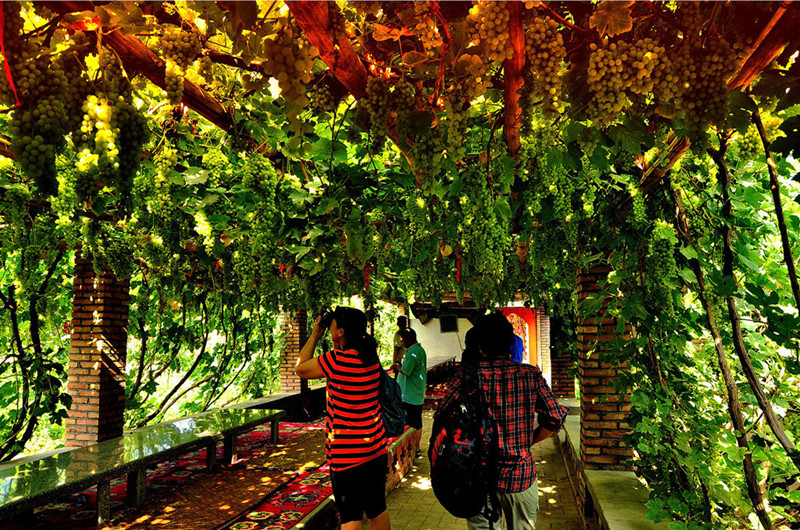
Grape Valley in Turpan
You step into Grape Valley (葡萄沟) at midday and the air temperature drops five degrees. Overhead, seedless white grapes hang from wooden trellises so densely that the light is broken into green stripes. A Uyghur host motions you to a raised platform bed, spreads a cotton mat, and starts bringing out lamb pilaf (抓饭) — the rice glossy with fat, studded with carrot and raisin, a spine of lamb rib laid across the top.
Fact Panel — Turpan (吐鲁番)
- Regional cuisine: Uyghur (维吾尔) + Turpan oasis (吐鲁番绿洲菜)
- Anchor dishes: lamb pilaf (抓饭 Uyghur polo); dapanji (大盘鸡 big-plate chicken); laghman / laghman (拉条子 Latiaozi, hand-pulled noodles with sauce); grape valley lunch spreads.
- Anchor experiences: Grape Valley (葡萄沟) vineyard lunch during grape season; Tuyoq Village (吐峪沟 Tuyoq) Uyghur family homestay dinner.
- Grape season: mid-July to early September. Outside this window, the vineyard-lunch experience does not exist.
- Signature fruit: seedless white (无核白 wuhebai), mare's-nipple (马奶子 manaizi), red globe (红提 hongti). Also famous: Hami melon (哈密瓜), Kuerle fragrant pear (库尔勒香梨).
Turpan sits in China's second-lowest depression and is essentially a giant oasis fed by the ancient karez (坎儿井) underground irrigation system. The heat is what everyone remembers — commonly reaching 45°C (113°F) at midday in July — but the shade under a grape trellis is one of Xinjiang's most photographed lunch settings for a reason. Book the vineyard-lunch experience only during grape season; outside July–September you will drive into a valley of bare trellises and be served a menu without the point of the visit. Our Turpan itineraries add a Tuyoq Village (吐峪沟) homestay dinner where the family cooks pilaf on charcoal in front of guests and serves it on a communal platter — one of the corridor's most memorable meals.
For non-lamb eaters, Turpan is where the Silk Road food journey turns easiest. Dapanji (大盘鸡, "big-plate chicken") is exactly what the name promises: a wok-sized plate of bone-in chicken braised with potato, green pepper, and hand-pulled belt noodles laid under the sauce to catch the juices. Order at any Uyghur restaurant with a queue; portions are enormous, so three people can share one plate.
Do not eat cold watermelon straight after a lamb-heavy meal. Locals will warn you before you do it — the combination causes cramps and, for a percentage of first-timers, worse. Same rule for iced pomegranate juice sold at roadside stands: unless the seller is visibly using bottled water and freshly-squeezed fruit, buy your pomegranate juice at a proper shop. When buying raisins in Grape Valley, ask for shade-dried (阴干); avoid sulphur-treated products (unnaturally bright yellow). Prices are per-jin (500g), not per-pound — check before you agree.
A Turpan-anchored short tour
For the deeper Turpan travel context — Jiaohe Ruins, Flaming Mountains, Karez system — see our full Turpan travel guide .
5. Kashgar (喀什) — Uyghur Food Heartland
Kashgar Old Town naan sesame onion pit-fired
Kashgar Sunday Bazaar samsa baked lamb bun pit oven
At 5 AM the first bread ovens light along the old-town alleys. By 7 AM the whole neighbourhood smells of hot naan, of tandoor smoke, and of milky Uyghur tea steaming in enamel bowls. This is the closest to Central Asia China's food gets — and for many foreign travellers, the most memorable meal of the whole corridor.
Fact Panel — Kashgar (喀什)
- Regional cuisine: Uyghur (维吾尔)
- Anchor dishes: polo / lamb pilaf (抓饭 zhuafan); samsa / baked lamb bun (烤包子 kaobaozi); laghman / hand-pulled noodles (拉条子 latiaozi); big-plate chicken (大盘鸡 dapanji); whole roast lamb (烤全羊 kaoquan yang) for special occasions; naan (馕 nang) — sesame naan (芝麻馕), onion naan (皮牙子馕 piyazi), pit-fired concave naan (窝窝馕 wowo nang).
- Anchor experiences: breakfast alleys behind the Old Town (老城 laocheng); Sunday Bazaar (星期天大巴扎) food row; Kashgar Night Market lamb-skewer street; Uyghur family home meal (with a guide who can arrange).
- Best time: any month, but Sunday for the full bazaar effect. Ramadan changes daytime eating substantially — confirm your travel window against the current lunar-calendar dates.
- Practical note: halal restaurants are the default here. Non-halal food is essentially unavailable in the Old Town.
Kashgar is where every Uyghur dish you have read about actually happens on its home ground. Start with breakfast at a Old Town tea house — hot naan straight off the tandoor wall, milky Uyghur tea, and a bowl of thick house-made yoghurt (qatiq) with local honey. Move to the Sunday Bazaar (星期天大巴扎), which is both a livestock market and a food row: samsa baking in a pit oven, cauldrons of polo, whole-lamb turning on spits, and dried-fruit stalls selling shade-dried raisins from Turpan and thick apricots from Kuqa. Save a proper polo lunch — the diced-lamb variety with oil-glossy rice and shredded carrot — for a sit-down family restaurant, ideally one your guide books ahead so you get the fresh cook rather than the reheat.
The most memorable meal of a Kashgar visit is almost always a Uyghur family home dinner. On our Kashgar in-depth trip the itinerary builds this in — often at a family compound in the Old Town or, on longer trips, on the Karakoram Highway back from Karakul Lake. Etiquette matters at these meals more than at any restaurant, so a pre-meal brief from your guide is essential (see the how-to section below).
In Kashgar, watch the lamb-skewer pricing. If a skewer is priced at ¥1 or ¥2, it is almost certainly duck (or a duck-lamb mix); real lamb runs ¥5–15 per skewer depending on cut. This is not a scam — it is the standard price signal — but foreigners who don't know the tell can end up eating duck all night. Also skip the loose-yogurt stalls in summer without a cover — the ambient temperature and open air spoil dairy fast. Buy packaged, or confirm the yogurt is made same-day and kept covered on ice.
A Kashgar-anchored trip
For the broader Kashgar experience — Old Town, Id Kah Mosque, Karakoram Highway, Sunday livestock market — see our full Kashgar travel guide .
A cross-corridor Muslim-food-forward tour that ends here
Tour Route:Kashgar-Urumqi-Turpan-Dunhuang-Xian
11 Days
9 Places View Detail
The Silk Road Food Map at a Glance
Xi'an (西安)|Shaanxi + Hui halal|Roujiamo, paomo, biang biang mian, guantang bao, liangpi
Lanzhou (兰州)|Gansu Hui halal|Lanzhou beef noodles, huidouzi, tianpeizi, niangpi|Any month; 7-9 AM breakfast
Hexi Corridor (河西走廊)|Gansu Hui + oasis|Three-piece set (Wuwei), chao bola (Zhangye), lamb + donkey noodles (Dunhuang)|May–October
Turpan (吐鲁番)|Uyghur + oasis|Lamb pilaf, dapanji, laghman, Grape Valley lunch, Hami melon|Jul–early Sep for grape season
Kashgar (喀什)|Uyghur|Polo, samsa, laghman, dapanji, naan variety, whole roast lamb|Any month; Sunday for bazaar
Sample 12-Day Silk Road Food Itinerary
This itinerary is the food-forward version of our 12-day Gansu Silk Road tour extended into eastern Xinjiang for Turpan — the sweet spot for travellers who want the full spectrum without committing to the 19-day panorama.
12-Day Silk Road Food Itinerary
Day 1
Arrive Xi'an
Land in Xi'an (XIY). Evening walk through the Muslim Quarter and Sajinqiao for roujiamo and hand-pulled noodles.
Day 2
Xi'an food and history
Terracotta Warriors in the morning; Yongxingfang for a curated Shaanxi-provincial lunch; paomo dinner at a proper old shop.
Day 3
Fly Xi'an → Lanzhou
Arrive Lanzhou by lunchtime. Beef-noodle lunch at Mazi Lu (finer gauge); evening market for huidouzi and skewers.
Day 4
Lanzhou → Wuwei
Drive west into the Hexi Corridor. Beiguan Market for the "three-piece set" lunch; overnight in Wuwei.
Day 5
Wuwei → Zhangye
Cross into Zhangye. Sunset at the Rainbow Mountains (Zhangye Danxia); dinner of chao bola at Ming-Qing Street.
Day 6
Zhangye → Jiayuguan
Jiayuguan Great Wall Fort; lamb dinner at a proper Hui restaurant.
Day 7
Jiayuguan → Dunhuang
Drive to Dunhuang. Sunset at Crescent Lake and Mingsha Dunes; night market for donkey noodles, apricot tea.
Day 8
Dunhuang
Mogao Grottoes in the morning. Lunch at Jingyuan Galiu Meiwei Lamb; free afternoon to shop the night market.
Day 9
Dunhuang → Turpan
Bullet train to Turpan. Karez irrigation system in the afternoon; overnight in Turpan.
Day 10
Turpan — Grape Valley
Full day in Grape Valley (Jul-Sep) with a vineyard lunch. Flaming Mountains photo stop; homestay dinner in Tuyoq Village.
Day 11
Turpan → Urumqi → fly Kashgar
Jiaohe Ruins in the morning; drive to Urumqi; evening flight to Kashgar. Late dinner of laghman near the Old Town.
Day 12
Kashgar — Old Town + Bazaar
Old Town breakfast alley; polo lunch; Sunday Bazaar in the afternoon (schedule the trip to end on a Sunday if possible). Depart Kashgar or connect to Karakul Lake extension.
Tour Route:Xian-Tianshui-Jiayuguan-Dunhuang-Turpan-Urumqi
10 Days
10 Places View Detail
Practical Logistics + How to Actually Eat on the Silk Road
Best Time to Go for Food
- Best all-round window: May–early October. Every food experience in this guide is available; weather is workable across the whole corridor.
- Grape Valley (Turpan): mid-July to early September only. Outside this window, skip the vineyard-lunch experience — the trellises are bare.
- Kashgar Sunday Bazaar: any Sunday of the year, but the atmosphere is at its best April–October. Winter still works; some food stalls scale back.
- Ramadan: in Muslim-majority areas (Xinjiang and parts of Gansu), daytime dining slows during Ramadan. Restaurants remain open for travellers but the tempo shifts to evenings. Confirm your travel window against the current lunar-calendar dates before booking Xinjiang-heavy itineraries.
What Food Actually Costs
Silk Road food is one of the best-value experiences in China, but exact pricing shifts with season, group size, and how many included meals your tour builds in. For an accurate cost breakdown tailored to your group size, dates, and preferences, contact the Yaso Trip team for a custom quote.
Two directional data points that are dish-specific rather than budget-planning: a bowl of Lanzhou beef noodles at a proper counter runs ¥7–10 ($1–1.50 USD), and lamb skewers at a Kashgar bazaar sit roughly in the ¥5–15 range per skewer. Anything outside those bands, in either direction, is a signal — worth checking before you order. On guided tours, most meals are already priced into your itinerary.
Permits and Documentation
For Xinjiang, all foreign travellers need a China tourist visa; some border zones (Karakoram Highway to Tashkurgan, sections south of Kashgar) require additional access arrangements that a licensed agency handles for you. There are no food-specific permits. For the full transport picture — trains, flights, drive times between the food cities in this guide — see our Silk Road transportation guide .
How to Order Food Without Speaking Mandarin
- Photo menus are common — most Xi'an, Lanzhou, and Kashgar restaurants used by tourists have them. If a shop does not have one, look at what neighbouring tables are eating and point.
- The one Mandarin phrase worth memorising: "Wǒ chī sù" (我吃素 — "I am vegetarian"). It is not a full solution (see below), but it is a start.
- On a guided tour, ordering is done for you. Yaso Trip guides brief every restaurant on the group's dietary constraints before you arrive; your job is to eat.
- Translation apps: the built-in menu-camera translation in Google Translate works when the wifi holds. In China, download Baidu Translate as a backup — it does not need a VPN and handles regional food-item names better than Google.
How to Spot a Good Restaurant on the Corridor
Long queue of locals during meal-time = go in. Empty room during meal-time = walk on. A hand-written menu on the wall in Chinese only, with prices per-jin instead of per-portion, usually signals a local-first place. If you see tour-bus windows outside, keep walking. In halal contexts, look for the 清真 (halal) signage on the shop face and the Arabic script above the door.
Dietary Restrictions on the Silk Road
- Vegetarian: possible, but you must be explicit. Say "no meat, no egg, no dairy, no animal broth, no lard" (a bilingual card is the best tool — Yaso Trip provides one on request). Hidden lamb fat in stir-fry oil and meat-based broth in "vegetable" noodles are the most common failure modes. Reliable vegetarian options exist at every stop: dry-fruit pilaf, tiger salad (老虎菜/皮辣红), vegetable laghman, and liangpi.
- Vegan: treat as strict vegetarian above, plus explicit "no dairy" (奶). Xinjiang cooking uses a lot of dairy — plan around it.
- Halal: the corridor is heavily halal-friendly, especially in Gansu and Xinjiang. In Xi'an, stay in the Muslim Quarter and eat at 清真-marked shops. In Xinjiang, most restaurants are halal by default.
- Nut and gluten allergies: treat as high-risk. Wheat is everywhere; nuts appear in pilaf and desserts. A bilingual allergy card, handed directly to the kitchen rather than the waiter, is the safe protocol.
Etiquette at Uyghur Home Meals — the 30-Second Brief
Our guides give this brief to every group before a Uyghur family dinner. It saves guests from the two or three easy-to-avoid missteps that would otherwise cause real offense.
- Shoes off at the door. Wash hands but do not shake water off — dry with the towel.
- Elders eat first. Wait for the host to invite you to start.
- Naan must be broken by hand, never bitten whole from the round. Tear it into pieces and pass. Do not stab it with utensils.
- Right hand for passing and receiving food. Left hand is considered unclean at table.
- No nose-blowing at the table. Step away.
- If sitting on the floor, do not point the soles of your feet at the host or elders.
- No alcohol into a Uyghur home. Do not bring wine as a gift; do not press the host to drink. Substitute apricot-skin tea or brick tea for social toasting.
- When eating pilaf from a communal platter, take from the section in front of you; do not dig across the plate and do not return food to the plate.
At a Hui Halal Restaurant in Lanzhou
- No pork, no alcohol, no outside food — this is the whole rule. Do not bring ham-sausage snacks or beer into the shop.
- "Vegetable dish" ordered in a halal shop is halal-vegetable, not vegan. Fat rendered from halal lamb may still be the cooking oil.
Tips & Cautions
- Ramp into heavy oil and spice. Do not go hard on laghman and dapanji on Day 1 — pace into the food. Foreign guests who ignore this rule typically lose Day 3 to their stomach.
- Carry a small GI kit. A basic anti-diarrheal (loperamide) and rehydration salts are cheap insurance. You probably will not need them; you also do not want to be looking for them at 2 AM in Dunhuang.
- Drink bottled water only. Northwest China is hard-water territory and tap water is not drinkable. Ice in fresh juice is a common weak point.
- Watch fruit-and-meat pairing. Cold watermelon or heavy fruit immediately after a lamb-heavy meal is a documented trigger for stomach cramps. Space fruit and meat by at least an hour.
- Portion-check every order. Northwest portions are enormous — one plate of laghman or one whole baked bun feeds two normal people. Order for the table, not per person.
- Pack a bilingual dietary card if you have any restrictions. Verbal-only communication through a waiter is the failure mode; the kitchen needs to see it in Chinese.
Why Travel the Silk Road With Yaso Trip
- Local restaurant relationships along the corridor. The stops named in this guide — Beiguan Market in Wuwei, the Ming-Qing chao bola stalls in Zhangye, Jingyuan Galiu in Dunhuang, the Kashgar Old Town breakfast alleys — are what our tour leaders actually take groups to. You get the meal, not a hotel banquet approximation of it.
- Dietary constraints handled at the kitchen level. Bilingual dietary cards for vegetarians, vegans, halal-strict guests, and allergy sufferers are provided on request and handed directly to each restaurant kitchen, not relayed through waitstaff.
- A pre-meal etiquette brief before every Uyghur home meal. The 30-second brief above is what your guide will give you before you sit down. In practice this is the difference between an awkward dinner and one everyone remembers well.
- A bookable food-forward version of any corridor route. We can add Grape Valley vineyard lunches, Uyghur family dinners, or additional Hui-halal stops to any of the tours in this guide — just tell us at the quote stage what you want to eat.
Ready to Eat Your Way Down the Silk Road?
The Silk Road's food is not a side attraction — it is one of the strongest reasons to make the trip. From a bowl of paomo in Xi'an to hot naan straight off a Kashgar tandoor wall, the corridor delivers a food journey that few overland routes in the world can match. Tell us the cities you want to eat in and how many days you have; we will build the itinerary around the food and the sights.