Quick Answer: What Are the Top Silk Road Attractions in China?
The top Silk Road attractions in China stretch across three provinces and 3,000 km (1,864 mi), from Xi'an's Terracotta Warriors in the east to Kashgar's Sunday Livestock Bazaar in the far west. The essentials are the Mogao Caves (莫高窟) and Crescent Lake (月牙泉) in Dunhuang, Zhangye Danxia (张掖丹霞) rainbow mountains, Jiayuguan Pass (嘉峪关) at the Great Wall's western terminus, Jiaohe Ruins (交河故城) and the Flaming Mountains in Turpan, Kashgar Old Town and Karakul Lake (喀拉库勒湖) on the Pamir Plateau, and Kanas Lake in Northern Xinjiang. Most trips cover 8–15 of these across two segments; a 7-day trip focuses on the Hexi Corridor, and 17–23 days covers the full corridor.
Key Takeaways
✔ The 18 essential Silk Road attractions divide across three segments — Xi'an (2), the Gansu Hexi Corridor (5), and Xinjiang (11 spread across east, west, north, and south).
✔ Two attractions cap or restrict entry: Mogao Caves releases only 6,000 A-tickets per day (peak season April–November), and Kashgar's Livestock Bazaar runs Sundays only.
✔ Foreign passport holders get a critical Mogao advantage — they can buy tickets on-site rather than compete in the 30-days-ahead online booking scramble.
✔ Zhangye Danxia is a sunset attraction, not an all-day one — arrive after 16:00 for the color saturation textbooks show.
✔ Hidden gems that beat the crowds: Yulin Caves (榆林窟) rival Mogao at one-tenth the tourists; Subashi Buddhist Ruins near Kuqa outshine Jiaohe for atmosphere.
✔ Two attractions are inaccessible to foreign visitors as of 2026 without special coordination — the Qinghai-Gansu Grand Loop's Delingha/Da Qaidam/Hoh Xil zone, and Bayinbuluk in Xinjiang without a border permit.
✔ Tourist traps to skip: Silk Road Heritage City replica outside Dunhuang, "silk factories" in Kashgar, and free-guide scams at the Terracotta Warriors parking lot.
Book a full Silk Road panorama
Tour Route:Beijing-Xian-Lanzhou-Wuwei-Zhangye-Jiayuguan-Dunhuang-Turpan-Urumqi-Kashgar-Shanghai
 19 Days
 13 Places
Why This List Is Different From Every Other Silk Road Roundup
Most "Top Silk Road Attractions" lists rank the same 10 sights by search volume and stop there. This one ranks by what actually delivers value on the ground:
- The 2026 reality, not the 2018 reality. Mogao's booking system changed, Xinjiang's high-speed rail expanded, drone rules tightened, and specific ruins closed for restoration. Every attraction below reflects rules and access as of July 2026.
- Hidden gems that outperform their famous neighbors. Yulin Caves get one-tenth of Mogao's crowds with equally significant Western Xia murals. Subashi Buddhist Ruins near Kuqa deliver more atmosphere than Jiaohe. These aren't consolation prizes — they're often the highlight.
- Timing tricks per attraction. Zhangye Danxia at noon looks nothing like Zhangye Danxia at 17:00. Kashgar's Livestock Bazaar peaks between 12:00 and 14:00, not at opening. Mingsha Mountain at midday cooks the sand to 60°C (140°F).
- Tourist traps flagged where they exist. Fake old-town alleys, replica "heritage" sites, and pressure-sale "silk factories" appear on other guides' recommendation lists. They're on ours as warnings.
- Every attraction tied to a bookable tour. No orphan attractions. If a sight is worth listing, it's worth reaching, and every entry below maps to at least one Yaso Trip itinerary.
- Ranked from the guide's chair, not from a spreadsheet. The 7-day essential ranking (Section 3 below) is the sequence Yaso Trip actually books when clients say "I've got one week."
 Mogao Caves Dunhuang Buddhist grottoes
 Zhangye Danxia rainbow mountains Gansu
The 18 Essential Attractions at a Glance
Silk Road Attractions Overview
The 7-Day Essential Ranking (What Yaso Trip Guides Actually Book)
If a client has one week on the Silk Road, the team routes them through the Hexi Corridor from Lanzhou west to Dunhuang. The road is contiguous, the sights are dense, and the historical narrative builds from Han-dynasty frontier defense to Tang-dynasty Buddhist art in five days. In order:
- Mogao Caves — the ceiling of Silk Road art. Book 30 days ahead or arrive with a foreign passport for on-site tickets.
- Yulin Caves — Mogao's sister site with one-tenth of the crowds and 1-hour deep-dive tours of Western Xia murals in Caves 2 and 3.
- Zhangye Danxia — the rainbow mountains, visited between 16:00 and sunset for the saturated color the guidebooks promise.
- Jiayuguan Pass — the Ming Great Wall's western terminus, city walls backed by snow-capped Qilian peaks.
- Crescent Lake and Mingsha Mountain — desert oasis at sunset, sand-boarding descent, camel-back return.
Most "must-see" the team steers clients away from: Tiantishan Grottoes (天梯山石窟). Marketed as a "Liangzhou-style" cave site, its best artifacts are actually displayed at the Gansu Provincial Museum in Lanzhou, and reaching the caves requires a dedicated detour. Guides substitute the museum plus Mati Temple's cliff-carved grottoes near Zhangye.
Gansu Silk Road tour with all five stops
Tour Route:Beijing-Lanzhou-Wuwei-Zhangye-Jiayuguan-Dunhuang-Beijing
The Attractions, By Segment
Xi'an — Where the Silk Road Begins
The dawn call to prayer drifts across the roofs of the Muslim Quarter as vendors fire up charcoal grills and roujiamo (肉夹馍) griddles hiss into service. Xi'an (西安), the ancient capital of Chang'an, was the imperial seat of 13 dynasties and the eastern terminus where Silk Road caravans loaded silk, tea, and porcelain for the long journey west. Its two essential sights bracket the corridor's origin story.
 Terracotta Warriors in Xi'an
 Xi'an Ancient City Wall
1. Terracotta Warriors and Horses (兵马俑)
The 8,000 individually sculpted soldiers of Qin Shi Huang's 210 BCE tomb complex remain one of the world's most staggering archaeological sites — every face unique, every weapon originally functional, every rank identifiable by armor and hairstyle. Pit 1 holds the main army in battle formation across a 230 m × 62 m (755 ft × 203 ft) hall; Pit 2 contains cavalry, chariots, and kneeling archers; Pit 3 is the compact command post. The adjacent Bronze Chariots Hall displays two half-scale imperial chariots recovered in 1980, both extraordinarily preserved.
Fact Panel:
- Location: Lintong District, 40 km (25 mi) northeast of Xi'an city center; ~1 hour by shuttle or the Line 9 metro terminus
- Opening Hours: 08:30–18:00 (Mar 16–Nov 15) / 08:30–17:30 (Nov 16–Mar 15); last entry 90 min before close
- Ticket: ¥120 (~$17 USD) peak season Mar 1–Nov 30 / ¥90 (~$13 USD) off-peak Dec 1–Feb 28; children under 1.2 m free
- Best Time to Visit: First entry at 08:30 to beat the 10:00 tour-bus wave; weekdays over weekends
- Time On-Site: 3–4 hours minimum to cover all three pits + Bronze Chariots Hall
- Booking: Real-name registration required; passport at the gate
- Why It's Worth It: The single most-cited archaeological discovery of the 20th century in China, and the visual anchor of Xi'an's Silk Road identity
2. Xi'an Ancient City Wall (西安古城墙)
The 14 km (8.7 mi) Ming-era wall is one of the best-preserved fortifications of its era anywhere in the world — 12 m (39 ft) tall, 15–18 m (49–59 ft) wide at the base, with 98 ramparts and four monumental gate towers at the cardinal directions. Rent a bike at the South Gate for the full circuit — the loop takes about 90 minutes with photo stops and offers overhead views of the Muslim Quarter, the Bell Tower, the Drum Tower, and the transition from old inner city to modern high-rise skyline. Evening lighting between 19:30 and 22:00 turns the wall into one of the most photogenic urban night scenes in China.
Fact Panel:
- Location: Rings the historic city center of Xi'an; four main gates (South, North, East, West) all accessible by metro
- Opening Hours: 08:00–22:00 (Apr–Oct) / 08:00–20:00 (Nov–Mar); night lighting 19:30 onward
- Ticket: ¥54 (~$7.50 USD) admission; bike rental ¥45 for 100 min, tandem ¥90; electric shuttle ¥80
- Best Time to Visit: Late afternoon into blue hour for the sunset-to-lit-wall transition; spring and autumn for cycling comfort
- Time On-Site: 2–3 hours (full bike circuit + short walk)
- Why It's Worth It: The most complete surviving Ming city wall in China, the best rooftop-scale view of central Xi'an, and the only ancient wall in China you can genuinely cycle end to end
In the Terracotta Warriors parking lot and outside the site's entrance, people in uniform-adjacent outfits offer "free guides" or "included commentary." They are third-party scalpers who steer groups into a fixed sales route ending at cinnabar jewelry and history-book stalls. Rent the official audio device at the visitor center, or book a licensed guide in advance.
Xi'an city discovery tour with Terracotta Warriors and City Wall
Tour Route:Xian-Mount Huashan-Xian
The Gansu Hexi Corridor — the Silk Road's Densest Segment
The sand swirls across the highway as the last gas station drops behind you, and the Gobi opens up — flat, pale, and borderless in every direction. This is the Hexi Corridor (河西走廊), the narrow strip of passable land between the Tibetan Plateau and the Mongolian desert that funneled all east-west trade for two millennia. Seven essential attractions cluster here, more densely packed than in any other Silk Road segment.
 Binglingsi Grottoes Buddhist cave art
 Zhangye Rainbow Danxia Landform
3. Bingling Temple Grottoes (炳灵寺石窟)
Reached by boat across the Liujiaxia Reservoir (刘家峡水库) west of Lanzhou, this UNESCO-listed cave complex holds 183 caves carved into sheer red-sandstone cliffs above the Yellow River. Sculptures date from the Western Qin (4th century CE) through the Ming, with 776 statues and about 900 square meters of murals surviving. The showpiece is Cave 171 — a 27 m (89 ft) seated Maitreya Buddha, hands folded in his lap, gazing across the water. The boat ride from Liujiaxia Pier is itself worth the trip: 90 minutes each way through Danxia-style cliff scenery locals compare to a smaller Three Gorges.
Fact Panel:
- Location: Yongjing County, ~100 km (62 mi) southwest of Lanzhou; access only by boat from Liujiaxia Pier
- Opening Hours: Site 08:30–18:00 (Apr–Oct) / 09:00–17:00 (Nov–Mar); last boat back typically 15:00–16:00
- Ticket: Site entry ¥50 (~$7 USD) plus boat: speedboat ¥100–120 (~$14–17 USD) round-trip / slow ferry ¥50 (~$7 USD); special caves (169, 172) additional ¥300 (~$42 USD) with reservation
- Best Time to Visit: May through October; site closes when reservoir levels or weather block boats in winter
- Time On-Site: Full day trip from Lanzhou (5–6 hours round-trip transit + 2 hours on site)
- Why It's Worth It: One of the earliest Buddhist cave complexes on the Silk Road, and the only one you reach by boat — the approach across the reservoir is half the experience
4. Zhangye Danxia (张掖丹霞)
The layered red, orange, yellow, and green sandstone ridges of the Zhangye National Geological Park look painted rather than eroded — the colors come from millions of years of iron oxide and mineral deposition tilted at 30–45 degrees. Four numbered viewing platforms link by shuttle bus around a 40 km² (15 sq mi) core zone. Platform 4 (七彩虹霞台, "Rainbow Danxia") is the textbook-cover shot and the sunset gathering point; Platform 1 (七彩仙缘台) is best for sunrise. The ticket is valid across two consecutive days — plan sunset day 1, sunrise day 2 for the strongest photography.
Fact Panel:
- Location: Linze County, 40 km (25 mi) northwest of Zhangye city; ~50 min drive
- Opening Hours: 06:00–19:30 (May–Oct) / 07:00–18:00 (Nov–Apr); shuttle stops running 30 min before close
- Ticket: ¥54 (~$7.50 USD) peak Apr 1–Oct 31 / ¥40 (~$5.60 USD) off-peak; mandatory shuttle bus ¥20 (~$3 USD); ticket valid for 2 consecutive days
- Best Time to Visit: After 16:00 for sunset color saturation (11:00–15:00 washes to grey/beige under high sun); September and October for the clearest air
- Time On-Site: 3–4 hours for all four platforms with sunset wait
- Why It's Worth It: The most spectacular Danxia landform in China and the visual centerpiece of most Silk Road photography
 Mati Temple in Zhangye
 Jiayuguan Pass
5. Mati Temple (马蹄寺)
An ancient Tibetan Buddhist temple complex carved directly into a red-sandstone cliff face in the Qilian foothills south of Zhangye. Founded in the Northern Liang (4th–5th century), the site includes 70 caves distributed across five separate cliff clusters; the Thousand-Buddha Cave section climbs seven stories up the cliff face via ladder-narrow stone stairs cut into the rock — vertigo-inducing but rewarding, with murals and small Buddha niches on every level. The name "Horse Hoof" (马蹄) comes from a hoofprint impression the founding monk claimed was left by a heavenly steed.
Fact Panel:
- Location: Sunan Yugu Autonomous County, ~65 km (40 mi) south of Zhangye at 2,700 m (8,858 ft) elevation
- Opening Hours: 08:00–18:00 (May–Oct) / 08:30–17:00 (Nov–Apr)
- Ticket: ¥74 (~$10 USD) combined ticket covering Thousand-Buddha Caves, Northern Cave Cluster, and Sanshi Buddha Cave
- Best Time to Visit: June through September when the surrounding Yugur grasslands are green; morning light for the east-facing cliffs
- Time On-Site: 3 hours if you climb the Thousand-Buddha stairs; 90 minutes for a shorter visit
- Why It's Worth It: Combines Tibetan Buddhist cliff art, Yugur ethnic minority culture, and Qilian mountain scenery in a single stop — genuinely three attractions in one
6. Jiayuguan Pass (嘉峪关)
The Ming dynasty's westernmost fortress, built in 1372 to mark the terminus of the Great Wall (万里长城) and the frontier between the Chinese empire and the "Western Regions." The pass sits on a plateau against the snow-capped Qilian Mountains, with a double-walled inner-and-outer fortress structure, three-tiered gate towers, and horse-training grounds still intact. Wang Han's Tang-dynasty poem "Grape wine in luminous cups, drinking under the moon…" (葡萄美酒夜光杯) was written for garrisons stationed here. The adjacent Great Wall Museum and Overhanging Great Wall (悬壁长城) — a steep 750 m (2,461 ft) section climbing the Heishan ridge — are included in the combined ticket.
Fact Panel:
- Location: 6 km (3.7 mi) southwest of Jiayuguan city center
- Opening Hours: 08:00–20:00 (May 1–Oct 31) / 08:30–18:00 (Nov 1–Apr 30)
- Ticket: ¥110 (~$15 USD) combined peak / ¥55 (~$7.70 USD) off-peak, covering the Pass, Overhanging Great Wall, and First Beacon Tower (第一墩); shuttle between three sites included
- Best Time to Visit: April–October; morning for cool temperatures and backlit Qilian peaks
- Time On-Site: 4–5 hours to cover all three linked sites; 2 hours for the pass alone
- Why It's Worth It: The only surviving western Ming-era Great Wall fortress and the physical marker of ancient China's western edge
7. Mogao Caves (莫高窟)
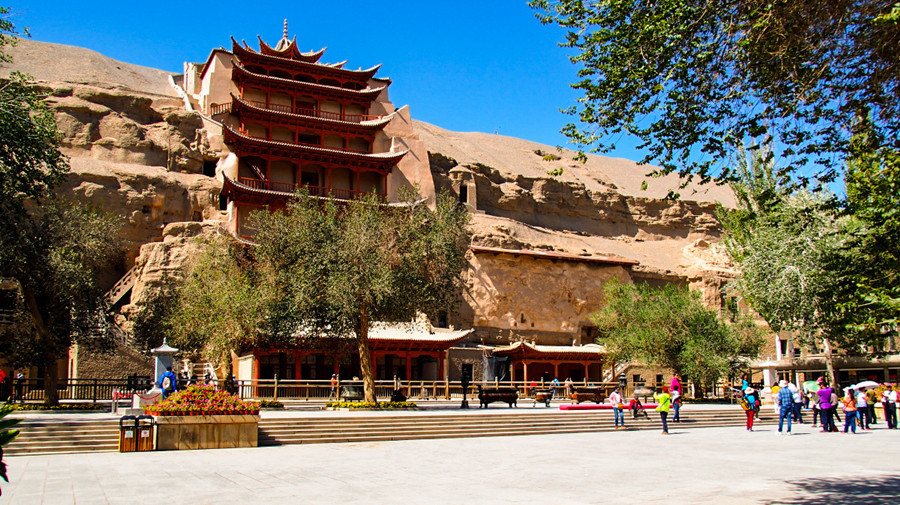 Mogao Caves entrance exterior
 Mogao Caves painted clay sculptures
The 735 Buddhist caves at Dunhuang (敦煌) hold 1,000 continuous years of religious art — some 45,000 square meters of murals, 2,400 painted clay sculptures, and the Library Cave's rediscovered manuscripts in Chinese, Tibetan, Sanskrit, Sogdian, and Old Uyghur that reshaped Silk Road scholarship after their 1900 discovery. UNESCO listed the site in 1987. Standard A-ticket visits cover 8 rotating caves in about 90 minutes with a licensed guide, preceded by two 20-minute films at the Digital Exhibition Center. Special caves (Cave 45 with its Tang Buddha ensemble, Cave 57 "the beauty cave," Cave 220, Cave 275, Cave 285 with Wei-dynasty flying-apsara murals) require additional on-site tickets and separate small-group access — buy at the "small archway" (小牌坊) window between 11:30 and 14:00 after your general tour.
Fact Panel:
- Location: 25 km (15.5 mi) southeast of Dunhuang city; the Digital Exhibition Center is your first stop before shuttle transfer to the cliffs
- Opening Hours: 08:00–18:00 (Apr–Nov peak) / 09:00–17:30 (Dec–Mar); closed briefly during major cave restoration
- Ticket: A-ticket ¥238 (~$33 USD) peak Apr 1–Nov 30 / ¥140 (~$20 USD) off-peak; B-ticket ¥100 (~$14 USD) peak / ¥50 (~$7 USD) off-peak; C-ticket (Digital Center + 4 caves) ¥120 (~$17 USD); special caves ¥150–200 (~$21–28 USD) each
- Best Time to Visit: First 08:30 batch — cooler in the caves, shorter special-cave queues at midday; September and October for the best weather window
- Booking: A-tickets released 30 days ahead at 07:00 Beijing time on the official mini-program; peak-season A-tickets cap at 6,000/day and sell out in minutes. Foreign passport holders can bypass the online queue and buy on-site.
- Time On-Site: 3.5–4 hours (Digital Center + shuttle + guided cave tour); add 1–2 hours for special caves
- Why It's Worth It: The single most important artifact of the Silk Road — Central Asian, Chinese, Tibetan, and Indian artistic traditions layered across a millennium in one continuous cliff face
8. Crescent Lake and Mingsha Mountain (月牙泉 & 鸣沙山)
 The Crescent Moon Spring in Dunhuang
 choing-Sand Mountain, Mingsha Shan
A crescent-shaped freshwater spring survives at the base of 100 m (328 ft) sand dunes 6 km (3.7 mi) south of Dunhuang town, an oasis-in-desert scene that has persisted for over 2,000 years. Climb the sand ridge for the sunset view — roughly 40 minutes up on the wooden-ladder track, sand-board down in 90 seconds, camel-back return across the flats. Options on-site include paragliding, dune-buggy rides, and stargazing tours after full dark; the park ticket is valid for three consecutive days with unlimited re-entry, so most visitors combine a sunset visit with a 05:30 sunrise return.
Fact Panel:
- Location: 6 km (3.7 mi) south of central Dunhuang; taxi or e-bike easy from town
- Opening Hours: 05:30–21:00 (May–Sep) / 06:30–19:30 (Oct–Apr); night-tour extensions in peak summer
- Ticket: ¥110 (~$15 USD) valid 3 consecutive days with re-entry; camel ride ¥100 (~$14 USD); sand-boarding ¥15 (~$2 USD); electric shuttle ¥20 (~$3 USD)
- Best Time to Visit: 05:30 opening for sunrise + morning mist over the spring, OR arrive 18:00 for the sunset climb; avoid 12:00–16:00 when sand surface hits 60°C (140°F)
- Time On-Site: 2–3 hours for one visit; 5–6 hours if you split sunrise and sunset across two entries
- Why It's Worth It: The signature desert-oasis image of Silk Road China, and one of the few sights where the ticket buys three visits so you can experience it in three different lights
9. Yardan National Geopark (雅丹国家地质公园)
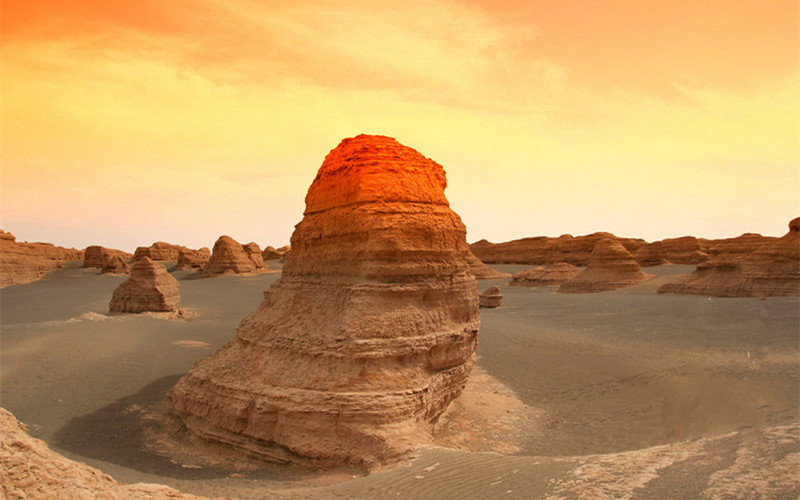 Yardang National Geopark in Dunhuang
 Yardang National Geopark in Dunhuang
Wind-eroded sandstone formations across 400 km² (154 sq mi) of Gobi desert 180 km (112 mi) northwest of Dunhuang town. Also called the Ghost City (魔鬼城) for the eerie sounds the wind makes as it channels through the yardang ridges, the park's formations have been nicknamed after ships, castles, camels, sphinxes, and mythical fleets. The mandatory shuttle covers a fixed loop with four numbered stops; the "Western Sea Fleet" (西海舰队) formation at Stop 3 is the most-photographed. Combine with a visit to Yumen Pass (玉门关) — the Han-dynasty jade-trade customs gate, its rammed-earth walls still standing after 2,100 years — which sits on the same access road.
Fact Panel:
- Location: 180 km (112 mi) northwest of Dunhuang; 2 to 2.5 hours each way on Highway S314
- Opening Hours: 06:30–18:00 (Apr–Oct) / 08:00–18:00 (Nov–Mar); last shuttle boards 3 hours before close
- Ticket: ¥50 (~$7 USD) entry + ¥70 (~$10 USD) mandatory park shuttle; sunset small-vehicle upgrade ¥199 (~$28 USD); combined with Yumen Pass ¥40 (~$5.60 USD)
- Best Time to Visit: Late afternoon into sunset for the golden light on yardang ridges; avoid midday for heat and flat lighting
- Time On-Site: 3–4 hours for the standard shuttle loop; full day when combined with Yumen Pass and the adjacent Han Great Wall (汉长城) ruins
- Why It's Worth It: The most surreal desert landscape on the Chinese Silk Road, and — combined with Yumen Pass — a full afternoon of Han-dynasty frontier atmosphere
Skip the Silk Road Heritage City (丝路遗产城) replica 40 km east of Dunhuang. Its "photo-friendly Gobi" set is a modern reconstruction with no historical foundation, and the ¥60–80 entry plus shuttle fee buys backdrops, not heritage. If a Mogao ticket falls through, the real alternative is the Dunhuang salt-tower solar power station — thousands of heliostat mirrors tracking the sun in the desert, a genuinely striking sight and free to observe from the perimeter.
Dunhuang city tour with Mogao, Crescent Lake and Yardan
Eastern Xinjiang — Turpan and Urumqi Gateway
Turpan (吐鲁番) sits at 154 m (505 ft) below sea level, the second-lowest basin on Earth after the Dead Sea, and functioned for 1,500 years as the eastern Xinjiang trading hub — the first oasis caravans reached after crossing the desert corridor from Dunhuang. Four attractions cluster in the Turpan basin, plus one alpine escape north of Urumqi (乌鲁木齐).
 Ancient City of Jiaohe Ruins
 Karez underwater System
10. Jiaohe Ruins (交河故城)
The best-preserved earthen city ruin on the Silk Road, and a UNESCO World Heritage site since 2014. Built by the Jushi (车师) kingdom around the 2nd century BCE on a leaf-shaped plateau between two river gorges — the natural cliff walls served as fortification — Jiaohe reached its peak under Tang-dynasty administration when the Anxi Protectorate governed the Western Regions from here. Streets, temples, monastic cells, residential quarters, official buildings, and a stupa forest remain visible in the packed loess earth after 1,500 years of abandonment. The layout follows a north-south axis with the temple district at the north end and the residential streets carved directly into the earth below street level. No shops or shade inside the site; ground temperatures hit 60°C (140°F) in summer.
Fact Panel:
- Location: 10 km (6.2 mi) west of Turpan city center; ~15 min by taxi
- Opening Hours: 08:00–20:30 (Apr–Oct) / 09:00–18:30 (Nov–Mar); last entry 1 hour before close
- Ticket: ¥70 (~$10 USD) peak / ¥40 (~$5.60 USD) off-peak; internal shuttle ¥5 (~$0.70 USD) for the 800 m access path
- Best Time to Visit: Before 09:00 or after 16:00 to avoid extreme heat; sunset gives the earthen walls a warm-red glow
- Time On-Site: 2–3 hours to walk the full north-south axis
- Access Note: The Anxi Protectorate core section is currently closed for restoration (see 2026 warning below)
- Why It's Worth It: The only surviving intact earthen Silk Road city, and the tangible ruin of the Tang-dynasty administrative center for all of Xinjiang
11. Karez Well System (坎儿井)
A 2,000-year-old underground irrigation network of vertical shafts and horizontal tunnels that channels Tianshan snowmelt into the Turpan oasis without surface evaporation. Total tunnel length across the greater Turpan basin exceeds 5,000 km (3,107 mi) — considered a hydraulic engineering feat comparable to the Great Wall or the Grand Canal. The Karez Museum and Demonstration Site outside town shows a cross-section with English signage, an underground walking tunnel where you can feel the temperature drop, and a small vineyard irrigated by an active karez channel. The working system still supplies parts of Turpan's agriculture today, including the raisin production the region is famous for.
Fact Panel:
- Location: 5 km (3.1 mi) west of Turpan city center on the way to Jiaohe; usually combined
- Opening Hours: 08:30–20:30 (Apr–Oct) / 09:30–18:30 (Nov–Mar)
- Ticket: ¥40 (~$5.60 USD) peak / ¥20 (~$2.80 USD) off-peak
- Best Time to Visit: Midday — the underground tunnel is 15°C (59°F) cooler than the surface, offering a heat break between other Turpan sites
- Time On-Site: 60–90 minutes
- Why It's Worth It: The engineering explanation for how Silk Road oasis civilizations existed at all in a basin that gets 16 mm (0.6 in) of rainfall a year
 Turpan Flaming Mountains Journey to the West
 Heavenly Lake of Tianshan in Xinjiang
12. Flaming Mountains (火焰山)
The 100 km (62 mi) east-west ridge of iron-oxide-red sandstone made famous by the 16th-century Ming novel Journey to the West (西游记), which describes the Monkey King borrowing an iron fan to cool the peaks so Xuanzang could pass. The mountains really do look ablaze at midday — surface temperatures peak at 66–89°C (151–192°F), the hottest recorded in China. The main visitor complex 40 km (25 mi) east of Turpan houses a 12 m (39 ft) gilded thermometer that displays real-time ground temperature, a Journey to the West sculpture park, and observation platforms. Best photographed as a drive-by on the way to Bezeklik Thousand Buddha Caves and Gaochang Ancient City — the whole ridge is visible from Highway G30.
Fact Panel:
- Location: 40 km (25 mi) east of Turpan city; visible from Highway G30 en route to Bezeklik/Gaochang
- Opening Hours: 08:00–21:00 (May–Sep) / 09:00–19:00 (Oct–Apr)
- Ticket: ¥40 (~$5.60 USD) for the main visitor complex with observation platform
- Best Time to Visit: Midday (12:00–15:00) for peak temperature reading on the thermometer and the strongest red-orange color; also the hottest moment to be outside
- Time On-Site: 60–90 minutes at the visitor complex; roadside photo stops are free
- Why It's Worth It: Journey to the West is one of the four classic Chinese novels; standing at the actual mountains it made famous is a cultural bucket-list moment
13. Heavenly Lake of Tianshan (天池)
A crescent-shaped alpine lake at 1,910 m (6,266 ft) elevation beneath Bogda Peak (5,445 m / 17,864 ft), formed by ancient glacial moraine 98 km (61 mi) northeast of Urumqi. UNESCO World Heritage since 2013 as part of the Xinjiang Tianshan property. The lake water is glacier-melt clear, ringed by spruce forest, and holds temperature at 10–15°C (50–59°F) even in mid-summer — a genuine escape from the Turpan basin heat 300 km (186 mi) south. Kazakh yurts line the eastern shore where seasonal herders and their goat and horse flocks graze the meadows. The park operates on a mandatory shuttle system from the base visitor center; boats circle the lake in summer.
Fact Panel:
- Location: 98 km (61 mi) northeast of Urumqi in Fukang City; ~2 hours by shuttle from Urumqi
- Opening Hours: 08:30–19:30 (Apr 20–Oct 20 peak) / 09:00–18:00 (Oct 21–Apr 19 off-peak); some winter closures during heavy snow
- Ticket: ¥95 (~$13 USD) entry + ¥90 (~$13 USD) mandatory shuttle peak / ¥45 entry + ¥60 shuttle off-peak (~$15 USD combined); boat cruise ¥60–160 (~$8–22 USD) optional
- Best Time to Visit: June through September for the greenest meadows and warmest lakeside conditions; frozen lake in winter for a different aesthetic
- Time On-Site: 4–5 hours minimum with shuttle transit; full day for lake walk + optional boat
- Why It's Worth It: The most accessible alpine lake in the Xinjiang Silk Road orbit and the natural counterweight to the Turpan desert heat — most itineraries pair them back-to-back for the contrast
As of mid-2026, the Anxi Protectorate core section of Jiaohe Ruins is closed for restoration — visitors can only view it from the outer observation platform, so the classic "ruined city with snow-mountain backdrop" shot from inside the ancient office complex is currently unavailable. Gaochang Ancient City (高昌故城) shuttle buses also run on a fill-the-car system, so groups may be rushed. Build in extra visit time.
Full Xinjiang panorama covering all eastern and western attractions
Tour Route:Urumqi-Kanas Lake-Karamay-Aksu-Kashgar-Korla-Turpan
23 Days 10 Places View DetailKashgar — the Western Terminus
The bass thump of a doira (frame drum) rolls out of a courtyard doorway as bakers slap naan dough against clay tandirs and the smell of cumin lamb drifts through the alleys. Kashgar (喀什) is 4,400 km (2,734 mi) from Beijing and closer to Baghdad than to Shanghai — the westernmost city in China and the historical hinge of the Silk Road's Central Asian arm. Three essential sights anchor the city.
 Kashgar Old Town
 Id Kah Mosque
14. Kashgar Old Town (喀什老城)
The largest surviving Uyghur old town in China — 8 km² (3.1 sq mi) of mud-brick houses, courtyards, tandoor bakeries, blacksmith workshops, hat shops, copper studios, and mosque squares that have functioned as continuously inhabited urban fabric for over 2,000 years. The Old Town divides sharply into two halves: the reconstructed street-front sections rebuilt after 2010 (Ostangboyi Chaykhana Street, the main tourist-facing streets around the central square) are photogenic but heavily commercialized; the genuine living quarters run through the back alleys east and south of the central mosque, where families still live in courtyard homes, children play in the lanes, and the tandoor smoke rises at 06:00. The Yaso Trip approach is to skip the reconstructed street and walk directly to the back alleys — follow the smell of baking naan.
Fact Panel:
- Location: Central Kashgar; the main entry is Ostangboyi Chaykhana Street opposite Id Kah Mosque
- Opening Hours: Open 24 hours (public streets); bazaars and workshops active roughly 09:00–20:00; morning bakery activity peaks 06:00–09:00
- Ticket: Free entry for streets and public spaces; some restored courtyard houses charge ¥15–30 (~$2–4 USD) for interior visits
- Best Time to Visit: Early morning (06:00–09:00) for tandoor baking and unfiltered daily rhythm; late afternoon for coppersmith and hat-shop activity; evening for street food
- Time On-Site: 3–4 hours minimum to walk both the front and back quarters
- Why It's Worth It: The most intact traditional Uyghur urban environment in the world, and the single most defining cultural experience of the western Silk Road
15. Id Kah Mosque (艾提尕尔清真寺)
The largest mosque in China, first built in 1442 by Saqsiz Mirza and expanded repeatedly through the 17th and 19th centuries to its current 16,800 m² (180,833 sq ft) footprint. The mosque holds up to 20,000 worshippers for Friday prayers and Eid gatherings, and its yellow-tiled prayer hall, courtyard gardens, and 12 m (39 ft) tall Arabic-inscription entry gate anchor the central Kashgar city square. The square itself functions as the social center of the old town — locals sit on the benches, children feed pigeons, and street vendors sell watermelon and yogurt drinks in summer. Non-Muslim visitors welcome outside the five daily prayer times; dress modestly (shoulders, chest, and knees covered), and women should carry a scarf for the prayer hall.
Fact Panel:
- Location: Central Kashgar's Id Kah Square, directly across from the Old Town entrance
- Opening Hours: 10:00–19:00 for tourist visits, closed during the five daily prayer times (roughly 05:30, 13:00, 17:00, 19:30, 21:30 — check locally as times shift by season)
- Ticket: ¥45 (~$6.30 USD) for non-Muslim visitors; free for Muslim worshippers
- Best Time to Visit: Non-prayer hours mid-morning or late afternoon; Fridays exceptionally busy — avoid unless you plan to observe (respectfully, from outside) the noon congregation gathering
- Time On-Site: 60–90 minutes for the mosque plus square
- Why It's Worth It: The largest and oldest continuously functioning mosque in China, and the physical heart of Kashgar's civic life
16. Kashgar Sunday Livestock Bazaar (喀什牛羊大巴扎)
 Kashgar Sunday Bazaar Uyghur culture
 Grand Sunday Bazaar in Kashgar
Sundays only, and unlike anything else in modern China. Kyrgyz, Tajik, Uyghur, and Kazakh herders drive sheep, cattle, camels, horses, and donkeys to a walled market 12 km (7.5 mi) east of central Kashgar for cash trading that has continued unchanged for over 1,000 years. Buyers inspect teeth, feel muscle tone, and haggle prices with hand gestures over animals that outnumber humans two-to-one at peak. Adjacent stalls sell tack, saddles, hand tools, rope, and butchering knives; food stands serve lamb polo (抓饭), naan, and the biggest baked samsa (烤包子) in western China. The scene disperses by mid-afternoon — livestock loaded onto small trucks or led home along the shoulder of the highway.
Fact Panel:
- Location: 12 km (7.5 mi) east of central Kashgar in Aizrait Township (艾孜热特乡); ~25 min by taxi
- Opening Hours: Sundays only, roughly 10:00–20:00; peak activity 11:00–14:00
- Ticket: Free entry
- Best Time to Visit: Arrive 11:00 (livestock still assembling before then; scene disperses after 14:00)
- What to Bring: Dark clothing (dust and animal residue), mask if sensitive to smell, cash in ¥1–20 notes for food stalls, closed shoes
- Photography Rules: Ask before photographing individuals; drones prohibited inside the market perimeter
- Time On-Site: 2–3 hours
- Why It's Worth It: The only weekly livestock bazaar of its historical scale still operating in China, and by consensus of returning Yaso Trip clients, the single most memorable single-scene attraction on the entire Silk Road
In Kashgar and along tour routes into Central Asia, avoid unbranded "silk factories," "jade workshops," and "ethnic culture centers" that pressure visitors into high-markup purchases. Low-budget package tours often route through these operations for kickback commissions. Buy silk and jade at established supermarkets or the main Grand Bazaar with published prices; anything sold through a "cultural" walk-through is marked up several multiples.
Kashgar in-depth tour with Old Town, Bazaar and Karakul Lake
Deep Xinjiang — Pamir, Northern Alpine, and the Desert Highway
The corridor's deepest sights sit beyond Kashgar and Urumqi — the alpine north, the Pamir west, and the desert-highway south. Two attractions here consistently rank among returning clients' favorites, plus one driving experience that reframes the entire idea of what a "Silk Road attraction" is.
17. Karakul Lake (喀拉库勒湖)
 Karakul Lake Muztagh Ata Pamir
 Cyclist on Karakul Lake Muztagh Ata
At 3,600 m (11,811 ft) on the Pamir Plateau, Karakul reflects the twin peaks of Muztagh Ata (慕士塔格峰, 7,509 m / 24,636 ft) — the "Father of Ice Mountains" — and Kongur Tagh (公格尔峰, 7,649 m / 25,095 ft) in a glacier-fed lake that shifts from turquoise at midday to indigo at dusk to jet-black under starlight. Reached along the Karakoram Highway (中巴公路, China–Pakistan Friendship Highway) south from Kashgar, a 4-hour drive each way through the Ghez Canyon (盖孜大峡谷) where the road cuts through 500 m (1,640 ft) red-sandstone cliffs. Kyrgyz families run traditional yurts on the eastern shore — overnight here to catch both the pre-dawn stillness (windless, mirror reflection of Muztagh Ata) and the sunset "golden mountain" alpenglow. The Pamir altitude is genuinely high; carry water and expect mild breathlessness on arrival.
Fact Panel:
- Location: Akto County, 200 km (124 mi) south of Kashgar along the Karakoram Highway (G314)
- Opening Hours: 24 hours (scenic area free-flow); yurt camps operate roughly May 1–October 15
- Ticket: ¥50 (~$7 USD) scenic area fee; yurt overnight approximately ¥150–300 (~$21–42 USD) per person with dinner and breakfast
- Best Time to Visit: June through September; the road may close for snow other months. Best photography 06:00–09:00 for mirror reflections, 18:00–20:00 for golden hour on Muztagh Ata
- Time On-Site: Overnight strongly recommended (single-day round-trip from Kashgar is exhausting and misses the light)
- Access & Permits: Passport-only access to Karakul Lake itself; onward travel to Tashkurgan (塔什库尔干) for the Stone Fortress or the Khunjerab Pass border requires a Border Management Area Permit applied for in person at a county-level Public Security office — plan 2–3 days lead time
- Altitude Note: 3,600 m is high enough to cause mild altitude symptoms; skip if you have unmanaged cardiovascular conditions
- Why It's Worth It: The single most spectacular alpine-lake reflection scene on the Silk Road, and the closest most travelers will physically get to the Pakistan border and the historical Silk Road branch into Central Asia
18. Kanas Lake and Hemu Village (喀纳斯 & 禾木)
 Kanas Lake autumn golden birch forest
 Hemu Village traditional log cabins Altai
Northern Xinjiang's flagship — a 24 km (15 mi) alpine lake of legendary color-changing water in a Tuvan-inhabited forest valley near the Kazakh, Russian, and Mongolian borders. The lake sits at 1,375 m (4,511 ft) elevation among the Altai Mountains (阿尔泰山), rimmed by Siberian spruce and larch that turn brilliant gold in late September through early October. Hemu Village (禾木), 60 km (37 mi) southeast of the lake, is the neighboring cluster of Tuvan log cabins whose morning mist rising through the pines is the region's most-photographed scene — the standard ritual is to hike or shuttle up to the "Sunrise Photography Platform" (禾木晨曦观景台) before 06:00. Plan two days minimum, three ideally, to properly cover the lake's viewing platforms (Guanyu Pavilion 观鱼台, Moon Bend 月亮湾, Fairy Bay 神仙湾, Wolong Bay 卧龙湾) plus Hemu.
Fact Panel:
- Location: Burqin County, Altay Prefecture; access via Burqin town (~800 km / 500 mi / 8–10 hour drive from Urumqi) or Kanas Airport for seasonal flights
- Opening Hours: Kanas scenic area 07:00–20:00 (May–Oct peak) / 09:00–18:00 (Nov–Apr, limited access); Hemu 24-hour village access
- Ticket: Kanas ¥185 (~$26 USD) peak / ¥90 (~$13 USD) off-peak entry + ¥120 (~$17 USD) mandatory interior shuttle; Hemu ¥60 (~$8.40 USD) entry + ¥100 (~$14 USD) shuttle; boat cruise on Kanas Lake ¥120 (~$17 USD) optional
- Best Time to Visit: Mid-September to early October for the golden birch and spruce color; June through August for wildflowers and long daylight; closed or severely limited December through April
- Time On-Site: Kanas 1.5–2 days; Hemu 1 additional day; combined itinerary 3 days minimum
- Getting There: Fly Urumqi → Kanas Airport (季节性航班, May–Oct only) to skip the long drive; otherwise via Burqin
- Why It's Worth It: The most dramatic alpine scenery in Chinese Xinjiang, and the only place on the Silk Road corridor where the landscape reads as boreal-northern rather than desert or oasis — a full contrast to everything south of Urumqi
Bonus mention — the Taklamakan Desert Highway (塔克拉玛干沙漠公路). The 522 km (324 mi) north-south highway across China's largest sand desert is not a single "attraction" but a driving experience — 12 hours of shifting sand dunes, roadside diversifolious poplar groves (胡杨林) that turn gold in late October, small oases with karez-fed melon fields, and the ancient Qiuci (龟兹) Buddhist ruins at Kuqa. The highway crosses the Tarim Basin from Luntai (轮台) in the north to Minfeng (民丰) in the south; a well-maintained straw-grid stabilization system holds the shifting dunes back from the road. Access: part of a longer Southern Xinjiang itinerary, not a day trip. Free — no entry fee, only the fuel and time.
Northern Xinjiang panorama photography tour
Tour Route:Urumqi-Kanas Lake-Karamay-Turpan-Heavenly Lake (Tianchi) in Xinjiang-Urumqi
13 Days 6 Places View DetailSouthern Xinjiang and Taklamakan Desert Highway adventure
Tour Route:Urumqi-Turpan-Korla-Ye'erqianghan Mausoleum in Yarkant County, Kashgar-Kashgar
12 Days 6 Places View DetailHidden Gems
 Yulin Caves in Dunhuang
 Suoyang City Ruins in Dunhuang
Yulin Caves (榆林窟) — Mogao's sister site with roughly one-tenth of the crowds and, arguably, better on-site interpretation.
- Location: Guazhou County, 170 km (106 mi) east of Dunhuang; ~2.5 hours by charter
- Opening Hours: 09:00–17:00 (Apr–Oct) / 09:30–16:30 (Nov–Mar)
- Ticket: ¥55 (~$7.70 USD) standard + ¥100–500 (~$14–70 USD) per special cave
- What to See: The Western Xia murals in Cave 3 (Thousand-Hand Guanyin, 千手观音) and Cave 2 (Water-Moon Guanyin, 水月观音) are peak-tier Silk Road Buddhist art; special-cave tours run a full hour with a specialist guide
- Combine With: Suoyang City ruins and Xuanquan Postal Station for a full-day charter loop from Dunhuang
Suoyang City Ruins (锁阳城遗址) — a Tang-dynasty frontier city Xuanzang passed through on his westward pilgrimage.
- Location: Guazhou County, ~90 km (56 mi) east of Dunhuang
- Opening Hours: 08:30–18:00 (May–Oct) / 09:00–17:00 (Nov–Apr)
- Ticket: ¥70 (~$10 USD) including internal shuttle
- What to See: Weathered rammed-earth walls, pagoda foundations, and the ruined Tar Temple (塔尔寺) in an empty Gobi setting that delivers the frontier atmosphere reconstructed sites cannot
- Time On-Site: 2 hours
Xuanquan Postal Station (悬泉置遗址) — the Han-dynasty imperial postal relay featured in the opening episode of the documentary Hexi Corridor (河西走廊).
- Location: Guazhou County, ~64 km (40 mi) east of Dunhuang
- Opening Hours: 09:00–17:00; recently opened to the public
- Ticket: Approximately ¥50 (~$7 USD); site + small museum
- What to See: Excavated bamboo-slip records (30,000+ pieces found on-site — one of the largest Han-dynasty document caches in China), the postal-station foundations, and a compact museum with English signage
- Time On-Site: 2.5 hours with museum
Subashi Buddhist Ruins (苏巴什佛寺遗址) — where Xuanzang studied and preached in the 7th century at an ancient Qiuci royal temple.
- Location: Kuqa County (库车), ~23 km (14 mi) north of Kuqa town
- Opening Hours: 09:00–18:30 (Apr–Oct) / 10:00–17:30 (Nov–Mar)
- Ticket: ¥55 (~$7.70 USD)
- What to See: Remaining pagoda bases, monastic residence walls, and the desert setting at the edge of the Tianshan foothills — more original and less trafficked than Turpan's Jiaohe
- Time On-Site: 90 minutes; combine with Kizil Grottoes (克孜尔千佛洞) for a full Kuqa day
Sister tip — three free "wild" ruins. Yemawan Fortress at Jiayuguan (野麻湾堡, a Ming defensive outpost, no ticket), Six-Workers City at Guazhou (六工城, Han–Tang ruins), and the bypass road around Dunhuang's Yardan geopark (yardang landforms visible from public road, no entry fee) all reward travelers who ask their driver to detour.
Sample Itinerary — 12-Day Attractions Route
12-Day Silk Road Essential Attractions Itinerary
Day 1
Arrive Xi'an
Fly into Xi'an (XIY); evening walk of the Muslim Quarter for roujiamo and lamb skewers.
Day 2
Terracotta Warriors + City Wall
Morning at the Terracotta Warriors pits; afternoon cycling loop on the Ancient City Wall.
Day 3
Fly Xi'an to Lanzhou; Bingling boat
Morning flight; afternoon Yellow River boat to Bingling Temple Grottoes.
Day 4
Lanzhou to Zhangye + Danxia sunset
High-speed train to Zhangye; late-afternoon shuttle to Danxia for sunset at Platform 4.
Day 5
Mati Temple; drive to Jiayuguan
Morning at Mati Temple cliff caves; afternoon drive to Jiayuguan.
Day 6
Jiayuguan Pass; drive to Dunhuang
Morning at Jiayuguan fortress and Overhanging Wall; afternoon drive to Dunhuang.
Day 7
Yulin Caves + Suoyang City
Full-day charter east to hidden-gem sites; return to Dunhuang for dinner.
Day 8
Mogao Caves + Mingsha sunset
Morning Mogao (booked A-tickets); evening Crescent Lake and Mingsha sand dunes at sunset.
Day 9
Fly Dunhuang to Turpan; Karez
Morning flight via Liuyuan train to Turpan; afternoon Karez Well System and Emin Minaret.
Day 10
Jiaohe + Flaming Mountains
Early-morning Jiaohe (beat the heat); midday Flaming Mountains drive; evening train to Urumqi.
Day 11
Heavenly Lake; fly to Kashgar
Morning at Heavenly Lake; afternoon flight to Kashgar.
Day 12
Old Town + Sunday Bazaar
If Sunday: livestock bazaar 11:00–14:00 plus Old Town in afternoon. Otherwise: Id Kah Mosque, Old Town, evening departure.
Extend three days to add Karakul Lake and Tashkurgan, or seven days to add Kanas Lake and Hemu Village in Northern Xinjiang.
Alternative — the same attractions by high-speed train (no long drives)
Tour Route:Lanzhou-Zhangye-Jiayuguan-Dunhuang-Turpan-Urumqi
10 Days 9 Places View DetailPractical Logistics for the 2026 Silk Road Traveler
Booking Ahead: What Requires It, What Doesn't
Only two of the 18 attractions genuinely require booking weeks ahead:
- Mogao Caves: A-tickets are capped at 6,000 per day in peak season (April–November), released 30 days in advance at 07:00 Beijing time on the official "Mogao Caves Booking" (莫高窟参观预约网) mini-program. They sell out within minutes. Foreign passport holders skip this queue — they can buy A-tickets at the on-site window without pre-booking. If your ID is a Chinese national ID, either book at 07:00 exactly 30 days out, or check the mini-program at 15-minute intervals around each hour for released returns (11:45–12:15 is a documented sweet spot). B-tickets (12,000/day, released 10 days ahead) are the fallback.
- Kashgar Sunday Livestock Bazaar: not "booking" per se, but the market runs Sundays only. Plan your Kashgar leg to include a Sunday.
Everything else — Danxia, Jiayuguan, Terracotta Warriors, Crescent Lake, Kashgar Old Town — accepts walk-up entry with same-day ticketing.
Best Time and Timing per Attraction
Attraction-Specific Timing
Permits and Access Restrictions (as of July 2026)
- No permits required for foreign visitors at any of the 18 attractions on this list, with two exceptions below.
- Border Management Area Permit required for Bayinbuluk Grassland and points beyond Tashkurgan on the Karakoram Highway. Kashgar city and Karakul Lake itself are accessible with passport only. Onward travel to Tashkurgan (for the Stone Fortress) or the Khunjerab Pass border requires the permit — applied for in person at a county-level public-security office, not online.
- Qinghai-Gansu Grand Loop restrictions: Delingha (德令哈), Da Qaidam (大柴旦), Hoh Xil (可可西里), and Halahu (哈拉湖) currently do not accept foreign visitors. For Mangnai (茫崖) — including the Emerald Lakes and Black Solitary Mountain — foreign visitors must contact Mangnai Public Security by phone in advance and confirm foreigner-permitted accommodation. This affects itineraries that combine the Silk Road with Qinghai.
Getting There
Every attraction on this list connects by a mix of high-speed rail, domestic flights, and highway. For the interconnection logic and station-by-station breakdown, see our Silk Road transportation guide . For the map view of how the attractions relate geographically, see the Silk Road map and route options guide .
What to Pack for the Attractions Specifically
- Water and salt tablets for Jiaohe, Yardan, and any Turpan or Dunhuang summer visit.
- Sun protection — the Gobi UV index reaches 11+ in summer; hat, long sleeves, and SPF 50+ are non-negotiable.
- Layered clothing for Karakul Lake and Heavenly Lake — alpine temperatures drop to 5°C (41°F) at night even in July.
- Cash in small denominations for Kashgar Sunday Bazaar (many stalls are cash-only) and rural Gansu ruins.
- Modest dress for Id Kah Mosque and Abakh Hoja Tomb — shoulders and knees covered, women bring a headscarf.
- Registered drone with UOM ID if flying — see 2026 rules below. Do not bring a drone if you plan to visit border areas around Karakul or Kanas.
Tips & Cautions
- Verify your Mogao ticket type before travel. A-tickets include 8 general caves plus the digital theater; B-tickets skip the film and cover fewer caves. Special caves (¥150–200 each) are purchased separately on-site.
- Bring a paper backup of your passport and visa. Xinjiang and border-zone hotels check documents rigorously; a phone-battery failure at the wrong moment causes real friction.
- Ask permission before photographing people, especially at Kashgar Sunday Bazaar and in the Uyghur old town. Silent nod-and-gesture is fine; camera-in-face is not.
- Do not skip the Gansu Provincial Museum in Lanzhou if your route passes through. It holds the Han-dynasty Flying Horse of Wuwei (马踏飞燕), the national tourism logo, plus the strongest single collection of Hexi Corridor artifacts.
- The Silk Road Museum in Xi'an is worth an afternoon before flying west — it frames the entire corridor's history in a way that makes every subsequent attraction hit harder.
As of May 1, 2026, all newly manufactured drones must be registered in the UOM (无人机综合监管平台) real-name system before flight; existing drones had to be registered by June 1. From November 1, 2026, drones must broadcast a Remote ID signal. Recreational flights under 120 m (394 ft) in general airspace do not require a pilot license, but scenic areas including Nalati (那拉提) and Sayram Lake (赛里木湖) still require pre-registration at UOM or the local police station. Border-zone areas within 10 km (6.2 mi) and airport perimeters are strict no-fly zones — unregistered flights face fines up to ¥100,000 (~$14,000 USD) and administrative detention.
As of midnight July 30, 2026, the G30 highway sections from Xingxingxia (星星峡) to Hami (哈密) and Hami to Tuyugou (吐峪沟) are officially tolled after years of free operation. Class-1 passenger cars pay approximately ¥0.453 per km. ETC-equipped vehicles pass automatically; others must collect a ticket at the toll gate. Self-drive travelers on the Silk Road should factor this into fuel and tolls budgets.
Why Travel the Silk Road Attractions With Yaso Trip
- A-ticket coordination for Mogao. For clients on Chinese passports, the team monitors the release window and books at 07:00 exactly 30 days ahead.
- Local ground teams in Kashgar and Urumqi. Bilingual Uyghur- and Kazakh-speaking staff based in Xinjiang, plus long-standing local-guide relationships in Dunhuang and Zhangye. This matters most at Sunday Bazaar and at ruins where interpretation makes the difference.
- Attraction-specific timing built into every itinerary. Zhangye Danxia scheduled for late afternoon, not midday. Mingsha for sunset. Jiaohe for early morning.
- Access-change monitoring. The 2026 changes above — Xingxingxia tolls, drone rules, Jiaohe restoration, Grand Loop foreign-visitor restrictions — are actively tracked and updated in itineraries rather than surfacing as day-of surprises.
Ready to Route the Attractions Into an Itinerary?
The 18 attractions above are the Silk Road spine. How you sequence them depends on which segments matter most, how many days you have, and whether you want the classic east-to-west drive, the high-speed train version, or the self-drive route. Send the itinerary preferences and travel window; the team will map your specific interests to a routing and provide an accurate cost breakdown tailored to your group size and dates.


 View All China Tours




 View All China Theme Tours by Interest


 Home


