Quick Answer: Where Should You Stay on China's Silk Road?
On the Chinese Silk Road, base yourself near each city's core transit or dining district — Bell Tower (Xi'an), Danghe River (Dunhuang), International Grand Bazaar (Urumqi), Old Town perimeter (Kashgar) — and stick to domestic 3-star-plus chain hotels or higher, which are set up to register foreign passports. Skip cheap county-town motels between big cities, and treat a desert-camp night as a one-time novelty, not a substitute for a real bed.
Key Takeaways
✔ Every hotel a foreign traveler stays in must register the guest with local police within 24 hours — big chains and 4-star-plus properties handle this routinely; small family guesthouses often do not.
✔ Since 2024, Chinese hotels have no legal basis to refuse foreign guests, but many county-town motels and Old-Town homestays still turn foreigners away in practice — a policy-vs-reality gap this guide explains how to work around.
✔ Domestic hotel brands (Atour 亚朵, Ji Hotel 全季, Holiday Inn Express 智选假日) are the safest choice in Zhangye, Jiayuguan, Turpan and Kashgar — their front desks know the foreign-passport registration workflow cold.
✔ In eight Silk Road cities — Xi'an, Lanzhou, Zhangye, Jiayuguan, Dunhuang, Turpan, Urumqi, Kashgar — there's a specific neighborhood or hotel cluster where Yaso Trip books foreign guests. This guide names them.
✔ The "sleep under the desert stars at Mingsha" experience competitors romanticize is more Instagram than comfort — foreigners consistently underestimate sand ingress, shared bathrooms, and cold-night gear needs.
✔ As of 2026, seven provinces (Hebei, Liaoning, Zhejiang, Hubei, Guangxi, Chongqing, Sichuan) now support online police registration via the 移民局12367 mini-program, sparing homestay guests the trip to a station.
✔ New boutique openings in 2025-2026 — Xi'an Shilla Monogram, Kashgar Silk Road Yueji (丝路有约), Dunhuang's desert-view boutique cluster, Zhangye Jinglong International — meaningfully upgrade the corridor's foreign-friendly options.
Book the flagship corridor tour
Tour Route:Beijing-Xian-Lanzhou-Wuwei-Zhangye-Jiayuguan-Dunhuang-Turpan-Urumqi-Kashgar-Shanghai
 19 Days
 13 Places
This guide names those neighborhoods and properties, explains the foreign-guest registration rule that shapes every booking decision, and gives an honest verdict on the desert-camp experience competitors love to sell. For the sights the corridor is built around — Mogao Caves, Zhangye Danxia, Jiayuguan Fort, the Sunday Bazaar — see our top Silk Road attractions roundup.
Why Silk Road Accommodation Is Different
 Silk Road highway Hexi Corridor Gansu
 Dunhuang Silk Road hotel accommodation
The three questions foreign travelers ask us most often before a Silk Road trip are always the same. "Can I just book on Booking.com?" "Do I really need a hotel that accepts foreigners?" "If I stay in a homestay, how do I do the police registration?" All three answers hinge on one system most guidebooks skip: China's foreign-guest hotel registration workflow.
Under Chinese law, every foreign visitor must be registered with local police within 24 hours of arrival at any accommodation. Large hotels handle this automatically through a networked terminal at the front desk — the guest scans a passport, the system pushes the record to the local station, and check-in continues. Small guesthouses, family homestays, and older county-town hotels often don't have that terminal, or have staff who've never used it. The Ministry of Public Security clarified in 2024 that hotels cannot refuse a foreign guest solely because they lack "涉外" (foreign-guest) qualification — but the practical reality is that a front desk clerk who doesn't know how to complete the registration will often invent a reason to turn you away rather than risk the paperwork.
That's the core problem. Solve for it — by booking the property types where the workflow is routine — and the rest of your Silk Road accommodation planning becomes normal travel planning.
The second reality is distance. Silk Road cities are strung 400–1,500 km (250–930 mi) apart — the transport logistics between corridor cities shape how many nights you'll actually spend in each place. Where you stay within each city matters less than in a compact European capital, because you're not walking between the airport, the museum, the food street, and the train station in one afternoon. What matters is proximity to the specific asset you're using each city for — the high-speed rail station if you're catching a 7 a.m. train onward, the Old Town if you're on foot for a full day, the Grand Bazaar for a single-night stopover before an early flight west.
City-by-City: Where to Stay on the Silk Road
Xi'an — Bell Tower & Zhonglou Metro Area
 Xi'an Bell Tower area
 Muslim Quarter street food stalls in Xi'an
Dusk falls behind the pagoda-shaped skyline of the Bell Tower and the illuminated Muslim Quarter alleys fill with the sizzle of charcoal-grilled lamb skewers. This is where you want to walk home to at 10 p.m. — not a suburban business district a taxi ride away.
Base yourself around Dachashi (大差市) or Bell Tower Metro Station. From here two subway lines converge, giving you fast access to the Terracotta Warriors airport-line transfer, Shaanxi History Museum, and Big Wild Goose Pagoda without a car. The area concentrates foreign-guest-qualified properties across every tier: the Jinjiang International (锦江国际) sits within walking distance of both the Bell Tower and Xi'an's dense evening food scene. New in 2026, Shilla Monogram Xi'an (Samsung's mid-luxury hotel brand's mainland debut, in the Gaoxin high-tech district) is worth considering if you don't mind a taxi ride for evenings out — front desk service is exceptional and rooms are new-build to international standards.
For families with a Silk Road World Amusement Park visit planned, the Roma Meisu (罗马美宿, opened June 2026) inside the park is a specialty option. For Xi'an's role as the ancient Silk Road's start and its Han Dynasty heritage sites, see our full Xi'an Silk Road travel guide.
Explore Xi'an as your Silk Road start city
Tour Route:Xian-Mount Huashan-Xian
Lanzhou — West Station & Zhongtianjian Plaza
The Yellow River (黄河) cuts through Lanzhou (兰州), and most travelers use the city as a transit day: fly in, eat one bowl of the definitive Lanzhou beef noodles (兰州牛肉面), catch the high-speed train onward to Zhangye or Dunhuang the next morning. For that pattern, stay near Lanzhou West Railway Station (兰州西站) or Zhongtianjian Plaza (中天健广场).
A property like the Holiday Inn Express Jianlan (建兰智选假日酒店) delivers the reliability that matters for a transit day: bilingual signage, a passport-registration workflow the staff know cold, a Western-style breakfast that ships you out the door by 7:30 a.m., and enough space to unpack for one night without unpacking your entire suitcase. Domestic chain brands like Atour (亚朵), Ji Hotel (全季), and Hanting (汉庭) all cluster in this area and all handle foreign guests without friction.
If your itinerary passes through Ningxia's Yinchuan on the way (or as an extension), stay near Yuehai Bay (阅海湾) or the city center — the Sheraton and Anmo Wild Luxury (安漠野奢) are the standouts for foreign clients. In Shapotou desert, the Shapotou S Tent Hotel (S帐篷酒店) is the honest desert-glamping upgrade if your itinerary includes a Yellow River bend stop.
 Shapotou S Tent Hotel Zhongwei
 Runhu Holiday Hotel Zhangye
Zhangye — Bell Tower & West High-Speed Rail Station
The colored ridgelines of Zhangye Danxia (张掖丹霞) sit an hour from town, and the classic play is to base in Zhangye city, day-trip to Danxia at sunset, and continue west to Jiayuguan or Dunhuang the following morning. That means proximity to two things: the evening food scene downtown, and the high-speed rail station for departure.
Stay around the Bell Tower (钟鼓楼) area or near Zhangye West Railway Station (张掖西站). A property like Runhu Holiday Hotel (润湖假日酒店) — mid-range domestic chain — sits in the food-and-shopping cluster and handles foreign guests without hesitation. Jinglong International Hotel (景珑国际酒店), a new 5-star that opened in 2026, meaningfully upgrades the top tier in Zhangye and is the current recommendation for foreign clients who want international-standard rooms and breakfast in this segment of the corridor. For a full walkthrough of the Gansu corridor between Lanzhou and Dunhuang, see our Gansu Silk Road guide.
Discover the Gansu Silk Road with Zhangye at its heart
Tour Route:Beijing-Lanzhou-Wuwei-Zhangye-Jiayuguan-Dunhuang-Beijing
 Zhangye Danxia landscape blue hour
 Yaso Silk road self driving tour in Jiayuguan
Jiayuguan — East Lake & Municipal Center
Jiayuguan (嘉峪关) is a small city organized around one thing: the Ming Dynasty fortress that marks the Great Wall's western end. Distances within the city are short, and hotel choice narrows to one question — which cluster has front desks that don't panic at a foreign passport.
Stay near East Lake (东湖) or the municipal government area. Domestic chain properties — a Hanting East Lake–Municipal Government branch (汉庭酒店东湖市政府店), for instance — deliver exactly what a one-or-two-night Jiayuguan stopover requires: fast check-in, breakfast open by 7 a.m., and a short taxi to the fortress gate. The area also has restaurants that stay open past 9 p.m. — a real consideration in a smaller corridor city.
Dunhuang — Shazhou Night Market & Danghe River Corridor
Dusk in Dunhuang has a specific choreography: the desert wind drops off around 6 p.m., a plume of charcoal smoke rises from the Shazhou Night Market (沙洲夜市), and the willow-lined Danghe (党河) promenade fills with the evening walk. Stay where you can join it on foot.
Base yourself along Shazhou Night Market or the Danghe Style Line (党河风情线). Foreign-friendly recommendations at the top tier are Shanhai International (山海国际酒店) and Grand Metropark (维景酒店). Both are domestic-chain 4-star or 5-star properties with front desks that register foreign passports as a matter of routine, and both put you a 5–10 minute walk from the night market and the river walk.
 Dunhuang Geyue Tingyuan Hotel
 Mogao Caves in Dunhuang, Gansu
Dunhuang boutique boom. A wave of new boutique properties opened in 2025-2026 specifically to serve travelers who want the desert view without sacrificing plumbing — Yazhi Hotel (Mogao Grotto branch, 雅致酒店莫高窟店), Geyue Hotel (戈樾酒店) facing the Mingsha dunes, Yinyue Yi (印玥驿) with private soaking pools, and Xiazhi (夏至) in Moroccan style. These are the current answer for guests who want "desert atmosphere" without actually sleeping in a tent.
For the true desert-side stay, the classic option remains Dunhuang Mountain Villa (敦煌山庄) on the edge of Mingsha Mountain — dune views from the room, full plumbing, air conditioning, and a working front desk. Skip the roadside camps, which we cover below. Our Dunhuang travel guide covers the Mogao Caves booking process and the Yardang and Yumen Pass day trips beyond the city.
Explore Dunhuang from a foreigner-friendly base
The "starlight tent" experience competitors sell as a Silk Road highlight often means: paint smell in a new-build tent, thin walls that transmit every campfire karaoke session until 11 p.m., a shared shower block that charges ¥15-30 (~$2-4 USD) per use, and a shuttle to the site that runs to somebody else's schedule. If you want the desert view, book Dunhuang Mountain Villa or one of the 2025-2026 boutique properties facing Mingsha. If you want a real camp night, we book Great Desert Long River Family Tent Hotel (大漠长河亲子帐篷酒店) — it has private bathrooms, 24-hour hot water, and air conditioning per tent, which is the honest minimum for "camping" to be enjoyable.
Turpan — City Center & North High-Speed Rail Station
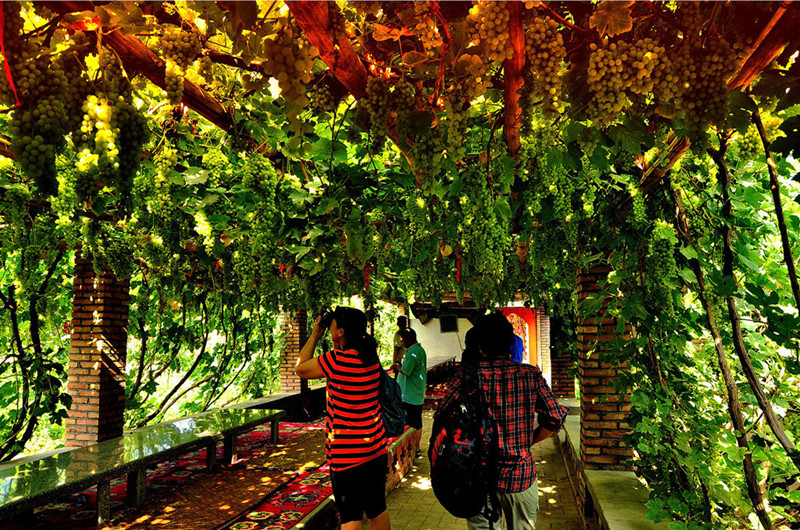
The Flaming Mountains (火焰山) glow orange at sunset and the Grape Valley (葡萄沟) delivers its shaded reprieve by mid-morning, but Turpan's baseline problem is heat — daytime highs of 40°C (104°F) are routine in July and August, and hotel choice comes down to reliable air conditioning.
Stay in the city center or near Turpan North Railway Station (吐鲁番北站). The high-speed rail station area is functional for one-night stopovers between Dunhuang and Urumqi; the city center works better if you're building in two full days for Jiaohe, Karez, Grape Valley, and Emin Minaret. Either way, choose a large domestic chain — Ji Hotel, Atour, or Hanting — which will have properly-sized AC units and a passport-registration workflow. Avoid remote homestays in surrounding grape villages; they're photogenic but the registration workflow is inconsistent and losing four hours to a front-desk problem in 40°C heat is a genuinely miserable travel day.
Explore Turpan and Urumqi together
Tour Route:Urumqi-Urumqi-Urumqi
5 Days 2 Places View Detail Xinjiang Urumqi International Grand Bazaar
 Turpan Flaming Mountains Journey to the West
Urumqi — International Grand Bazaar & South Gate
Urumqi (乌鲁木齐) is the modern hub of the western Silk Road — a 4-million-person city with an international airport, direct flights to Kashgar and Beijing, and the Xinjiang Regional Museum's Tarim mummies collection. Where you stay depends on why you're there: transit, or two days of city exploration.
Base yourself around the International Grand Bazaar (国际大巴扎) or South Gate (南门). This is the historic core and food scene — Uyghur restaurants, lamb-skewer streets, night markets — and the metro puts the airport and Xinjiang Museum within 30 minutes. Domestic 4-star-and-up chain hotels concentrate here and all handle foreign passports routinely. Our full Xinjiang travel guide covers the Urumqi–Turpan–Kashgar triangle and the northern extensions to Kanas and Ili.
The Xinjiang comprehensive tour flagship
Tour Route:Urumqi-Kanas Lake-Karamay-Aksu-Kashgar-Korla-Turpan
23 Days 10 Places View DetailIf your itinerary continues north to Kanas Lake or Yining, note that Yining Intercontinental (伊宁洲际酒店), opened in July 2025, is IHG's first Xinjiang property and now the standard for that side trip.
Kashgar — Old Town Perimeter, Not Inside
The old city's mud-brick alleys, coppersmiths' hammering, and 500-year-old Id Kah Mosque (艾提尕尔清真寺) are the emotional climax of a Silk Road trip. Where you sleep determines whether you actually enjoy them.
Base yourself on the Old Town perimeter or at its main entrance — properties like Lechang Hotel (丽呈酒店). This positioning lets you step out the door and into the Old Town on foot for a full day of exploration, while sleeping in a hotel with a functioning shower, English-capable staff, and a properly registered check-in.
What we do not recommend for foreign guests: deep-Old-Town family homestays. Uyghur family courtyard conversions photograph spectacularly, but a large share of them lack the foreign-guest registration terminal, have poor soundproofing (wood-and-mud construction transmits every 5 a.m. call to prayer), and offer erratic hot water. Staff often don't speak English or Mandarin fluently, and the "system is down" excuse comes out when a foreign passport arrives. If you want the Old Town courtyard experience specifically, our on-the-ground team can book the newly-opened Silk Road Yueji Kashgar Homestay (丝路有约·喀什民宿) — a 2025-opened, high-end Old Town courtyard property with butler service and vetted foreign-guest workflow. It's the closest thing Kashgar has to Aman-style hospitality, and it's the exception, not the rule. Our Kashgar travel guide walks through the Old Town, Id Kah Mosque, Sunday Bazaar, and the Karakoram Highway extension.
 Kashgar Old Town
 Silk Road Yueji Kashgar Homestay
Discover Kashgar in depth
Booking platforms will show Old Town courtyard homestays with photogenic thumbnails and "accepts foreign guests" tags. In our experience, more than half of these properties will call at check-in to say the "room is unavailable," or will simply not have the registration terminal working. If a courtyard homestay is what you want, book through an agency that has directly confirmed with the property in the past 30 days — not a booking platform.
Silk Road Cities at a Glance
Where to Stay: Silk Road Cities Compared
Sample Stay Pattern: 12-Day Silk Road Corridor
Every guest itinerary is customized, but the pattern below shows how Yaso Trip actually distributes overnights across a classic 12-day Xi'an-to-Kashgar corridor trip — which cities get 2 nights (worth unpacking), which get 1 (transit only), and where the natural rest days fall.
12-Day Silk Road Corridor Stay Pattern
Day 1
Xi'an Arrival
International arrival, check into Bell Tower area hotel, evening walk in Muslim Quarter.
Day 2
Xi'an
Terracotta Warriors morning, Xi'an City Wall bike loop, second night same hotel.
Day 3
Xi'an → Lanzhou → Zhangye
Fly Xi'an to Lanzhou, high-speed train to Zhangye, one night at West Station area hotel.
Day 4
Zhangye Danxia
Sunrise or sunset Danxia visit, second night Zhangye same hotel.
Day 5
Zhangye → Jiayuguan → Dunhuang
Morning Jiayuguan Fort, afternoon high-speed rail via Liuyuan to Dunhuang.
Day 6
Dunhuang
Mogao Caves morning, Crescent Lake and Mingsha sunset — Danghe area hotel second night.
Day 7
Dunhuang → Turpan
Fly or take overnight sleeper to Turpan, city-center hotel check-in.
Day 8
Turpan
Jiaohe Ruins, Karez system, Grape Valley — same city-center hotel.
Day 9
Turpan → Urumqi
Bullet train to Urumqi, Grand Bazaar area hotel, Xinjiang Museum.
Day 10
Urumqi → Kashgar
Flight west to Kashgar, Old Town perimeter hotel check-in, evening Id Kah Square.
Day 11
Kashgar
Sunday Bazaar or Old Town full-day walk, second night same hotel.
Day 12
Kashgar Departure
International connection via Urumqi or direct flight home.
Two nights in Xi'an, Zhangye, Dunhuang, Turpan, and Kashgar; single-night transits at Lanzhou and Urumqi. That's the corridor stay pattern that works for most first-time Silk Road travelers. For comparison across 5-day, 10-day, and 3-week variants, see our full Silk Road itineraries guide.
Travel the Silk Road by high-speed train
Tour Route:Lanzhou-Zhangye-Jiayuguan-Dunhuang-Turpan-Urumqi
10 Days 9 Places View DetailPrefer to reverse the direction and start in Xinjiang? The 16-day Marco Polo Silk Road tour runs Urumqi → Xi'an, giving you the geographic contrast in the opposite order.
Silk Road in the Marco Polo direction
Tour Route:Beijing-Urumqi-Kashgar-Turpan-Dunhuang-Xian-Shanghai
16 Days 11 Places View DetailPractical Logistics: Booking, Registration & Payment
Which booking platform actually works
Trip.com (Ctrip's international arm) is the most reliable choice for the Silk Road corridor. It lists the same domestic properties as the Chinese Ctrip, and its foreign-guest-status filter is more accurate than Booking.com's. Trip.com also lets you message the hotel directly before booking to confirm they'll accept your passport — a step worth taking for any property under a 4-star international rating.
Booking.com works for the international-branded 4-star and 5-star properties in Xi'an, Urumqi, and the largest chain hotels in the corridor cities. Beyond that tier, Booking.com's "accepts foreign guests" tag is unreliable — several Yaso Trip clients have arrived at Booking-tagged properties in Dunhuang and Kashgar to be turned away at check-in despite the tag. If you use Booking.com for a smaller property, cross-check the listing on Trip.com or Ctrip Chinese domestic before paying.
Airbnb is a poor fit for the Silk Road. Most Chinese homestay hosts are not set up for the foreign-guest registration workflow, and the platform doesn't reliably surface whether a specific property is legally able to host you.
The 24-hour police registration rule
Every foreign traveler in China must be registered with local police within 24 hours of arrival at accommodation. Hotels handle this automatically — the passport scan at check-in is the registration. Homestays and Airbnb-style properties often do not, which puts the responsibility on you.
As of March 2026, seven provinces — Hebei, Liaoning, Zhejiang, Hubei, Guangxi, Chongqing, and Sichuan — piloted online registration through the National Immigration Administration's 12367 mini-program. For homestay guests in those provinces, this eliminates the traditional police-station visit. The Silk Road corridor's provinces (Shaanxi, Gansu, Xinjiang) are not yet in the pilot as of 2026, so a homestay night in Xi'an, Dunhuang, or Kashgar still requires the traditional local station visit — which is why we default to registered hotels along the corridor.
If a hotel refuses to accept your passport despite Ministry of Public Security guidance to the contrary, call 12367 — the National Immigration Administration's bilingual hotline — or 110 for local coordination. The policy is on the traveler's side, though invoking it can add hours to a check-in.
Foreign-card payment along the corridor
Since 2024, foreign cards have become significantly more usable in Xi'an and the larger corridor cities, but the Silk Road is not a place to rely on card payments in smaller Xinjiang and Gansu towns. Carry enough cash for one full day's food and taxi budget, and use Alipay's Tour Card (or WeChat Pay's international linkage) for hotel deposits and larger purchases. The 4-star-plus international brand hotels along the corridor all accept foreign cards; anything below that tier is a coin flip.
For an accurate cost breakdown tailored to your group size, dates, and preferences, contact the Yaso Trip team for a custom quote.
Peak-season minimum stays
In Dunhuang and Kashgar during July and August, boutique properties and courtyard homestays increasingly require a 2-night minimum stay. Some quote roughly double the shoulder-season nightly rate. If your itinerary passes through in peak season and only allows a single night per city, book domestic chain properties (Atour, Ji Hotel, Hanting) which do not enforce minimum stays and hold rates closer to standard.
Tips & Cautions
Book chain properties in tier-3 cities. In Zhangye, Jiayuguan, Turpan, and Kashgar-city — the corridor's tier-3 destinations for foreign travelers — domestic chain properties (Atour, Ji Hotel, Hanting, Holiday Inn Express, or any 4-star-plus international brand) are the surest way to avoid check-in problems. The staff have processed dozens of foreign passports and the system runs without human intervention.
Call ahead when booking a homestay. If a Kashgar Old Town courtyard or a Turpan family homestay is what you want, have Yaso Trip (or a Chinese-speaking friend) call the property directly to confirm two things: they can accept a foreign passport, and they can complete the police registration on site. Only book after verbal confirmation — the booking-platform tag alone is not enough.
Prepare for the Qinghai-Gansu AC blind spot. If your itinerary extends south into the Qinghai Lake loop (Delingha, Dachaidan, Golmud) as part of a "big loop" Silk Road trip, older hotels in these towns commonly have sealed windows for winter insulation and no air conditioning — a serious problem for a July or August traveler.
Some competitor guides describe Qinghai Lake extension hotels as "adequate." The bigger issue than adequacy is heat: rooms in Delingha (德令哈) and Dachaidan (大柴旦) can be sealed and unventilated, and many mid-tier and homestay properties have no working AC. If your itinerary crosses through in summer, insist on a chain hotel with confirmed AC — a Courtyard by Marriott Delingha (德令哈万怡酒店) or equivalent — and if you're offered a homestay, ask specifically whether the room has air conditioning or a functioning fan, and whether the window opens fully. Owners assume "cool at night" is enough; for someone acclimated to standard hotel AC, it usually isn't.
Consider the luxury train option. The Silk Road Dream Express (丝路梦享号) launched to full operations in 2026 — 15 cars, 38 VIP suites, en-suite bathrooms, 270° panoramic windows, and a moving-hotel model that removes the daily check-in-check-out grind. For guests traveling with elderly parents, children, or anyone who dreads repeated luggage handling, this changes the corridor experience meaningfully.
Prepare for early breakfast timing. Many Silk Road cities have hot summer days and travelers depart hotels by 7 a.m. to beat heat. Choose properties whose breakfast opens by 6:30 a.m. — most domestic chains do; smaller boutique properties often don't.
Why Book Your Silk Road Stays Through Yaso Trip
The Silk Road corridor's accommodation landscape has one specific problem that a foreign booking platform cannot solve: verifying, in real time, that a specific front desk on a specific night will handle a specific foreign passport. Yaso Trip's ground team maintains direct working relationships with front desks in every corridor city — in Xi'an we have the Bell Tower properties on speed-dial for last-minute rebookings, in Dunhuang we know which of the 2026 boutique openings actually functions as advertised, and in Kashgar we have the property manager at Silk Road Yueji direct.
That direct-line access matters most on the two nights that most often go wrong for independent travelers: the first night in Kashgar and the peak-season Dunhuang night. Our team confirms the room-hold, the passport-registration workflow, and the airport-pickup timing the day before arrival. If a property drops the ball, we relocate the guest in-region rather than filing a complaint from abroad.
The team also builds itineraries around the honest facts of the corridor — which cities deserve two nights (Xi'an, Dunhuang, Kashgar), which are transit-only (Lanzhou, sometimes Jiayuguan), and where the "sleep in the desert" trope translates to a real experience versus an Instagram bait-and-switch.
Book through direct corridor operations
Tour Route:Beijing-Urumqi-Kashgar-Urumqi-Dunhuang-Jiayuguan-Lanzhou-Xiahe-Tongren-Xining-Xian
17 Days 5 Places View DetailReady to Plan Your Silk Road Stay?
Every Silk Road guest we book has a slightly different corridor — some skip Xi'an and start in Lanzhou, some fly into Urumqi and reverse the route, some add the Kanas Lake extension after Kashgar, some fold in a Central Asia crossing. What doesn't change is the accommodation logic: book the neighborhoods with the food scene, book the properties with the registration workflow, and use direct agency contact for the boutique nights where the difference between a great memory and a lost evening comes down to whether the front desk knows what to do with your passport.
Our team is available to build a custom Silk Road itinerary and lock in the specific properties named in this guide, or to recommend alternatives when they're fully booked in peak season.


 View All China Tours




 View All China Theme Tours by Interest


 Home