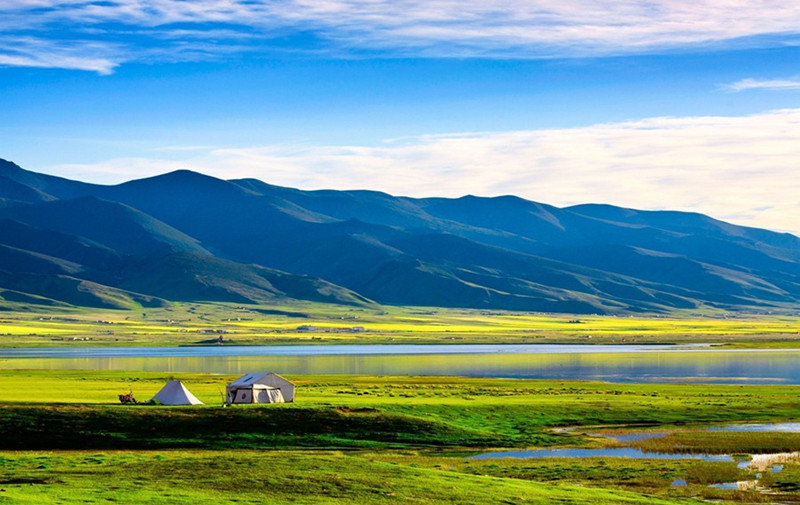
Quick Answer: Can Foreigners Self-Drive from Qinghai to Sichuan?
Foreign travelers can self-drive the Qinghai-Sichuan grasslands corridor — a route from Xining (西宁) through Qinghai Lake (青海湖), the Gannan Tibetan Plateau (甘南), Labrang Monastery (拉卜楞寺), and Jiuzhaigou Valley (九寨沟) to Chengdu (成都). Like all self-drive routes in China, this requires a temporary Chinese driving licence — International Driving Permits are not accepted — and a licensed guide-escort arranged through a registered Chinese travel agency. No Tibet Travel Permit is needed because the route stays within Qinghai, Gansu, and Sichuan provinces. That makes it one of the most accessible high-altitude self-drive routes in western China, with elevations reaching roughly 3,800 m (12,467 ft) on the Gannan plateau — high enough to feel the Tibetan world, low enough to enjoy it comfortably.
Tour Route:Xining-Jinyintan Prairie in Haibei-Qinghai Lake-Labrang Monastery in Xiahe County, Gannan-Flowers Lake in Zoige County, Aba-Jiuzhaigou Valley Scenic and Historic Interest Area-Chengdu-Chengdu Research Base of Giant Panda Breeding--Wuhou Memorial Temple in Chengdu-Jinli Old Street in Chengdu
Key Takeaways
✔ The Qinghai-Sichuan grasslands self-drive runs from Xining to Chengdu in 10 days, crossing Qinghai, Gansu, and Sichuan provinces with no Tibet permit required.
✔ Qinghai Lake sits at 3,200 m (10,499 ft) and is China's largest saltwater lake — the route's dramatic opening act before the Gannan corridor begins.
✔ Labrang Monastery in Xiahe (夏河) is one of the six great Gelug monasteries of Tibetan Buddhism and one of the largest monastic communities outside the Tibet Autonomous Region.
✔ Jiuzhaigou Valley's turquoise travertine pools are the route's natural-wonder climax — advance reservations are mandatory, with a daily visitor cap of 41,000 in peak season.
✔ The Gannan plateau averages 3,200–3,800 m (10,499–12,467 ft) — significantly lower than the G318's 5,130 m (16,831 ft) Dongda Pass, making altitude manageable for most travelers.
✔ June through September is the driving window; mid-June and late September offer the best balance of scenery, weather, and fewer crowds.
✔ An extended 15-day version adds the Yushu Horse Racing Festival (玉树赛马节), held annually around July 27–August 2, for deeper Tibetan cultural immersion.
Why Self-Drive the Qinghai-Sichuan Grasslands?
Qinghai Lake rapeseed flowers with Qilian Mountain foothills
Gannan Tibetan Plateau grasslands self-drive road
The wind carries the scent of wild rapeseed across a plateau so vast the road ahead dissolves into sky. Yaks drift across the tarmac in no particular hurry. A golden monastery roof catches afternoon light against a hillside of green — and there is no one else on the road for the next forty minutes.
- No Tibet permit required. The entire route stays within Qinghai, Gansu, and Sichuan — three provinces that do not require the Tibet Travel Permit. For foreign self-drivers, this removes the single biggest bureaucratic barrier to high-altitude western China.
- Amdo Tibetan culture without the access restrictions. The Gannan corridor is home to Amdo Tibetan communities, Gelug monasteries, and a nomadic pastoral world that is culturally rich and largely open to foreign visitors — a contrast to the permit-heavy Tibet Autonomous Region.
- Qinghai Lake and Jiuzhaigou in a single journey. Two of China's most iconic natural landmarks bookend the route: the vast blue mirror of Qinghai Lake at the start and the turquoise travertine pools of Jiuzhaigou at the finish.
- Approachable altitude. The route's highest points sit around 3,800 m (12,467 ft) on the Gannan plateau — well below the G318's passes above 5,000 m (16,404 ft). Altitude awareness is still essential, but most travelers acclimate comfortably with a staged approach.
- Vast grasslands with minimal traffic. Between Xiahe and Zoigê (若尔盖), the road crosses open plateau where the dominant traffic is livestock. Driving here feels less like navigating and more like traveling.
- Labrang Monastery — one of Tibetan Buddhism's great seats. The Gelug monastery at Xiahe houses one of the largest monastic communities outside the Tibet Autonomous Region, with a pilgrim kora circuit that ranks among the most atmospheric walks in western China.
- A festival-timed extension. The 15-day route adds the annual Yushu Horse Racing Festival — horsemen in traditional dress racing on a plateau above 3,700 m (12,139 ft) — for travelers who want an event that exists nowhere else in the world.
The Route: What You'll See Day by Day
The Qinghai-Sichuan grasslands self-drive covers roughly 1,800 km (1,118 mi) from Xining to Chengdu. The route divides into four natural segments, each with its own character.
1. Xining & Qinghai Lake — Starting on the Tibetan Plateau
Morning light on Qinghai Lake is a flat, luminous blue that runs to the horizon in every direction. The air is thin and dry at 3,200 m (10,499 ft), and the surrounding Jinyintan Prairie (金银滩草原) smells of grass and cold wind.
Qinghai Lake blue water with rapeseed fields in July
Riyue Mountain Sun and Moon pass Qinghai self-drive
The journey begins in Xining — a mid-sized plateau city at 2,275 m (7,464 ft) that serves as the natural staging point for the entire route. Day one is for arrival and acclimation. On day two, the drive west to Qinghai Lake passes through Jinyintan Prairie and crosses Riyue Mountain (日月山, Sun & Moon Mountain), part of the Qilian range. The pass at Riyue marks the historical boundary between agricultural China and the Tibetan pastoral world — Princess Wencheng's famous crossing point, commemorated by the Ri (Sun) and Yue (Moon) pavilions on either side.
Qinghai Lake itself is China's largest saltwater lake. In July, the surrounding rapeseed fields turn a vivid yellow against the lake's deep blue, creating one of western China's most photographed landscapes. After the lake loop, the drive returns to Xining for the night.
2. Gannan Corridor — Labrang, Langmusi & the Grasslands
Labrang Monastery golden roof, Gannan
Langmusi town straddling Gansu Sichuan border
The scent of juniper incense drifts from an open monastery door as pilgrims in heavy robes circle the kora path, spinning prayer wheels without breaking stride. Beyond the roofline, green hills roll to the south without interruption.
Day three heads south from Xining toward Xiahe, stopping at Ta'er Monastery (塔尔寺, also known as Kumbum Monastery), roughly 25 km (16 mi) from Xining. This is the birthplace of Tsongkhapa, founder of the Gelug school. Then onward to Labrang Monastery in Xiahe — one of the six great Gelug monasteries of Tibetan Buddhism, with a 3 km (1.9 mi) kora circuit lined with more than 1,700 prayer wheels. The monastery's golden roofline against the surrounding green hills is one of the Gannan corridor's defining images. Walk the kora at dawn, when the light is low and the pilgrims outnumber visitors.
Day four crosses into the grasslands proper. Sangke Grassland (桑科草原), just outside Xiahe, is pastoral grazing land where nomadic families pitch their tents in summer. The road continues south to Langmusi (郎木寺), a small town straddling the Gansu-Sichuan border — two monasteries face each other across a narrow valley, with green hills and morning mist closing in behind them. This is one of the route's most photogenic stops: a single frame captures both provinces.
From Langmusi, the route reaches Flower Lake (花湖, Hua Hu Marsh), a wetland reserve at roughly 3,400 m (11,155 ft) in the Zoigê grasslands. Boardwalks extend into the reeds. Black-necked cranes breed here from May through June. The First Bend of the Yellow River (黄河九曲第一湾) at Tangke is worth the early-morning detour — the river loops through flatland in enormous meanders visible from an elevated viewpoint.
Some online forums suggest skipping the Jiuzhaigou national park entrance and viewing the area from the roadside. The park's post-earthquake restoration has made the full interior experience dramatically better than roadside glimpses — the restored turquoise pools, waterfalls, and boardwalk trails are only accessible inside. The reservation system exists because the restored park is managing visitor flow, not because it is overpriced. Your agency pre-books tickets and schedules full days inside. This is the right approach.
3. Northern Sichuan — Huanglong & Jiuzhaigou
Huanglong cascading calcite pools with snow peaks
Jiuzhaigou Valley Five Flower Lake turquoise water
The first pool you see at Huanglong glows a deep amber-gold against white calcite terraces, and the color deepens as you climb — layer after layer of mineral pools cascading down a valley backed by snow-dusted peaks.
Day five drives from Songpan (松潘) to Huanglong National Park (黄龙). The park's cascading calcite pools — more than 3,000 individual travertine formations — change color from gold to blue to green depending on depth, mineral content, and light. Huanglong sits at roughly 3,100–3,600 m (10,170–11,811 ft); a cable car covers most of the ascent, and the walk down follows boardwalks through the pool terraces. The park stays open year-round, but the cable car may close for maintenance in November or December. Peak-season conditions run April through November.
Days six and seven are dedicated to Jiuzhaigou Valley — the route's natural-wonder climax. Since the post-earthquake restoration, the park operates a reservation system with a daily cap of 41,000 visitors in peak season (April 1–November 15). Tickets must be booked online in advance — during July through October, book at least seven days ahead. The park's three valleys hold dozens of turquoise lakes, multi-tier waterfalls, and old-growth forest. Five Flower Lake (五花海) and Long Lake (长海) are the signature stops. Two full days allow unhurried exploration of all three valleys.
Day eight is the transfer to Chengdu — a flight from Jiuhuang Airport (九黄机场) covers the distance in roughly an hour, bypassing a long overland drive.
4. Chengdu — Gateway In, Gateway Out
Chengdu at 500 m (1,640 ft) feels like a different planet after a week on the plateau — warm, humid air, the sound of traffic, and the smell of Sichuan peppercorn drifting from every second doorway.
Days nine and ten are in Chengdu (成都). Most travelers use Chengdu as both a recovery stop after the plateau and a springboard to other trips. The Chengdu Research Base of Giant Panda Breeding is a morning visit — arrive when the gates open, before the pandas retreat from the midday heat. Afternoon options include Wenshu Monastery (文殊院), Wuhou Temple (武侯祠), and Jinli Old Street (锦里古街). Some travelers adjust their Chengdu stay to a single night, flying out the same afternoon they arrive from Jiuzhaigou.
Qinghai-Sichuan Self-Drive at a Glance: 3 Tour Options Compared
Three guided self-drive options cover this corridor, each tailored to a different schedule and interest level.
Qinghai-Sichuan Self-Drive at a Glance: 3 Tour Options Compared
Tour Route:Xining-Jinyintan Prairie in Haibei-Qinghai Lake-Labrang Monastery in Xiahe County, Gannan-Flowers Lake in Zoige County, Aba-Jiuzhaigou Valley Scenic and Historic Interest Area-Chengdu-Chengdu Research Base of Giant Panda Breeding--Wuhou Memorial Temple in Chengdu-Jinli Old Street in Chengdu
The 10-day route is the core journey. It covers the full Qinghai-Sichuan grasslands corridor at a pace that allows two full days in Jiuzhaigou and unhurried time at each monastery stop. For travelers who want to go deeper, the 15-day extension adds the Yushu Horse Racing Festival and a sweep through the Kham Tibetan heartland — Dege (德格), Ganzi (甘孜), Tagong (塔公), and Danba (丹巴) — before descending to Chengdu via Mt. Siguniang (四姑娘山). Note that the Yushu extension adds significant altitude and remote driving; it suits travelers with prior plateau experience.
Tour Route:Xinning Plaza-Chengdu
15 Days
4 Places View Detail
The 8-day option runs the same corridor in reverse — starting in Chengdu and ending in Lanzhou (兰州) — and fits travelers who are beginning from eastern China or have fewer days available. It covers Jiuzhaigou, Huanglong, the Ruoergai (若尔盖) grasslands, Langmusi, and Labrang, but omits the Qinghai Lake segment and the Xining starting leg.
Tour Route:Chengdu-The City Walls of Songpan Ancient Town in Songpan County, Aba (Ngawa)-Huanglong Scenic and Historic Interest Area-Jiuzhaigou-Langmusi Monastery in Gannan, Gansu-Sangke Grassland in Xiahe, Gannan-Lanzhou
8 Days
6 Places View Detail
Sample 10-Day Qinghai-Sichuan Self-Drive Itinerary
10-Day Qinghai-Sichuan Grasslands Self-Drive Itinerary
Day 1
Arrive in Xining
Fly into Xining Caojiabao Airport. Transfer to hotel at 2,275 m (7,464 ft). Acclimate and explore the city at leisure.
Day 2
Qinghai Lake Day Trip
Drive west through Jinyintan Prairie and over Riyue Mountain to Qinghai Lake at 3,200 m (10,499 ft). Loop the lake, return to Xining. ~220 km (137 mi).
Day 3
Xining to Xiahe
Visit Ta'er Monastery (25 km from Xining), then drive south to Xiahe. Explore Labrang Monastery and walk the 3 km kora circuit. ~250 km (155 mi).
Day 4
Xiahe to Songpan
Cross Sangke Grassland, visit Langmusi at the Gansu-Sichuan border, stop at Flower Lake in the Zoigê wetlands. Continue to Songpan. ~350 km (217 mi).
Days 5–6
Huanglong & Jiuzhaigou
Day 5: Drive to Huanglong National Park, hike the calcite pool terraces. Transfer to Jiuzhaigou. Day 6: Full day inside Jiuzhaigou Valley — Shuzheng, Rize, and Zechawa valleys.
Day 7
Jiuzhaigou Second Visit
Return to Jiuzhaigou for a second full day. Focus on quieter trails and revisit Five Flower Lake in different light.
Day 8
Jiuzhaigou to Chengdu
Morning at leisure in the valley. Fly from Jiuhuang Airport to Chengdu (~1 hr). Check into city hotel at 500 m (1,640 ft).
Days 9–10
Chengdu & Departure
Day 9: Chengdu Panda Base (morning), Wenshu Monastery, Wuhou Temple, Jinli Old Street. Day 10: Departure at leisure.
Planning Your Qinghai-Sichuan Grasslands Self-Drive
Permits & the Guide-Escort Rule
The Qinghai-Sichuan grasslands route requires two documents that every foreign self-driver in China needs: a temporary Chinese driving licence and a licensed guide-escort.
Temporary Chinese driving licence. International Driving Permits (IDPs) are not valid in mainland China. Foreign drivers must apply for a temporary Chinese driving licence at a local vehicle management office (车管所), bringing their passport, visa, foreign driving licence with a certified Chinese translation, and a temporary accommodation registration form. The licence is valid for up to three months and covers the vehicle classes listed on your home licence. Driving without it is classified as driving without a licence — penalties include fines and potential detention. Yaso Trip arranges this process as part of tour preparation, so you do not need to navigate the vehicle management office alone.
For the full step-by-step process, see our guide to China's temporary driving licence for foreigners.
Guide-escort requirement. Chinese regulations require foreign self-drivers to travel with a licensed guide-escort throughout their journey. This is not optional — foreign-plated or foreign-driven vehicles cannot legally operate on Chinese roads without an accompanying guide. The guide handles checkpoint communication, navigation through restricted areas, accommodation registration at each stop, and emergency coordination. On the Qinghai-Sichuan route, the guide-escort is especially valuable on the Gannan plateau, where phone signal drops in valleys and the road crosses three provincial jurisdictions.
For a detailed explanation of why independent self-driving is not permitted, see our guide-escort rule explainer.
What you do NOT need. The Qinghai-Sichuan grasslands route does not enter the Tibet Autonomous Region. No Tibet Travel Permit, Alien's Travel Permit, or Military Permit is required. This is the route's key bureaucratic advantage over the G318 Sichuan-Tibet Highway self-drive, which requires all three.
Best Time to Drive the Grasslands
The driving window is June through September. Outside this window, high-altitude road closures, snow, and brown dormant grasslands make the route impractical for most travelers.
Best Time to Drive the Qinghai-Sichuan Grasslands
Clear mornings can turn to hail within an hour at 3,400 m (11,155 ft). Temperatures at altitude drop sharply after sunset — from 23°C (73°F) in afternoon sun to near 5°C (41°F) by nightfall, and close to 0°C (32°F) on high passes. Pack a shell jacket and insulating layers even in July. Monitor short-term forecasts daily and keep flexibility in the schedule for weather-forced route changes.
Altitude on the Grasslands Route
The Qinghai-Sichuan route's altitude profile is a key selling point: high enough to enter the Tibetan plateau world, low enough to be manageable.
- Xining: 2,275 m (7,464 ft) — the starting acclimation point
- Qinghai Lake: ~3,200 m (10,499 ft)
- Gannan plateau (Xiahe to Zoigê): 3,200–3,800 m (10,499–12,467 ft) — the route's sustained high segment
- Huanglong: 3,100–3,600 m (10,170–11,811 ft)
- Jiuzhaigou Valley: ~2,000 m (6,562 ft) — a welcome descent
- Chengdu: ~500 m (1,640 ft)
Most travelers acclimate well if they spend the first night in Xining, not on the plateau. The critical rule: do not sleep above 3,500 m (11,483 ft) on day one. Let your body adjust at Xining's moderate altitude first. Carry a pulse oximeter and medical-grade oxygen canisters — not the small decorative cans marketed to tourists. If headaches become severe or persistent, descend immediately and seek medical attention.
For context, the grasslands route is substantially lower than the Sichuan-Yunnan-Tibet self-drive via Daocheng Yading, which crosses passes above 4,600 m (15,092 ft).
How to Get to Xining
Xining is the starting point for the 10-day and 15-day routes and is well connected by air and rail.
If you are starting from Chengdu and heading to Lanzhou instead, the 8-day reverse route covers the same corridor without the Xining starting leg.
Road Conditions & What to Expect Behind the Wheel
The Qinghai-Sichuan grasslands route runs primarily on well-maintained national highways — G213, G347, and connecting provincial roads. Most segments are paved and suitable for a standard SUV. A few sections require extra attention:
- Xiahe to Langmusi corridor. The G213 through the Gannan plateau is paved but narrow in places. Yaks and sheep occupy the road regularly — slow down, do not honk, and wait for them to clear. Hitting livestock carries heavy financial liability. Speed cameras and interval speed checks are frequent on grassland highways.
- Langmusi to Zoigê transition. This segment crosses from Gansu into Sichuan and climbs above 3,500 m (11,483 ft). Road conditions are generally good, but afternoon rain can make surfaces slippery. Phone signal drops in valleys along this stretch.
- Songpan to Huanglong. A mountain road with sustained climbs and long descents. On long downhill stretches, use low gear (manual mode or L gear) to control speed — do not ride the brakes continuously. Brake fade from overheating is a serious risk on extended descents in western China. This applies to both manual and automatic vehicles.
- Fuel planning. Fuel stations thin out on the Gannan plateau, particularly between Langmusi and Zoigê. Fill up when your tank reaches half. Do not wait for the fuel warning light. For detailed fuel-stop planning, see our fuel and range planning guide for remote China routes.
- Vehicle choice. A mid-size SUV with reasonable ground clearance handles the entire core route comfortably. You do not need a hardcore off-road vehicle unless you plan detours onto unpaved side roads. Avoid renting a vehicle you are not familiar with — mountain driving demands confidence with the car's braking and low-gear behavior.
- Offline maps. Download offline maps for the full route before departure. Multiple stretches on the Gannan plateau and around mountain passes have no mobile signal. Carry a high-capacity portable charger.
The corridor between Xiahe (Gansu), Langmusi (Gansu-Sichuan border), and Zoigê (Sichuan) crosses three provincial jurisdictions. Phone signal drops in valleys, fuel stations thin out, and road surface quality varies. This is the segment where the guide-escort and support vehicle earn their value — checkpoint communication, emergency response, and route knowledge on the ground.
Tips & Cautions
Not every hotel or guesthouse on the Gannan plateau and in northern Sichuan is licensed to accommodate foreign guests. Booking a non-registered property can result in a police visit and forced relocation — sometimes late at night. In counties like Aba (阿坝), Jiuzhi (久治), and Rangtang (壤塘), the selection of foreign-guest-approved hotels is limited. Always confirm foreign-guest registration status before booking. Yaso Trip pre-confirms every hotel on the route for foreign-guest compliance.
- Walk the Labrang kora at dawn. The prayer-wheel circuit is atmospheric at any hour, but early morning brings the most pilgrims and the softest light. The full 3 km (1.9 mi) loop takes about 45 minutes at a contemplative pace.
- Book Jiuzhaigou tickets well in advance. The park's daily visitor cap of 41,000 in peak season means summer tickets sell out days to weeks ahead. Tickets are sold exclusively online through the official Jiuzhaigou tourism platform — there are no on-site cash windows. Your agency handles this, but last-minute plan changes are difficult once booked.
- September delivers the best photography conditions. The rain season ends, air clarity peaks, and the grasslands take on golden-amber autumn tones. Crowds thin after the August domestic holiday season, and hotel prices drop.
- Qinghai Lake rapeseed flowers peak in July. The vivid yellow rapeseed fields surrounding the lake are at their most photogenic in July — combine with the early-July start of the high season for best conditions.
- The First Bend of the Yellow River is best at sunrise. The Tangke (唐克) viewpoint shows the river's enormous meanders across the flatland. Morning light reveals the full extent of the curves. Locals at the Aman Cang (阿万仓) wetland viewpoint — a free, uncrowded alternative accessed via a village road off Route 345 — offer horseback rides to the summit for a more immersive view.
- Langmusi straddles two provinces. The town's two monasteries — Kirti Monastery on the Sichuan side and Sertri Gompa on the Gansu side — face each other across a narrow valley. One photograph captures both provinces. Visit both sides.
- Flower Lake's black-necked cranes are best seen in May and June. The cranes breed in the Zoigê wetland during spring. By July, they are less reliably visible from the boardwalk.
- Pack for four seasons in one day. The plateau's temperature range — from 23°C (73°F) at midday to near 0°C (32°F) on a pass after sunset — means layering is not optional. A wind-shell, insulating midlayer, and sun hat are daily essentials.
- Control daily driving to six hours maximum. Altitude, winding roads, speed cameras, and livestock crossings mean actual drive time far exceeds navigation estimates. Finish driving by 5:00 PM. Never drive after dark on plateau roads.
- Carry two to three drivers if possible. The attention demands of western China mountain driving — constant hairpins, speed checks, unpredictable livestock, altitude effects — cause fatigue faster than city driving. Rotating drivers every two to three hours keeps everyone safer.
Why Travel With Yaso Trip for Your Qinghai-Sichuan Self-Drive
- Foreign-guest logistics handled end to end. Yaso Trip pre-confirms every hotel on the route for foreign-guest registration compliance, manages the temporary driving licence application before departure, and pre-books Jiuzhaigou tickets within the daily cap — three friction points that regularly derail independent attempts.
- Guide-escort with multi-province expertise. The grasslands route crosses Qinghai, Gansu, and Sichuan in ten days. Each province has different checkpoint protocols and different restricted-area lists for foreign visitors. Yaso Trip's guide-escorts know the current status of every section and handle checkpoint communication in real time.
- Support vehicle and emergency coordination. The Gannan plateau has stretches with limited phone signal and few roadside services. A Yaso Trip support vehicle carries spare fuel, oxygen, and basic mechanical tools. If altitude sickness or a vehicle issue occurs in a signal-dead zone, the support team coordinates the response.
- Flexible itinerary within the framework. Want to add the Aman Cang wetland viewpoint instead of the ticketed Yellow River Bend? Swap a monastery visit for extra time at Jiuzhaigou? Shorten the Chengdu stay to a single night? Yaso Trip adjusts the daily plan around your priorities without compromising the logistics chain.
For an accurate cost breakdown tailored to your group size, dates, and preferences, contact the Yaso Trip team for a custom quote.
Ready to Drive the Qinghai-Sichuan Grasslands?
The Qinghai-Sichuan grasslands self-drive is western China's most accessible high-altitude route for foreign drivers — Tibetan monasteries, vast plateau, and Jiuzhaigou's turquoise pools, all without a Tibet permit. Choose the 10-day core journey, the 15-day festival extension, or the 8-day reverse from Chengdu, and let Yaso Trip handle the permits, hotels, and guide-escort so you can focus on the road.
For more self-drive routes across China, see our complete guide to China self-driving tours.