Quick Answer: Is Qinghai Halal-Friendly for Muslim Travelers?
Qinghai is one of the most naturally halal-friendly provinces in China. Its capital, Xining (西宁), sits at the crossroads of Hui, Salar, Tibetan, and Tu cultures — and the Dongguan Grand Mosque (东关清真大寺), one of northwestern China's largest and most historic mosques, anchors a city where halal restaurants outnumber non-halal ones in entire neighborhoods. Beyond Xining, four Hui autonomous counties — Datong (大通), Menyuan (门源), Hualong (化隆), and Minhe (民和) — form a ring of Muslim communities where qingzhen (清真) dining, working mosques, and centuries of Hui heritage are the norm, not the exception. The route to Qinghai Lake has halal restaurants every 20–30 km (12–19 miles), and the Gansu-Qinghai corridor connects seamlessly to the broader Silk Road Muslim travel circuit.
Key Takeaways
✔ Xining's Dongguan Grand Mosque dates to the Ming dynasty, covers over 13,600 square meters (146,000 sq ft), and serves as the spiritual center for the city's large Hui Muslim community — one of the most important mosques in northwestern China.
✔ Four Hui autonomous counties surround Xining, each with distinct character: Datong for mountain hiking 40 minutes from the city, Menyuan for rapeseed flower fields under snow-capped peaks, Hualong as China's "Lamian Capital," and Minhe for Tu ethnic cultural experiences.
✔ The food street beside Dongguan Grand Mosque is Xining's best halal dining zone — better value and more variety than the tourist-oriented Daxin Street Night Market.
✔ Qinghai Lake — China's largest inland saltwater lake — is accessible on a day trip from Xining, with halal restaurants along Route 109 every 20–30 km (12–19 miles).
✔ Hualong County's entrepreneurs run tens of thousands of "Lanzhou lamian" noodle shops across China — the county, not Lanzhou, is where most of the country's hand-pulled noodle operators actually come from.
✔ Qinghai connects naturally to the Gansu-Ningxia Silk Road corridor, making it an ideal extension for Muslim travelers already visiting Linxia, Yinchuan, or Xi'an.
✔ Altitude matters: Xining sits at 2,275 m (7,464 ft) and Qinghai Lake at 3,200 m (10,500 ft) — allow time for acclimatization on your first day.
Why Visit Qinghai on a Muslim Tour?
Most Muslim travelers to China head to Xi'an, Kashgar, or Beijing. Qinghai sits between them — geographically on the high plateau, culturally at the meeting point of Hui, Salar, Tibetan, and Tu worlds — and almost no English-language travel guide covers its Muslim heritage in depth. That gap is the opportunity.
Dongguan Grand Mosque exterior in Xining Qinghai
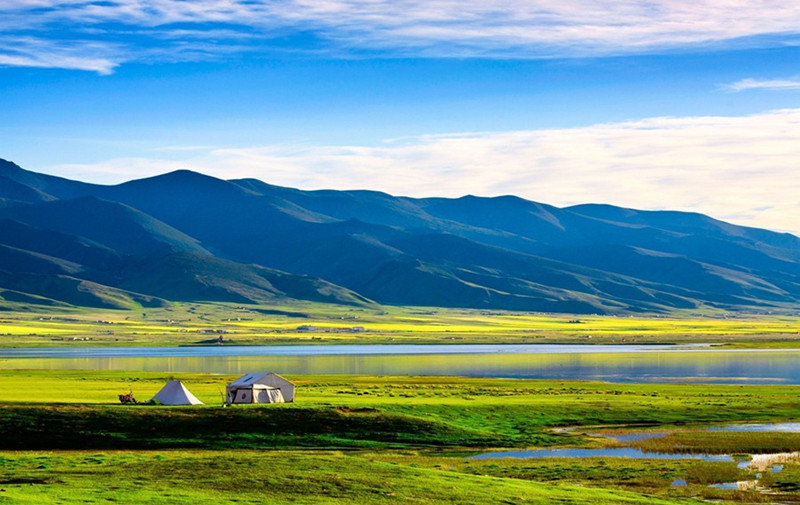
Qinghai Lake panoramic view with snow mountains and grasslands
- A Muslim-majority capital neighborhood. Xining's Dongguan district is over 70% Hui. The mosque food street, the alleys, the morning markets — this is a neighborhood where Islam shapes daily life, not a curated heritage zone.
- Four Hui autonomous counties within day-trip range. Datong, Menyuan, Hualong, and Minhe each carry autonomous status recognizing their Hui (and in two cases Hui-Tu) populations. No other province concentrates this many Hui administrative units so close together.
- Effortless halal dining across the province. Look for 清真 (qīngzhēn) signage — but in Xining and the Hui counties, finding a non-halal restaurant takes more effort than finding a halal one.
- The Silk Road corridor's highest stop. At 2,275 m (7,464 ft), Xining is the highest-altitude major Muslim city on the ancient Silk Road. The plateau landscapes — alpine grasslands, rapeseed flower fields, snow-capped peaks — are unlike anything on the lowland Xi'an-to-Kashgar route.
- Multi-ethnic crossroads. Qinghai is where Hui Muslim culture meets Tibetan Buddhism, Tu shamanic traditions, and Salar Turkic heritage. The cultural layering is unique in China and visible in architecture, food, and festivals.
- Natural connection to Gansu and the Silk Road. The 9-day Gansu & Qinghai Muslim tour threads Lanzhou, Linxia, Xunhua, Xining, Qinghai Lake, and the Rainbow Danxia into a single corridor — one of the richest Hui cultural immersions available to foreign travelers.
Tour Route:Kunming-Lanzhou-Binglingsi Grottoes in Yongjing County, Linxia-Linxia-Mengda Heaven Lake in Xunhua County, Haidong-Xining-Qinghai Lake-Huahai Yuanyang Wetland in Menyuan County, Haibei-Zhangye-Jiayuguan-Dunhuang-Lanzhou-Kunming
Xining — China's Halal Capital on the Plateau
Steam rises from a row of noodle pots along a narrow lane just east of the Dongguan Grand Mosque. A cook stretches dough in long, rhythmic pulls — slap, stretch, fold — and drops fresh strands into boiling broth. The air smells of beef stock, chili oil, and freshly baked naan. In Xining, halal is the default, not the exception.
Xining (西宁), the capital of Qinghai Province, sits at 2,275 m (7,464 ft) on the northeastern edge of the Tibetan Plateau. The city has been a crossroads of Hui Muslim, Tibetan, Tu, and Han cultures for centuries — a place where minarets and prayer flags share the skyline. For Muslim travelers, Xining serves as the anchor for all Qinghai exploration: the city where you eat, pray, and plan before heading to the lake, the mountains, or the Hui counties.
Dongguan Great Mosque interior in Xining
Dongguan Great Mosque in Xining
Dongguan Grand Mosque (东关清真大寺)
The Dongguan Grand Mosque is Xining's spiritual and architectural centerpiece. Built during the Ming dynasty (Hongwu era, late 14th century), the mosque covers over 13,600 square meters (146,000 sq ft) and is counted among the four great mosques of northwestern China — alongside Xi'an's Great Mosque, Lanzhou's Qiaomen Mosque, and Kashgar's Id Kah Mosque. Its green domes, white walls, and elegant prayer halls blend Chinese palatial architecture with Islamic design elements.
The mosque is the focal point of the Dongguan neighborhood, where the Hui population exceeds 70%. On Fridays, the scale of Jummah prayer here is striking — the mosque and surrounding streets fill with worshippers. Non-Muslim visitors are welcome outside prayer times.
Xining's Halal Food Scene
The food street flanking the Dongguan Grand Mosque is Xining's best halal dining district — and a genuine insider recommendation over the more tourist-oriented Daxin Street Night Market (大新街夜市). The Dongguan street has better variety, better value, and the authenticity of a neighborhood that eats here every day.
Three spots worth seeking out:
- 震亚牛肉面 (Zhenya Beef Noodles): The niurou mian (beef noodle soup) and gan ban (dry-tossed noodles) here are outstanding — hand-pulled to order, served in a rich beef broth.
- 团结一巷 (Tuanjie Yi Xiang / Unity First Alley): This entire alley next to the Dongguan Grand Mosque is a Hui Muslim residential lane lined with family-run restaurants and small eateries. Walk in, pick a busy table, and eat what the locals eat.
- 益鑫手抓 (Yixin Hand-Grabbed Lamb, Huayuan North Street): Xining's most established spot for shou zhua yangrou (手抓羊肉) — bone-in lamb boiled tender and eaten by hand, the Hui plateau's signature dish.
Avoid the Tourist Trap: Skip Daxin Street Night Market. It is set up for out-of-town tourists with inflated prices and little local character. The Dongguan Mosque food street and Tuanjie Yi Xiang — steps from the mosque — offer everything Daxin has, but with more variety and prices that locals actually pay.
Xiananguan Muslim Halal Ethnic Snack Street in Xining
Hand-grabbed lamb shou zhua yangrou Hui halal food
Xining Halal Must-Try Dishes
Qinghai's Four Hui Autonomous Counties
Most travelers pass through Qinghai without knowing that four counties surrounding Xining hold autonomous status specifically recognizing their Hui (and in two cases Hui-Tu) Muslim populations. These are not tourist destinations in the conventional sense — they are living communities where Hui culture, mosque life, and halal food are the fabric of daily existence. Yaso Trip can arrange customized visits to any of them as extensions to a Qinghai itinerary.
Datong Hui and Tu Autonomous County (大通回族土族自治县)
Morning mist lifts over Laoye Mountain as the first hikers pick their way along a forested ridge. Below, the town of Qiaotou is already awake — smoke from breakfast kitchens drifts past the green-tiled roof of the Qiaotou Grand Mosque.
Datong (大通) is the closest Hui autonomous county to Xining — just 35 km (22 miles) north, about 40 minutes by car on the Ning-Da Expressway. The county's population is approximately 43.5% Hui and 12.7% Tu, making it a dual Hui-Tu autonomous unit.
What to see:
- Laoye Mountain (老爷山): A national AAAA scenic area with forested ridges, temple ruins, and panoramic views — Datong's headline natural attraction.
- Yaoziggou (鹞子沟) and Chahanhe (察汗河) National Forest Parks: Two highland forest parks with hiking trails through spruce and birch forests, alpine meadows, and clear streams.
- Qiaotou Grand Mosque (桥头清真大寺) and Taerwan Grand Mosque (塔尔湾清真大寺): Datong's two principal mosques, each blending Hui and Tu architectural elements.
- Halal food: The same plateau Hui cuisine found in Xining — hand-grabbed lamb, ga mianpian, zasui soup, niang pi — at local prices.
Best for: A half-day nature escape from Xining with Hui-Tu cultural flavor. Combine with a Xining mosque visit for a full day.
Menyuan Hui Autonomous County (门源回族自治县)
The road north from Xining climbs through the Daban Mountain tunnel and drops into a valley that, in July, turns solid gold. Rapeseed flowers stretch to every horizon — over 500,000 mu (roughly 330 square kilometers / 127 square miles) of blossoms carpeting the valley floor, with prayer flags fluttering above the fields and snow-capped peaks filling the northern skyline.
Menyuan (门源) sits about 150 km (93 miles) north of Xining in the Haibei Tibetan Autonomous Prefecture. The county's Hui population is approximately 45.8%. While Menyuan is best known for its rapeseed flower spectacle — one of the most photographed landscapes in western China — it also anchors a stretch of the Gansu-Qinghai corridor that Muslim travelers pass through on Silk Road itineraries.
What to see:
- Hundred-Mile Rapeseed Flower Sea (百里油菜花海): The main event. Peak bloom runs from early July through August, with fields remaining photogenic into September-October. The combination of golden flowers, Tibetan prayer flags, and distant snow mountains is unique to Menyuan.
- Gangshika Snow Peak (岗什卡雪峰): A 5,254 m (17,238 ft) peak visible from the rapeseed fields — accessible for experienced mountaineers, a dramatic backdrop for everyone else.
- Xianmi National Forest Park (仙米国家森林公园): Dense highland forest in the Qilian Mountain foothills.
- Haomen Mosque (浩门清真寺): Menyuan's principal mosque and a local cultural landmark.
Practical note: On the 9-day Gansu & Qinghai Muslim tour (product 112071), Menyuan is a scenic driving stop on Day 6 between Xining and Zhangye — most itineraries pass through rather than overnight. For travelers wanting more time, an overnight in Menyuan can be arranged.
Menyuan rapeseed flower fields and snow mountains
Gangshika Snow Peak above golden rapeseed flowers Menyuan
Minhe Hui and Tu Autonomous County (民和回族土族自治县)
The drums start before dawn and continue for weeks. In Minhe's Tu villages, the Nadum Festival (纳顿节) unfolds across more than 60 days — the longest harvest celebration in China, possibly in the world — with masked dances, wrestling, horse racing, and feasting that blur the line between harvest festival and month-long carnival.
Minhe (民和) is Qinghai's eastern gateway, about 110 km (68 miles) from Xining and directly accessible via the Lanxin high-speed rail (Minhe South Station) and the Beijing-Tibet Expressway. The county is approximately 46% Hui and 16% Tu, making it a dual Hui-Tu autonomous unit where two distinct ethnic cultures coexist.
What to see:
- Lajia Archaeological Site (喇家遗址): Called "China's Pompeii," this Bronze Age settlement was preserved by a catastrophic earthquake and mudslide roughly 4,000 years ago. A nationally designated key cultural relics protection unit, the site includes intact dwelling foundations and the world's oldest known noodles — a 4,000-year-old bowl of millet noodles unearthed in 2002.
- Nadum Festival (纳顿节): Held annually from roughly July to September across Tu villages, this harvest celebration is recognized as a national intangible cultural heritage. Participation can be arranged for travelers who time their visit right.
- Tu Pan Embroidery (土族盘绣): A national intangible cultural heritage — intricate needlework using a technique unique to the Tu people. Workshops and demonstrations can be arranged through local artisans.
- Qilisi Flower Sea (七里寺花海) and Medicinal Springs (药水泉): Seasonal wildflower meadows and natural mineral springs in the county's mountain valleys.
Best for: Travelers interested in deep ethnic heritage — the intersection of Hui Muslim culture and Tu minority traditions — and ancient history.
Qinghai's Hui Autonomous Counties at a Glance
Qinghai's Four Hui Autonomous Counties Compared
Qinghai Lake — Halal Logistics for Muslim Travelers
The blue hits you before the lake does — a band of impossible turquoise stretched across the horizon, bordered by green grassland and backed by snow-dusted mountains. At 3,200 m (10,500 ft), the air is thin and the light is sharp. Qinghai Lake (青海湖) is China's largest inland saltwater lake, covering over 4,500 square kilometers (1,737 sq mi), and it is accessible as a day trip from Xining.
Halal food along the route: The 150 km (93 mile) drive from Xining to Qinghai Lake follows Route 109. Halal restaurants appear every 20–30 km (12–19 miles) along this road, particularly around Heimahe (黑马河) and the Erlangjian Scenic Area (二郎剑景区). The restaurants serve standard plateau Hui fare — hand-grabbed lamb, noodle soups, and flatbread — covering breakfast, lunch, and dinner needs without advance planning.
Prayer logistics: No dedicated mosque sits at Qinghai Lake itself, but Xining's Dongguan Grand Mosque is accessible before departure, and your guide carries qibla direction tools for prayer at scenic-area rest stops.
Altitude note: Qinghai Lake sits roughly 1,000 m (3,280 ft) higher than Xining. Travelers arriving on the same day as their flight into Xining should spend at least one full day acclimatizing in the city before the lake excursion.
Qinghai Lake crystal blue water with rapeseed flower fields
Erlangjian scenic area boardwalk Qinghai Lake Qinghai
Tour Route:Beijing-Xian-Xining-Zhangye-Shanghai
12 Days
8 Places View Detail
Sample Itinerary: the 9-Day Gansu & Qinghai Muslim Tour
The Qinghai portion of Yaso Trip's 9-day Gansu & Qinghai Muslim Halal Tour covers Days 4–6 of the full itinerary. The complete circuit runs from Kuala Lumpur via Kunming to Lanzhou, threading Linxia, Xunhua, Xining, Qinghai Lake, Menyuan, and the Gansu Silk Road corridor (Zhangye, Jiayuguan, Dunhuang) before returning.
Qinghai Highlights — Days 4–6 of the 9-Day Gansu & Qinghai Muslim Tour
Day 4
Xunhua to Xining — Salar Heritage & Arrival
Travel from Linxia through Xunhua Salar Autonomous County. Visit Camel Spring (骆驼泉), Imam Mosque (伊玛目清真寺), and the Quran Museum (古兰经博物馆). Continue to Xining. Halal dinner in the city.
Day 5
Xining & Qinghai Lake — Mosque, Food & the Plateau Lake
Morning visit to the Dongguan Grand Mosque (东关清真大寺). Drive to Qinghai Lake Erlangjian Scenic Area — explore the lakeside boardwalks, photograph the alpine meadows, and breathe the high-plateau air. Return to Xining for halal dinner.
Day 6
Xining to Menyuan to Zhangye — Rapeseed Fields & Rainbow Mountains
Depart Xining northward through the Qilian Mountains (祁连山). Pass through Menyuan's rapeseed flower fields and the Biandukou Scenic Area (扁都口). Arrive in Zhangye for a mosque visit and the Rainbow Danxia Geopark at golden hour.
Tour Route:Kunming-Lanzhou-Binglingsi Grottoes in Yongjing County, Linxia-Linxia-Mengda Heaven Lake in Xunhua County, Haidong-Xining-Qinghai Lake-Huahai Yuanyang Wetland in Menyuan County, Haibei-Zhangye-Jiayuguan-Dunhuang-Lanzhou-Kunming
Practical Information
Best Time to Visit
Best Time to Visit Qinghai
Ramadan timing: Ramadan dates shift approximately 10–11 days earlier each year. Halal restaurant hours may adjust during Ramadan, particularly in Guangzhou's Hui neighborhoods. Mosques in Guangzhou provide iftar meals — a meaningful community experience for visiting Muslims.
Ramadan & Eid Dates for China Muslim Tour Planning (2026–2030)
Getting There
Getting to Qinghai — Key Routes
Prayer Logistics
Prayer is straightforward in Xining and the Hui counties. The Dongguan Grand Mosque is the natural anchor — located centrally, open daily, and welcoming to visiting Muslims. Each of the four autonomous counties has multiple working mosques. On driving days between Xining and Qinghai Lake or the Gansu corridor, guides arrange prayer stops at mosques en route or provide qibla direction at rest stops.
How to Find Halal Food
Look for the characters 清真 (qīngzhēn) — China's universal halal marker. In Xining's Dongguan district and throughout the Hui autonomous counties, this sign is nearly redundant: most restaurants are halal by default. For the Qinghai Lake day trip, halal restaurants line Route 109 every 20–30 km, so no advance planning is needed.
For an accurate cost breakdown tailored to your group size, dates, and preferences, contact the Yaso Trip team for a custom quote.
Tips for Your Qinghai Halal Tour
Xining sits at 2,275 m (7,464 ft) and Qinghai Lake at 3,200 m (10,500 ft). If you are arriving by air, spend at least one full day in Xining before heading to the lake. Drink plenty of water, avoid strenuous activity on your first day, and carry basic altitude medication if you are sensitive to elevation changes.
- Pack layers. Qinghai's plateau climate means wide daily temperature swings — mornings can be cool even in summer (10–15°C / 50–59°F), while afternoons warm to 20–25°C (68–77°F). A light down jacket is useful year-round.
- Download a translation app. English is rarely spoken outside Xining's hotels. Baidu Translate or Google Translate with offline Chinese packs will help with restaurant menus and directions — especially in the Hui counties.
- Set up Alipay or WeChat Pay. Both now support foreign cards. Cash is accepted but mobile payment is universal in China — including at night markets and small county restaurants.
- Carry a portable prayer mat. Mosques are plentiful in Xining and the county towns, but driving days to Qinghai Lake or between counties may require prayer at rest stops or hotels.
- Eat at the Dongguan Mosque food street, not Daxin Street. This is the genuine insider recommendation — better variety, lower prices, and the authenticity of a neighborhood that feeds itself here daily.
- Time your visit for Menyuan flowers. If rapeseed fields matter to you, visit between early July and late August. Outside this window, the valley is green and pleasant but not the golden spectacle.
- Request county visits in advance. Hualong lamian experiences, Minhe Nadum Festival attendance, and Datong mountain hikes are available as customized add-ons — tell Yaso Trip what interests you when you book.
Why Travel With Yaso Trip
- Halal logistics handled end-to-end. Every meal on a Yaso Trip itinerary is halal-certified, prayer stops are built into driving days, and guides carry qibla direction tools for rest stops between cities and the lake.
- Access beyond the guidebook. The four Hui autonomous counties are virtually unknown to English-speaking travelers. Yaso Trip arranges experiences that independent visitors cannot easily find — Hualong lamian workshops, Tu cultural visits in Minhe, and mosque visits that require local introductions.
- Seamless Silk Road connections. Qinghai connects naturally to Gansu (Lanzhou, Linxia, Zhangye, Dunhuang), Ningxia (Yinchuan), and Xi'an. Yaso Trip builds modular itineraries that extend in any direction along the corridor.
- English-speaking Muslim guides. Navigating Qinghai's Hui counties without Chinese is challenging. Yaso Trip's bilingual guides bridge the language gap and provide the cultural context that transforms a county visit into a genuine understanding of Hui life on the plateau.
Whether you are combining Qinghai with a Gansu & Ningxia Muslim tour, threading it into a broader China Silk Road Muslim journey, or adding it to a China Muslim Tours itinerary that includes Beijing, Xi'an, and Shanghai, Qinghai adds a dimension no other stop on the corridor can match — the high plateau, the golden fields, the quiet counties, and the deepest Hui food culture in China.
Tour Route:Kunming-Lanzhou-Binglingsi Grottoes in Yongjing County, Linxia-Linxia-Mengda Heaven Lake in Xunhua County, Haidong-Xining-Qinghai Lake-Huahai Yuanyang Wetland in Menyuan County, Haibei-Zhangye-Jiayuguan-Dunhuang-Lanzhou-Kunming