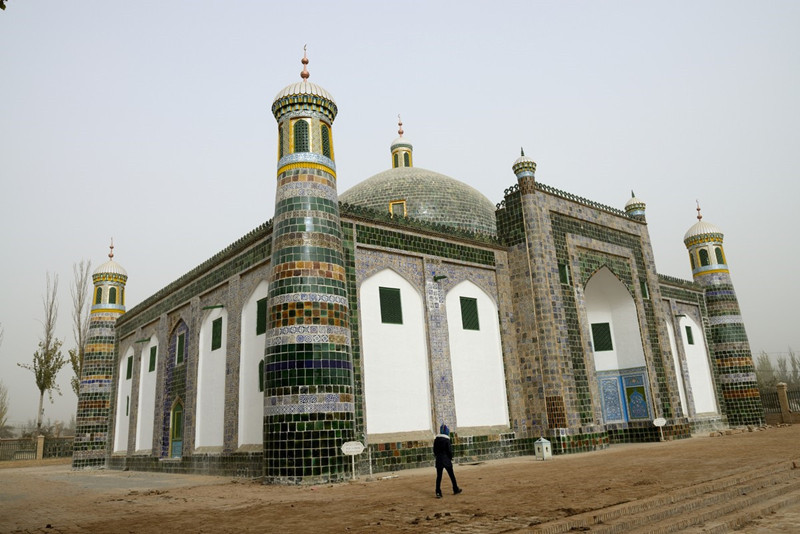
Quick Answer: What Is Worth Seeing in Kashgar?
A Kashgar travel guide covers three anchor experiences and one high-plateau extension. The three anchors are Kashgar Old Town (喀什古城) — a Uyghur quarter split by Jiefang North Road into a tourist-facing east side and a residential west side; the Sunday Bazaar (喀什大巴扎) — a working livestock and goods market that starts around 10:00 with roughly 5,000 stalls; and the Id Kah Mosque (艾提尕尔清真寺) — Xinjiang's largest mosque, founded in 1442 with capacity for around 20,000 worshippers. The one-day extension is the Karakoram Highway to Karakul Lake, White Sand Lake, and Tashkurgan, which requires a Border Management Area Permit for foreign passports. Most travellers spend 3–6 days in Kashgar and combine it with Urumqi and Turpan for a 7–10 day Xinjiang loop.
Key Takeaways
✔ Kashgar (喀什, Kashi) is the western terminus of China's Silk Road, closer to Baghdad than to Beijing and the deepest Uyghur-cultural city on any China itinerary.
✔ Kashgar Old Town splits into two very different halves — the east side runs on ceremony and street food, the west side is where quiet artisan lanes, teahouses, and residential courtyards still function.
✔ Sunday Bazaar in 2026 is physically zoned: the livestock trading area is separated from the food and goods bazaar, so the "chaotic market smell" is only in one part. Best visiting window is 11:00–14:00, not 08:00.
✔ Id Kah Mosque, the Sunday Bazaar, and the Old Town's west-side artisan lanes are the three sites described generically — the specifics of when to go, which gate to enter, and which alley to walk are what separates a good Kashgar day from a mediocre one.
✔ Foreign visitors going up the Karakoram Highway to Karakul Lake or Tashkurgan need a Border Management Area Permit (边防证). As of April 2026 domestic citizens can apply online, but foreign passports still require in-person application at a specific PSB service centre in Kashgar; budget half a day of your arrival day.
✔ Foreigners are permitted to visit Kashgar city, the Old Town, Karakul Lake, White Sand Lake, and Tashkurgan county, but are NOT permitted to enter the Khunjerab (Hongqilafu) Pass to the Pakistan border — the closest legal viewpoint is the country-gate plaza area.
✔ Trip length: 3–4 days for Kashgar city + one Karakoram day; 5–7 days for a proper Kashgar deep-dive including Yarkant and southern-Silk-Road villages; 7–10 days when combined with Urumqi and Turpan into a Xinjiang loop.
Explore Kashgar in depth with Yaso Trip's photography tour
Why Visit Kashgar on the Silk Road?
 Kashgar Old Town Uyghur architecture
 Karakul Lake Muztagh Ata Pamir
Kashgar sits at the western elbow of the Tarim Basin, 4,000 km (2,485 mi) west of Beijing and closer to Kabul, Islamabad, and Bishkek than to any large Chinese city. For 2,000 years it was the last major oasis on the Silk Road before caravans crossed the Pamir Plateau into Central Asia and the Indian subcontinent, and the intersection of Han, Uyghur, Tajik, Kyrgyz, and Persian trade shows in the food, architecture, and language you still see today. Modern Kashgar is one of the most distinctive cities in China precisely because it does not feel Chinese in the eastern-coastal sense — it feels Central Asian, oasis, and Uyghur.
- The Silk Road's western terminus. Every classic Silk Road grand tour ends (or begins) in Kashgar. Kashgar is where the Northern and Southern Silk Roads reunited before splitting again toward Samarkand and Kashmir, and the corridor's cultural gradient — from Han Chinese in Xi'an to Uyghur in Kashgar — is most vivid here.
- The most Uyghur city in China. Around 90% of Kashgar prefecture's population is Uyghur. The language you hear on the street is Uyghur, the food is Uyghur, and the Old Town's residential courtyards still function as extended-family compounds in a way you don't find in Urumqi or Turpan.
- Living Silk Road architecture. Id Kah Mosque, the Abakh Hoja Tomb, the residential quarters of the Old Town's west side, the Sunday Bazaar's caravanserai layout — all of this is architecture Silk Road travellers would recognise from 500 years ago.
- Direct access to the Pamir Plateau. Karakul Lake at 3,600 m (11,800 ft) and Muztagh Ata's 7,509 m (24,636 ft) snowcap sit only a half-day's drive from Kashgar. The Karakoram Highway (国道G314) is one of the world's great mountain roads and a legitimate Silk Road extension that most Xinjiang tours skip.
- Bazaar culture at working scale. The Sunday Bazaar and the Bird Bazaar are not tourist reenactments — Uyghur farmers from surrounding counties still travel in for the weekly trade, and the goods, negotiation styles, and social rhythm are what you'd have seen a century ago.
- The one Xinjiang trip that changes people. Turpan and Urumqi are Silk Road introductions; Kashgar is the destination that most travellers describe as the reason they returned to China. It is far, it is different, and it rewards the extra travel days.
The Sites: What to See in Kashgar
Kashgar's core sights cluster in and around the Old Town — Id Kah Mosque, Handicraft Street, and the east/west split are all within a 20-minute walk. Sunday Bazaar and Abakh Hoja Tomb sit in the northeast of the city (10–15 minutes by taxi). The Karakoram Highway extension to Karakul Lake and Tashkurgan is a separate one- or two-day loop. This section walks through each in the order most itineraries visit them.
1. Kashgar Old Town (喀什古城) — East Side vs. West Side
You cross under Jiefang North Road through the tiled pedestrian underpass and the whole atmosphere shifts. The east side, where you emerge, smells of grilled samsa and lamb fat and rings with the amplified voice of the daily gate-opening ceremony; the west side, twenty steps into the lanes, drops into the sound of a coppersmith's hammer and a boy's schoolbag scraping past a low doorway. Kashgar Old Town is two neighbourhoods in one map pin, and how you split your day between them decides what kind of trip you have.
 Kashgar Old Town Uyghur residentials
 Kashgar Old Town lane copper workshop
Fact Panel — Kashgar Old Town
- Location: Central Kashgar, divided by Jiefang North Road (解放北路); east side has ticketed / performance areas, west side is free residential lanes
- Best Time to Visit: East side 10:00–12:30 (opening ceremony 10:30) and after 20:00 for the night market; west side late afternoon (16:00–19:00) for golden-hour photography and cooler temperatures
- Ticket: Free entry to the Old Town area itself; specific buildings (e.g., Bayi Laoye's House 巴依老爷的家) have small internal charges
- Time Needed: Half day minimum split east + west; a full day for a proper walk-through of both sides
- Highlights: East Gate opening ceremony, Hanbazha food street (汗巴扎), Bayi Laoye's House (traditional Uyghur mansion), Aerial Garden rooftop viewpoint (空中花园), west-side Hundred-Year Teahouse (百年茶馆), Oil Painting Street (油画街), Copper Street (铜器街), west city-wall sunset
- Accommodation: Multiple foreign-registration-licensed hotels within a 5–10 minute walk of both entrances; boutique guesthouses inside the Old Town are often NOT licensed for foreign guests — book carefully
The Old Town's east side is the ceremonial and food-service face — this is where the tourist infrastructure lives. The 10:30 gate-opening ceremony at the East Gate Plaza (东门广场) is genuinely worth attending, then the standard walk takes in Bayi Laoye's House (a preserved traditional Uyghur mansion showing how a merchant family lived), the Aerial Garden rooftop viewpoint for photos across the Old Town's flat roofs, and the Hanbazha night-food street after dark for baked samsa, cup-of-mutton (缸子肉), rice-in-lamb-intestine (米肠子), lung-in-noodle (面肺子), and grilled eggs. What is NOT worth deep time on the east side is the main commercial street with its dense souvenir shops — pass through it, don't linger.
The west side is where Kashgar's soul actually lives. This is a working residential quarter — kids walking home from school, women baking naan in shared courtyard tandoors, coppersmiths and blacksmiths in workshops the family has held for generations. The Hundred-Year Teahouse (百年茶馆) upstairs on Ostangboyi Road serves brick tea while Uyghur elders play dutar and sing muqam. The Oil Painting Street and Copper Street are quieter photography lanes than any of the "instagram alley" spots on the east side. The west city wall around sunset is one of the best free viewpoints in Xinjiang. Wander into any lane without a wayfinding sign — the ones that aren't marked are usually the best.
Skip Gaotai Minju (高台民居, the "high-platform residential quarter") — as of mid-June 2026 it has been closed for renovation and is not accessible. Also skip the "instagram alleys" with queues (Rainbow Lane, Cloth Bag Lane, etc.); the photos are heavily sunlight-dependent and the queues are long, and the neighbouring unmarked lanes are usually more photogenic without the crowd. If a photographer offers "Uyghur costume rental + shoot" for a low headline price, ask separately what makeup, hair, and file delivery cost — the package is often split-priced.
Kashgar city-only itinerary with Yaso Trip
2. Id Kah Mosque (艾提尕尔清真寺)
You step off the plaza into the mosque's forecourt and the noise of the surrounding pedestrian street drops away. The yellow-painted gate tower and its two 18 m minarets have been the visual anchor of Kashgar for almost 600 years, and the courtyard inside — a 16,800 sqm (180,835 sqft) rectangle of flagstones and plane trees, the largest mosque courtyard in Xinjiang — holds a stillness that the city outside does not.
 Id Kah Mosque in Kashgar
 Eid al-Adha celebrations at Id Kah Mosque
Fact Panel — Id Kah Mosque
- Location: Id Kah Square, central Kashgar Old Town (100 m from the east side entrance)
- Founded: 1442 by Saqsiz Mirza; expanded across Ming and Qing dynasties
- Scale: ~16,800 sqm total (140 m north–south × 120 m east–west); capacity for approximately 20,000 worshippers, with around 10,000 attending typical Friday prayers
- Ticket / Hours: Small entry ticket for non-worshippers (~¥45); open 09:30–19:30 in summer, shorter in winter; closed to non-worshippers during Friday midday prayer (~13:00–14:30)
- Best Time to Visit: Mid-morning before 12:00 (best light in the courtyard) or 90 minutes before sunset
- Highlights: Yellow gate tower, twin minarets, prayer hall carved-wood ceiling, courtyard poplars, view of Id Kah Square from the gate steps
Id Kah is Xinjiang's largest mosque and one of the largest in China, but its architectural interest is not scale — it is composition. The gate tower is the front of the building, but the actual prayer hall (a long, low, colonnaded structure at the back of the courtyard) is smaller and more restrained than the gate suggests. The carved wooden pillars in the hall, the mihrab prayer niche facing Mecca, and the calligraphy in the entry portal are the elements worth reading with a guide who can translate the Uyghur inscriptions. Dress modestly — long sleeves, long trousers or skirts, headscarves are appreciated for women — and respect the closed prayer periods on Friday.
The plaza in front of Id Kah is worth an hour of its own. Uyghur elders sit at the bench line reading, kids play in the fountains after school, and the whole square is one of the best places in Kashgar to simply sit and watch the city function. Sunset light hits the gate tower directly and turns the yellow paint gold for about 20 minutes; the best photograph of Id Kah is usually from ground level on the plaza, not from inside the courtyard.
3. Sunday Bazaar (喀什大巴扎) — What the Guidebook Version Misses
By late morning on any Sunday, the wide lane in front of the livestock ring is already the loudest place in Xinjiang. Rams the size of small cars are being led on ropes by traders who have driven in from four counties, prices are being negotiated in the traditional "sleeve grip" (袖中议价) — buyer and seller pinch each other's fingers through joined sleeves so the price stays private — and every twenty seconds a truck reverses in with more livestock. This is not the chaotic all-under-one-roof market the guidebooks still describe. It is now physically zoned, and the zoning changes how you visit.
 Kashgar Sunday Bazaar samsa baked lamb bun
 Kashgar Sunday Bazaar Uyghur culture Silk Road
Fact Panel — Sunday Bazaar (Kashgar Grand Bazaar / Yengi Bazaar)
- Location: Northeast Kashgar, along Aizirete Road (~4 km / 2.5 mi from central Old Town); ~10 minutes by taxi
- Days Open: Daily for the goods section; the full livestock market only runs on Sunday (some traders arrive Saturday afternoon)
- Hours: Livestock zone active from ~10:00; peak trading 11:00–14:00; wind-down after 15:00; goods section 10:00–18:00
- Scale: ~0.17 sq km (~42 acres), around 5,000 permanent stalls plus mobile livestock traders
- Zoning: Physically divided into a livestock trading area (rams, cattle, camels, horses) and a food + goods bazaar (dry fruits, spices, carpets, handmade knives, saddles, textiles) on the outer ring
- Ticket: Free entry
- Best Time to Visit: Sunday, 11:00–14:00 — livestock is fullest and food stalls are all open. Arriving at 08:00 (a common guidebook recommendation) is too early; the market is only half-open.
- What to Wear: Dark, dust-tolerant clothes; closed shoes you don't mind ruining if you enter the livestock ring; hat and mask recommended in the livestock zone for dust
The Sunday Bazaar has changed enough in the past ten years that most English-language guides describe an experience that no longer exists. The old "everything mixed together" chaos is gone; the layout is now a livestock ring on one side and a food-and-goods bazaar on the other, physically separated. You can spend two hours on the goods side eating samsa and buying raisins without smelling livestock at all, or you can go straight to the ring for the Sleeve Grip and the traditional red-paint marking of rams. If your group is on the fence about visiting a livestock market, split up — send interested travellers to the ring for 30 minutes, the rest to the food side.
Timing is the single most-underestimated variable. Sunday Bazaar runs on Xinjiang's ~2-hour informal delay from Beijing time — the livestock traders and food vendors don't really arrive until 10:00, and peak activity is 11:00–14:00. Arrive at 08:00 and you'll find half-set-up stalls and no atmosphere. After 15:00, buyers have started to leave with their livestock and the ring thins out fast. Book your Sunday specifically around this window and skip other activities for it — you cannot substitute a Wednesday visit.
Do not underestimate the return-transit chaos. Kashgar's Route 23 city bus, the standard way home from the bazaar, effectively re-routes itself on Sunday afternoons around traffic jams — the marked stops move by 100–300 m and buses may only make partial loops. Foreigners who try to wait at a scheduled stop can stand for 30–40 minutes with no bus. The reliable approach: take a metered taxi to the bazaar, keep the driver's WeChat, and pre-book the return. Photograph traders and animals only with a smile-and-nod ask first, and never stand directly behind a ram or cow — they kick. Skip cheap 10-yuan lamb skewers if your stomach is sensitive; the food is authentic but hygienic standards are basic.
A short Kashgar city itinerary including the Sunday Bazaar
4. Abakh Hoja Tomb (阿帕克霍加麻扎, "Fragrant Concubine's Tomb")
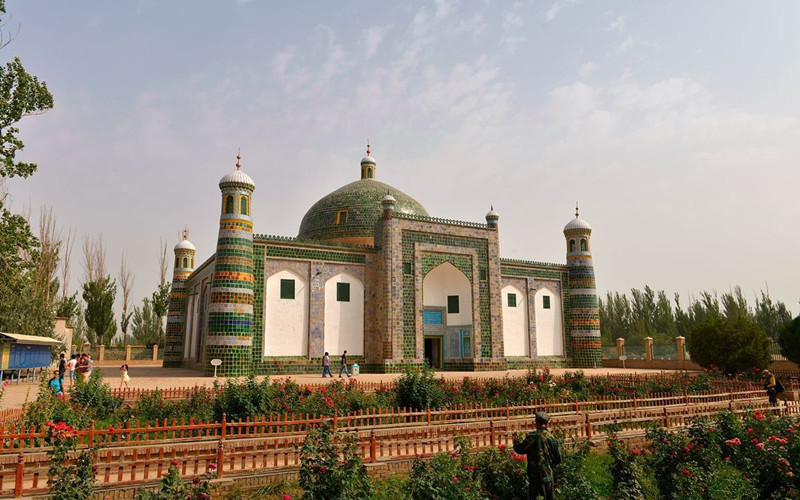 Abakh Khoja Tomb in Kashgar
 Abakh Khoja Tomb in Kashgar
Green tile domes flash between poplar leaves as you walk up the entrance drive, and the whole complex opens onto a raised platform — a mausoleum, a Friday prayer mosque, a summer prayer hall, a Islamic teaching school, and a family cemetery, all arranged around the domed main tomb. This is the largest surviving Islamic mausoleum in Xinjiang and the burial place of five generations of the Hoja family, the 17th-century Islamic teachers whose descendants shaped religious authority across the Tarim Basin.
Fact Panel — Abakh Hoja Tomb
- Location: ~5 km (3 mi) northeast of central Kashgar; ~15 minutes by taxi (often combined with Sunday Bazaar in the same half-day)
- Founded: 17th century (main tomb ~1640)
- Scale: ~30,000 sqm compound; central mausoleum ~24 m tall with a green tile-clad dome
- Ticket / Hours: ~¥45; 09:30–19:30 summer, shorter in winter
- Time Needed: 60–90 minutes with interpretation
- Highlights: Central domed mausoleum, mihrab-facing prayer hall, teaching hall, family cemetery, and the "Xiangfei" (Fragrant Concubine) narrative
The site is popularly known as the "Fragrant Concubine's Tomb" for Iparhan (伊帕尔汗) — a Uyghur woman said to have entered the Qianlong Emperor's harem in the 18th century as a peace-making gesture and whose body legend says was returned here after her death. Historians debate the story (the actual Qianlong-era Uyghur consort was likely buried in Beijing), but the folk narrative gives the site emotional weight and appears in Uyghur, Han, and Manchu retellings. Whether you take the Xiangfei story as history or folk memory, the architecture is worth an hour — the tile work, the calligraphy, and the layout of the teaching complex around the tomb show 400 years of Central Asian Islamic craft on one site.
5. Karakoram Highway to Karakul Lake, White Sand Lake & Tashkurgan
The road climbs out of the Kashgar oasis and the Pamir Plateau rises to meet you. Within 90 minutes the surface is 3,000 m (9,842 ft) above sea level, ranks of 7,000 m snow peaks fill the windscreen, and a Kyrgyz herder waves you past on a small brown pony. This is Highway G314, the Chinese portion of the Karakoram Highway to Pakistan — the highest paved international road in the world — and the day-trip to Karakul Lake (or the overnight extension to Tashkurgan) is the single most memorable thing most travellers do in Kashgar.
 Karakoram Highway G314 Muztagh Ata Kashgar
 Karakoram Highway G314 Kashgar to Tashkurgan
Fact Panel — Karakoram Highway Extension
- Route: Kashgar → White Sand Lake (白沙湖) → Karakul Lake (喀拉库勒湖) → Tashkurgan (塔什库尔干), on Highway G314
- Distances: Kashgar to Karakul Lake ~190 km (118 mi), 3–4 hours; Kashgar to Tashkurgan ~290 km (180 mi), 5–6 hours
- Elevation: Kashgar 1,289 m (4,229 ft) → Karakul Lake 3,600 m (11,811 ft) → Tashkurgan 3,090 m (10,138 ft)
- Duration: 1-day round-trip to Karakul (long day) or 2 days with a Tashkurgan overnight (much better)
- Best Time: May to October; the highway can close for snow October–April at higher passes
- Difficulty: Low physically; altitude 3,000 m+ affects some travellers with mild headache
- Permit: Border Management Area Permit (边防证) mandatory for foreign passports beyond the Ghez checkpoint (~130 km from Kashgar). See "Practical Logistics" below.
- Restricted: Khunjerab Pass (红旗拉甫口岸) — the Pakistan border crossing — is closed to foreign tourists; the closest legal viewpoint is the country-gate plaza area, not the pass itself.
- Highlights: Muztagh Ata (慕士塔格峰) 7,509 m snowcap, Karakul Lake reflections, White Sand Lake north-shore viewpoint, Kyrgyz yurt homestays, Tashkurgan Stone Fortress ruins, Tajik Ethnic Museum
The standard tour drops you at the paid south-shore parking of Karakul Lake — a fenced viewing area with entry ticket, boardwalks, and a queue for the yak-photograph spot. The alternative is the free north shore (search "白沙湖北岸" or "Kunle Qiuk Nebashi 库勒却克能巴什" on domestic map apps) — no fence, no crowd, a higher vantage, and the Muztagh Ata reflection uninterrupted. This is where Yaso Trip clients almost always end up flying drones and are alone at the water's edge; the difference is 20 minutes' drive north on the same highway.
Tashkurgan itself is worth the overnight. The Tajik-populated county town sits at 3,090 m against the Pamirs, the Stone Fortress (石头城) ruins — an ancient caravanserai overlooking the grasslands — catch late-afternoon light, and the Tajik Ethnic Museum explains the Wakhi and Sarikoli communities that most Silk Road travellers have never heard of. Return to Kashgar the next day.
Skip the Karakul Lake south-shore ticketed viewing area. Drive an additional 20 minutes north to the free White Sand Lake north-shore viewpoint — no fences, no tour buses, drone-friendly, and the classic Muztagh Ata reflection is actually better from this angle. Yak photograph on the south shore is ¥30 per person; the equivalent on the north shore, negotiated directly with a Kyrgyz herder, is ¥20. Also: some tour packages promise "the Pakistan border" and then only drive you to a distant plaza — foreigners cannot legally enter Khunjerab Pass at all, so any "border crossing photo op" is a plaza several kilometres from the actual pass. Ask specifically what you'll see before paying.
Karakoram Highway extension with permit pre-arrangement
Tour Route:Urumqi-Turpan-Kashgar
 7 Days
 4 Places
6. Handicraft Street (工艺品街) & the Living Uyghur Crafts
You turn the corner off the main Old Town lane and the noise you were following — a rhythmic metallic tap, tap, tap-tap — sharpens into a coppersmith working an unfired teapot on an anvil. Two doors down, a woodworker is chiselling the eight-sided base of a dutar. Three doors down, an old man is dyeing raw silk yarn in a copper vat. Handicraft Street is the Old Town's working-artisan spine, and it is where you buy things you'll actually keep.
Fact Panel — Handicraft Street
- Location: Ostangboyi Road (阔孜其亚贝希巷) and its side lanes on the west side of the Old Town
- Best Time: 11:00–17:00 when workshops are active
- Notable Crafts: Copper (teapots, water jugs, incense burners), dutar / rawap (Uyghur stringed instruments), Yengisar knives (英吉沙小刀), silk carpets, hand-hammered brass, raw-silk fabric, Uyghur pottery, felted wool
- Highlights: Hundred-Year Teahouse upstairs viewpoint at the top of the street; live copper-hammering and instrument-making workshops; the north-end pottery studio
The three crafts most travellers take home are: (1) a small copper teapot (~¥150–400 depending on size and finish; older, hand-hammered ones cost more than machine-formed reproductions — look for tool marks on the base as the mark of a hand piece); (2) a Yengisar knife (英吉沙小刀), historically the most famous Uyghur blade tradition, sold in decorated sheaths — check current customs rules for taking bladed items home, most airlines require they be in checked baggage; (3) a small silk atlas (爱得莱斯绸) scarf or fabric length, the distinctive Uyghur ikat-dyed silk with lightning-bolt patterns.
The Hundred-Year Teahouse (百年茶馆) at the top of Ostangboyi Road is not a craft but is the single best 30-minute stop on the west side. Take the stairs to the second-floor balcony overlooking the lane, order brick tea and a plate of dried fruits, and sit through a muqam performance if one is running. It costs the price of a pot of tea and is where locals go, not tour groups.
7. Two Hidden Kashgar Experiences Most Guides Skip
 Uyghur wedding at Qishi Grand View Garden
 Guli's Home cultural visit Kashgar Xinjiang
Sunday Bird Bazaar (家鸟巴扎). A separate market from the main Sunday Bazaar, running Sundays around the same 10:00–17:00 window. Domestic navigation apps find it under "喀春粮油有限公司" (a nearby landmark with roadside "bird market" signage). This is not livestock — this is pigeons, parrots, songbirds, chicken, and quail, sold by Uyghur men who spend Sunday morning drinking tea with their cages hanging from tree branches. There are often informal rooster fights on the periphery. No English-language guide mentions it; the crowd is entirely local, and it captures the market rhythm of southern Xinjiang more calmly than the crowded livestock ring. Combine with the main Sunday Bazaar in the same morning.
Uyghur wedding at Qishi Grand View Garden (骑仕大观园). Most Kashgar tour packages include a "Uyghur folk performance" — a staged song-and-dance in a restaurant. The real thing is different. At Qishi Grand View Garden, actual family weddings run most evenings around 20:30, and the second-floor open seating is available to walk-in diners. Order pilaf and lamb skewers, watch the dawaz tightrope walker, the collective meshrep dance, and (if you want) join in — Uyghur weddings welcome strangers, and small cash gifts to the couple's family are appreciated. Reservations recommended in advance; ask your guide to phone through.
Guli's Home cultural visit (古丽的家). A structured Uyghur family home-visit experience (~¥30 per person) with tea, seasonal fruit, and small-group dance; also a small workshop where you can make a coaster or paint a moon-plate with Uyghur motifs to take home. Better than most staged "ethnic culture villages" and small enough to feel like a household rather than a performance.
At-a-Glance: Kashgar Sites Timing Cheat Sheet
Kashgar Site Timing Cheat Sheet
Sample 6-Day Kashgar Itinerary
Kashgar rewards depth — this itinerary combines the Old Town, Sunday Bazaar, Id Kah, and a two-day Karakoram Highway extension into Karakul Lake and Tashkurgan. It follows the structure of Yaso Trip's 6-day Kashgar in-depth photography tour.
6-Day Kashgar & Karakoram In-depth Itinerary
Day 1
Arrive Urumqi — Xinjiang Museum + International Bazaar
Fly into Urumqi (URC). Afternoon at the Xinjiang Museum for the Silk Road mummies and textile collection; evening at the International Grand Bazaar for orientation lamb skewers and naan.
Day 2
Urumqi → Kashgar — Id Kah + Handicraft Street + Abakh Hoja
Morning flight to Kashgar. Afternoon Id Kah Mosque, Handicraft Street walk, and Abakh Hoja Tomb with the Xiangfei history. Overnight Kashgar.
Day 3
Kashgar → Karakul Lake — Sunday Bazaar + Pamir Plateau
Morning at Sunday Bazaar (11:00–14:00 window). Afternoon drive up the Karakoram Highway (G314) to White Sand Lake north shore and Karakul Lake with Muztagh Ata views. Overnight in a Kyrgyz-style yurt.
Day 4
Karakul Lake → Tashkurgan — Stone Fortress + Tajik Museum
Morning drive to Tashkurgan via the Pamirs; afternoon at the Stone Fortress ruins and the Tajik Ethnic Museum. Overnight Tashkurgan (3,090 m).
Day 5
Tashkurgan → Kashgar — Old Town West Side Deep Walk
Morning drive back to Kashgar. Afternoon on the Old Town west side — Hundred-Year Teahouse, Copper Street, Oil Painting Street, west city-wall sunset. Evening Hanbazha night food street.
Day 6
Kashgar Departure
Morning free for last handicraft shopping or a final visit to Id Kah Square. Transfer to Kashgar Airport for onward flight.
Book the 6-day Kashgar & Karakoram in-depth itinerary
Practical Logistics
Getting to Kashgar
Kashgar sits 1,470 km (913 mi) southwest of Urumqi across the Taklamakan Basin. Most travellers fly. Kashgar Airport (KHG) has multiple daily flights from Urumqi (~1.5 hours) and direct connections to Beijing, Shanghai, Xi'an, Guangzhou, and Chengdu — the flight is by far the most efficient option. The Southern Xinjiang high-speed rail extension links Urumqi to Kashgar in around 11–13 hours (day and overnight trains); scenic but a long journey. Driving is only relevant if you are on the Taklamakan Desert Highway self-drive circuit — Urumqi to Kashgar by G30/G3012 is 18–20 hours split over two days.
For the wider corridor logistics — flights, trains, and road transfers between every Silk Road city — see our Silk Road transportation guide .
The Xinjiang Time Difference
Kashgar runs on Beijing time officially but functions on an informal ~2-hour delay. Sunrise arrives around 07:30 in summer and sunset is close to 22:00; the working day starts around 10:00 and dinner is at 20:00 or later. Plan Sunday Bazaar for the local rhythm — traders arrive at 10:00 (Beijing time), not 08:00. Restaurants stay open past 22:00 in the Old Town; adjust your body clock to add roughly 90 minutes to every meal.
Border Management Area Permit (边防证) for the Karakoram Highway
Any foreign visitor going beyond the Ghez (盖孜) checkpoint on Highway G314 — which includes White Sand Lake, Karakul Lake, Tashkurgan, and the whole Pamir extension — must hold a Border Management Area Permit (边防证). This is a small paper permit issued free of charge but the workflow for foreigners has specific 2026 rules.
- Foreign passports cannot use the online mini-program. From 15 April 2026, mainland Chinese citizens can apply through the "Immigration Bureau 12367" mini-program and receive an electronic border pass in seconds. Foreign passports, HK/Macau, and Taiwan permits are not eligible for the online channel and must apply in person.
- Location matters. In Kashgar, foreign-passport applications for the Border Management Area Permit are handled at specific designated PSB (Public Security Bureau) service points — currently the Kashgar International Self-Drive & RV Camp Comprehensive Service Hall (喀什国际自驾车与房车营地综合服务大厅) on the G314 road, or the Kashgar Airport PSB duty room during operating hours. Regular local police stations inside the Old Town typically will not process foreign-passport applications.
- Bring the paperwork. Passport with valid visa, plus a temporary residence registration certificate (临时住宿登记证明) from the hotel you checked into in Kashgar — the officer usually asks for this. Your route (which counties you'll enter) also needs to be declared.
- Timing. The application itself takes 5–10 minutes at the window if there's no queue; peak-season Sunday and holiday queues can add 1–2 hours. Budget half a day of your arrival day in Kashgar. The permit is valid for one month.
- Avoid the 14:00–16:00 lunch break window and weekend hours — the foreign-passport window may not be staffed.
- Khunjerab Pass (红旗拉甫口岸) remains closed to foreign tourists. No permit, in any category, will get a foreign passport into the pass itself. The closest legal viewpoint is the country-gate plaza area near Tashkurgan — a legitimate stop, but not "the border."
Yaso Trip pre-collects your passport and visa page before arrival, pre-books a compatible hotel to generate the residence certificate, and sends a guide with you to the correct PSB service hall to shortcut queues — compressing what can otherwise be a full-day PSB visit into 30 minutes.
For the full Xinjiang-corridor permit and access picture, see the Xinjiang travel guide .
Hotel Foreign-Guest Registration in Kashgar
Under Chinese law, foreign guests must be registered with the local police within 24 hours of arrival, and only hotels holding a foreign-guest license (涉外资质) can process this at check-in. In Kashgar city there are around 15–25 currently-licensed properties — most international-standard four- and five-star hotels and long-standing business hotels, plus a small number of higher-end boutique guesthouses. Many mid-price local hotels and Old Town family guesthouses are not licensed and will refuse foreign guests at the door. Booking through your agency or confirming the foreign-registration capability directly with the property (in Chinese) is the reliable path — do not rely on OTA "accepts foreign guests" filter labels alone.
Best Time to Visit Kashgar
- April to June: Ideal. Warm days (18–28°C / 64–82°F), pleasant nights, the Karakoram Highway is fully open, the Sunday Bazaar is at full strength, and the Old Town isn't at peak crowds.
- July to mid-August: Peak visitor season. Days can hit 35°C (95°F) in the oasis but the Pamirs are pleasantly cool at 10–20°C (50–68°F). Best window for combining Kashgar with Northern Xinjiang's alpine lakes.
- September to mid-October: The other ideal window. Cooler weather, harvest colours on the fruit orchards around Kashgar, still-warm Karakoram days.
- Late October to March: Kashgar city stays open and mild-cold, but the Karakoram Highway can close for snow above Ghez, closing Karakul Lake and Tashkurgan. Sunday Bazaar continues year-round but with reduced livestock volume.
Peak local demand is Chinese domestic golden weeks (early October) and Uyghur Corban Festival (dates vary annually) — avoid those weeks if you can.
For a corridor-wide seasonal picture across Xi'an, Gansu, and Xinjiang, see our best time to visit the Silk Road guide .
How to Behave in Kashgar: Etiquette, Photography, Language
- Ask before you photograph people. This is the single most important etiquette rule in Kashgar. A smile, gesture toward the camera, and nod is enough — most Uyghur elders at Id Kah Square or the Sunday Bazaar will nod yes or wave you off. Never take portrait shots of Uyghur women in a mosque courtyard, and never photograph inside a working mosque during prayer.
- Do not photograph security infrastructure. Checkpoints, police stations, military vehicles are off-limits. Standard for all of Xinjiang.
- Dress modestly in mosques. Long sleeves and long trousers or skirts. Women appreciate a light headscarf inside Id Kah's prayer hall; men remove hats.
- Cost: not appropriate to itemise in a route guide. For a per-person cost breakdown of a Kashgar trip tailored to your group size, dates, and preferences, contact the Yaso Trip team for a custom quote.
- Language. Uyghur is the everyday language; Mandarin is widely understood by younger Kashgaris and shop staff; English is rarely useful outside hotels. Your guide translates.
- Payment. WeChat Pay and Alipay work everywhere. Small vendors at the Sunday Bazaar and Handicraft Street prefer cash — keep small ¥ notes.
Tips & Cautions
- Sunday is fixed. If your Kashgar itinerary is 3 days, one of those must be a Sunday for the Bazaar. Do not build a Kashgar trip that misses the Sunday.
- The Karakoram Highway needs the border pass. Do not attempt White Sand Lake, Karakul Lake, or Tashkurgan without arranging the pass first — the Ghez checkpoint will turn foreign passports back.
- Altitude at Karakul (3,600 m) and Tashkurgan (3,090 m). Most travellers are fine; those with cardiac or respiratory conditions should discuss with a doctor. Symptoms — headache, dizziness, nausea — usually resolve after 24 hours acclimatising; if severe, descend to Kashgar.
- Midday sun in Kashgar is punishing in summer. Xinjiang's ~2-hour local time shift means midday is 14:00–16:00, not 12:00–14:00. Retreat to the hotel for an hour or two and re-emerge after 16:00 — locals do the same.
- Drone rules. Drones are broadly allowed in Kashgar city and at the free Karakul north-shore area; not at the airport, PSB areas, or military zones. Register the drone with your local authority as required by Chinese aviation rules; your guide can advise.
- Currency at the Sunday Bazaar. Small vendors often prefer cash; the food-and-goods bazaar is fully WeChat Pay-enabled but ¥10, ¥20, ¥50 notes remain useful for bargaining.
As of 2026, the following areas around Kashgar and Xinjiang are closed to foreign passports even with a Border Management Area Permit: Khunjerab Pass (红旗拉甫口岸, Pakistan border), Horgos Port (霍尔果斯口岸, Kazakhstan border), Baihaba (白哈巴) in the far north, Bayanbulak (巴音布鲁克, foreigners only) grasslands, and Hejing County (和静县). Foreigners CAN visit Kashgar city, the full Old Town, Karakul Lake, White Sand Lake, and Tashkurgan county (with permit). Some tour packages sold to domestic Chinese travellers include restricted-zone stops — verify the itinerary is foreign-passport-compatible before booking.
Why Travel Kashgar with Yaso Trip
Kashgar is a city where the difference between a good trip and an average one is entirely about the details — which Old Town gate you enter, which hour you arrive at the Sunday Bazaar, which shore of Karakul Lake you photograph from, whether the Border Management Area Permit is waiting for you or you are queuing for it. These are not itinerary questions. They are operational ones, and they are what a local team solves in advance.
- Border Management Area Permit pre-arrangement. We collect your passport and visa page before arrival, secure your hotel's temporary residence certificate, and send a guide to the correct PSB service hall on your arrival day — 30 minutes instead of half a day of your trip.
- Uyghur-speaking local guides. Our Kashgar guides live in the city, speak Uyghur, and have the coppersmith / teahouse / vineyard / Kyrgyz-herder relationships that turn photo stops into workshop visits.
- Old Town route design. East side for ceremony and food, west side for artisan work and residential rhythm — split in the right order so you experience both, without the "instagram alley" queues.
- Karakoram Highway logistics. Vehicle, driver, permit, hotels — the entire Pamir extension handled so all you do is look out the window.
Whether you have four days for Kashgar city plus one Karakoram day, six days for the deep Kashgar + Tashkurgan experience, or three weeks for a full Silk Road corridor from Xi'an through Gansu and across all of Xinjiang, we build the itinerary around your dates and interests.
Extend Kashgar into a full 23-day Xinjiang panorama
Tour Route:Urumqi-Kanas Lake-Karamay-Aksu-Kashgar-Korla-Turpan
23 Days 10 Places View DetailReady to Plan Your Kashgar Trip?
Every Kashgar trip is different. Some travellers want three days for the Old Town and the Sunday Bazaar; some want a proper Pamir extension to Tashkurgan; some want to combine Kashgar with the full Xinjiang loop or with a Central Asia self-drive. Tell our Silk Road team your dates, interests, and travel style, and we'll build the itinerary — with the border permits, foreign-registration-cleared hotels, Uyghur-speaking guides, and the west-side Old Town lanes — around what actually matters to you.
Plan a full Silk Road panorama that ends in Kashgar
Tour Route:Beijing-Xian-Lanzhou-Wuwei-Zhangye-Jiayuguan-Dunhuang-Turpan-Urumqi-Kashgar-Shanghai
19 Days 13 Places View Detail


 View All China Tours




 View All China Theme Tours by Interest


 Home