Is Harbin Halal Friendly for Muslim Travelers?
Harbin (哈尔滨) is one of China's most exciting winter destinations — and yes, Muslim travelers can experience it comfortably. The city has a well-established Hui Muslim community centered in the Daowai District (道外区), home to century-old halal restaurants and the largest mosque in Northeast China. Halal lamb hot pot, hand-wrapped beef shaomai, and braised mutton line the streets around the Daowai Mosque (道外清真寺), while newer halal options have appeared near Central Street and even inside the Harbin Ice and Snow World (冰雪大世界). The key to a great Harbin Muslim tour is advance planning — knowing where to eat, where to pray, and how to manage religious obligations in temperatures that regularly drop to −20°C (−4°F). This guide covers all of it, from mosque locations and halal restaurant recommendations to winter clothing strategy and family-friendly Ice Festival logistics.
Key Takeaways
✔ Harbin's Daowai District has a deep-rooted Hui Muslim food culture with century-old halal restaurants serving lamb, beef, and mutton specialties — no need to compromise on dining.
✔ The Daowai Mosque (道外清真寺), built in 1897, is the largest Islamic mosque in Northeast China and welcomes foreign Muslim visitors with heated indoor wudu facilities year-round.
✔ The Harbin Ice and Snow World now has halal dining options inside the venue, including a dedicated halal hot pot and stir-fry restaurant — a significant improvement over previous years.
✔ The Tatar Mosque (鞑靼清真寺) near Central Street is the only Tatar mosque in northern China, blending Byzantine and Arabian architecture — a rare cultural landmark worth visiting.
✔ Combining Beijing and Harbin is the most practical itinerary for Muslim travelers, with high-speed rail connecting the two cities in approximately 4.5 hours.
✔ Extreme cold is the primary challenge — heated vehicles, indoor prayer arrangements, and a layered clothing strategy make the experience manageable and rewarding.
✔ Families with children should enter the Ice and Snow World around 12:30–1:00 PM when temperatures are warmest, and note that the Super Ice Slide requires visitors to be 15+ years old and over 160 cm (5 ft 3 in) tall.
Why Harbin Belongs on a Muslim Traveler's Winter Bucket List
 Harbin Ice and Snow World illuminated ice palace winter night
 Central Street Harbin winter snow European architecture
Steam rises from a copper pot filled with tender sliced lamb while frost patterns climb the restaurant window. Outside, the temperature reads −25°C (−13°F). Inside the halal hot pot restaurant near Daowai Mosque, your family is warm, fed, and 15 minutes from one of the most extraordinary ice sculpture parks on Earth.
Harbin is not Xi'an (西安) or Kashgar (喀什) — it is not a historically Muslim city, and it does not have the density of halal dining those destinations offer. What Harbin delivers is something different and genuinely rare: a winter experience of global caliber in a city where Muslim travelers can eat, pray, and explore with confidence.
- World-class winter spectacle — The Harbin Ice and Snow World features over 2,000 illuminated ice sculptures carved from blocks harvested directly from the frozen Songhua River (松花江), spread across a park that covered over 1 million square meters (247+ acres) in recent seasons.
- Deep-rooted Hui Muslim food culture — Harbin's Daowai District has served halal lamb, beef, and mutton dishes for over a century. Restaurants like Laorenyi (老仁义饭店) have operated continuously since the late Qing Dynasty.
- Historic mosques with winter-ready facilities — The Daowai Mosque's minaret and triple green domes mark one of Northeast China's most architecturally striking Islamic buildings, with heated indoor wudu rooms that function through the harshest winter months.
- Improving Muslim-friendly infrastructure — Over the past two to three years, halal dining options have expanded beyond the traditional Daowai cluster, with new halal restaurants near Central Street and dedicated halal food stalls inside the Ice and Snow World venue.
- Natural Beijing combination — A high-speed train connects Beijing and Harbin in approximately 4.5 hours, making it easy to combine a Beijing Muslim tour with Harbin's winter attractions.
Harbin's Hui Muslim Community and Mosques (哈尔滨清真寺)
The minaret of the Daowai Mosque rises above the low-rise rooftops of southern Daowai, its green domes visible from several blocks away. Pigeons circle the tower in the cold morning air while the first call to prayer echoes through streets that have served Harbin's Hui community since the late nineteenth century.
Harbin's Muslim heritage is quieter than Xi'an's or Kashgar's, but it runs deep. The Hui community established itself here during the late Qing Dynasty, drawn by trade along the Chinese Eastern Railway. Today, four mosques serve the city's Muslim residents and welcome foreign visitors.
 Harbin Daowai Mosque green domes minaret Arabian architecture
 Tatar Mosque Harbin Byzantine Arabian style heritage building
Daowai Mosque (哈尔滨道外清真寺)
Located at No. 54 South Thirteenth Street, Daowai District (道外区南十三道街54号), inside the Arabian Square (阿拉伯广场), this is the largest Islamic mosque in Northeast China. Built in 1897, the mosque is one of the few pure Arabian-style Islamic buildings in China, with a prominent minaret and three green domes crowning the main prayer hall. The mosque is equipped with heated indoor ablution rooms (wudu facilities), a rest area, and regularly receives international Muslim visitors from Arab and West Asian countries. Metro Line 3 — Qingzhensi Station (清真寺站) — provides direct access.
Tatar Mosque (鞑靼清真寺)
Situated at No. 108 Tongjiang Street, Daoli District (道里区通江街108号), just steps from Central Street (中央大街), the Tatar Mosque is the only Tatar Muslim mosque in northern China. Its architecture fuses Byzantine and Arabian elements into a distinctive silhouette. Currently operating as a heritage exhibition hall and cultural landmark, the mosque also houses a Turkish coffee shop on the second floor. Opening hours can be irregular — confirm before visiting through your hotel or guide. The basement level includes wudu facilities.
Acheng Mosque (阿城清真寺)
Located in Acheng District (阿城区), approximately 50 km (31 mi) southeast of downtown Harbin, this mosque dates to 1777 and holds national-level cultural heritage protection status. Unlike the Arabian-style Daowai Mosque, Acheng Mosque follows a traditional Chinese courtyard (四合院) layout integrated with Islamic decorative elements — a rare example of localized Islamic architectural aesthetics in northern China.
Xiangfang Mosque (香坊清真寺)
Situated at No. 4 (auxiliary) Songshan Road, Xiangfang District (香坊区嵩山路副4号), this mosque serves the Xiangfang community. It is farther from the main tourist areas and is best visited if your itinerary passes through the district.
Harbin winter days are short — sunrise is around 7:00 AM and sunset falls before 4:00 PM in December and January, compressing the window between Dhuhr and Maghrib prayers. Plan indoor prayer locations in advance, especially on days spent at outdoor attractions. Your Yaso Trip guide carries portable prayer mats and coordinates heated indoor spaces for prayer stops throughout the day.
Halal Food in Harbin — Where and What to Eat
The scent of cumin-rubbed lamb ribs drifts from a charcoal grill propped against the snow-dusted sidewalk. A few steps further, a window counter displays rows of hand-pleated beef shaomai, their wrappers thin enough to show the dark filling through the dough. This is the halal food corridor around Daowai Mosque — Harbin's undisputed center for Muslim dining.
Harbin's halal food scene is anchored in the Hui tradition of slow-braised beef and lamb, charcoal-fired hot pot, and hand-wrapped dumplings. It is concentrated but authentic, and it has been expanding in recent years.
 Harbin halal copper pot charcoal lamb hot pot Daowai District
 Halal beef shaomai hand-wrapped Harbin traditional Muslim food
Near Central Street and Zhaolin Park
These restaurants are within walking distance of Harbin's most popular tourist zone:
- Laojiangyan Halal Charcoal Hot Pot (老江沿清真炭火锅) — Traditional copper-pot charcoal hot pot. The Xiqi lamb stays tender through extended cooking, served with pure sesame paste dipping sauce and rose-oil fried pastries. A few minutes' walk from Central Street — the best option for warming up after a winter evening stroll.
- Shunhexiang Halal Garden Restaurant (顺和祥清真花园餐厅) — Garden-style setting suited for family and group dining. Signature dishes include guobao beef (锅包牛肉), braised beef strips (扒牛肉条), and stewed beef ribs (清炖牛肋骨). Open kitchen, clean and well-maintained.
- Ayiguli Xinjiang Restaurant (艾依姑丽新疆餐厅, Central Street branch) — Uyghur cuisine near Youyi Gong metro station. Xinjiang-style lamb skewers, crispy baked samsa (烤包子), and vegetable pilaf (素抓饭). The ethnic decor and family-friendly atmosphere make it a good option for travelers craving Xinjiang flavors.
Inside the Ice and Snow World (冰雪大世界)
- Binshengyuan Halal (缤圣源清真菜) — Located inside the Ice and Snow World food hall. The first floor serves halal hot pot; the second floor offers stir-fried dishes including braised beef strips, beef shaomai, and braised lamb leg. Portions are prepared in advance during peak hours and prices run higher than off-site restaurants, but having a warm halal dining option inside the park — where outdoor temperatures can reach −30°C (−22°F) — eliminates the need to carry food or leave the venue mid-visit.
Daowai District Halal Heritage Restaurants (道外清真老店)
Worth a dedicated visit for food-focused travelers:
- Laorenyi Restaurant (老仁义饭店) — A century-old halal institution on Jingyu Street (靖宇街). The signature braised beef (扒肉) uses fresh beef slow-cooked until rich but not greasy. The shaomai, tripe, and braised lamb strips have earned the loyalty of local drivers and serious food lovers. Located near the exit of a major shopping area — you walk out and face Saint Sophia Cathedral.
- Laodaowai Yiteng Baodu Zhang (老道外伊腾爆肚张) — A family-run shop in the Beiqi residential area for over 30 years. The flash-boiled tripe (水爆肚) is the signature — precisely timed to preserve a slight crunch — served alongside braised beef strips and crispy fried pork-belly-style beef strips (焦烧肉条). Generous portions. Walk here after exploring the Chinese Baroque historic district (中华巴洛克街区).
- Halal Ma Family Shaomai (清真马家烧麦) — Hand-rolled wrappers, thin-skinned beef shaomai served with yellow mustard and vinegar. In autumn and winter, pair with a bowl of lamb broth — one of Harbin's most warming halal meals.
Central Street's famous Madieer Ice Cream (马迭尔冰棍) and Russian-style sausages (哈尔滨红肠) are not halal — they contain pork or pork-derived ingredients. Muslim travelers should skip these widely promoted snacks and instead head to the halal restaurants listed above, all within a short walk or taxi ride from Central Street. If booking a "Russian-style dinner" experience at a tour restaurant, confirm in advance that the kitchen uses no pork products or alcohol in cooking.
Top Winter Attractions with Muslim Travel Tips
 Harbin Ice and Snow World
 Sun Island Snow Sculpture Harbin
Harbin Ice and Snow World (冰雪大世界)
Thousands of ice blocks glow amber, blue, and violet under LED arrays, their frozen surfaces catching and scattering light across a park the size of 115 football fields. Towers, pagodas, castles, and replicas of world landmarks rise from the frozen ground — all carved from ice harvested directly from the Songhua River.
The Harbin Ice and Snow World is the centerpiece of the annual Harbin International Ice and Snow Festival. The park typically opens in mid-to-late December and closes in late February, depending on temperature and ice conditions. As of the most recent season, adult tickets are approximately ¥328 (about $45 USD). Tickets must be purchased through the official "Harbin Ice and Snow World" (哈尔滨冰雪大世界) WeChat mini-program or authorized travel platforms — avoid scalpers.
Muslim travel tip: The park now has halal dining inside the food hall (Binshengyuan, 缤圣源). No dedicated prayer room exists inside the venue — plan prayer times around your visit by using the Daowai Mosque or a hotel prayer space before entering, or bring a portable prayer mat and use the indoor rest areas. Enter around 12:30–1:00 PM for the warmest daytime temperatures; stay through sunset (around 4:00 PM) for the full lighting spectacle, and exit by 6:00 PM for dinner.
Explore Harbin's iconic winter festival with Yaso Trip
Tour Route:Shenyang-Changbai Mountains-Harbin-China Snow Town-Harbin
 9 Days
 9 Places
Sun Island Snow Sculpture Art Expo (太阳岛国际雪雕艺术博览会)
Morning sunlight strikes a 20-meter snow dragon whose scales catch shadow and glare in equal measure. Behind it, a snow-carved palace rises three stories high, its turrets sharp against the blue winter sky. This is the Sun Island Snow Sculpture Art Expo — an open-air gallery of massive snow sculptures spread across 600,000 square meters (148 acres).
Located on Sun Island Scenic Resort (太阳岛风景区) across the Songhua River, the expo showcases works by artists from around the world. Sunglasses are essential — the reflected glare from snow under bright winter sun can strain unprotected eyes within minutes.
Muslim travel tip: No dedicated halal food options are available on Sun Island itself. Eat a substantial halal breakfast at your hotel or a Daowai restaurant before crossing the river, and carry packaged halal snacks for the visit.
Central Street (中央大街) and Saint Sophia Cathedral (圣索菲亚大教堂)
Cobblestones smoothed by a century of foot traffic run 1.45 km (0.9 mi) through a corridor of Baroque, Renaissance, and Art Nouveau facades. In winter, the European-style buildings wear caps of snow and frames of icicles, and the street fills with vendors, performers, and families bundled against the cold.
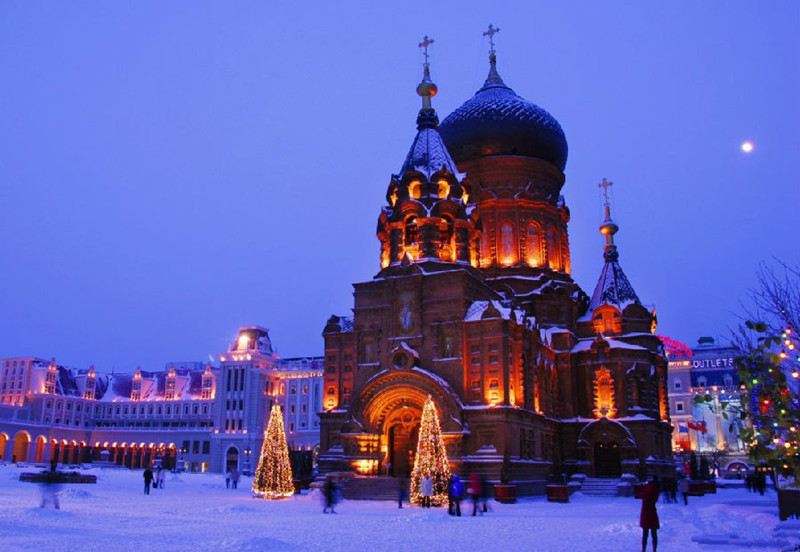
Central Street is Harbin's most walkable tourist zone and makes a natural base for exploration. Saint Sophia Cathedral, built in 1907 in Russian Orthodox style with its green onion dome, now serves as an architectural art gallery. The Tatar Mosque is a short walk from the northern end of Central Street — combine a cathedral visit with a stop at the mosque and Turkish coffee on the second floor.
Muslim travel tip: The halal restaurants listed in the food section above — Laojiangyan, Shunhexiang, and Ayiguli — are all within walking distance of Central Street. Plan lunch or dinner here between sightseeing stops.
 Saint Sophia Cathedral snow covered
 Siberian Tiger Park in Harbin
Siberian Tiger Park (东北虎林园)
A Siberian tiger lifts its head from the snow, amber eyes tracking the safari bus as it rolls through the enclosure. In the next clearing, a white tiger rests against a snowdrift, nearly invisible until it moves.
The Siberian Tiger Park is the world's largest breeding center for endangered Siberian tigers (东北虎), housing over 1,000 purebred animals. Visitors observe the tigers from secure safari-style buses that pass through large open habitats. Optional feeding demonstrations are available at additional cost.
Muslim travel tip: The park is in a semi-remote area on the northern bank of the Songhua River with limited food options. Eat before you go. Visit duration is typically 1.5–2 hours. Combine this stop with Sun Island, which is nearby.
Snow Town / China Snow Village (中国雪乡)
Red lanterns glow against snow that sits in thick, rounded layers on every roof and fence post, shaped by wind into formations the locals call "snow mushrooms" (雪蘑菇). Smoke curls from chimneys into the frozen night air. The snow in Shuangfeng Forest Farm (双峰林场) averages nearly 2 meters (6.5 ft) deep and has a sticky quality that clings to structures in dramatic, sculptural shapes.
Snow Town is approximately 280 km (174 mi) from Harbin — a 5 to 6 hour drive through mountainous terrain. It is China's most photographed winter village and a core component of most multi-day Harbin winter itineraries.
Snow Town (雪乡) has very few — if any — halal restaurants. Muslim travelers should pre-arrange halal meals through their tour operator before arrival. Yaso Trip coordinates in advance with local accommodation to prepare halal-compliant meals or provides a packed halal meal option for the Snow Town portion of the itinerary. Carry packaged halal snacks as backup.
 Hot water ice-throwing Snow Village Harbin winter
 Songhua River frozen ice activities winter Harbin
Songhua River Winter Activities (松花江冬季活动)
The frozen surface of the Songhua River becomes a vast natural playground every winter — locals and visitors skate, ride ice bicycles, tube down ice slides, and even drive snowmobiles across the thick river ice. The enormous ice blocks used to build the sculptures at Ice and Snow World are harvested directly from this river each year.
Muslim travel tip: Activities on the river are outdoors and exposed. Limit each session to 1–1.5 hours and warm up at a nearby indoor venue. Stalin Park (斯大林公园) borders the south bank and has heated rest areas.
Harbin Winter Attractions at a Glance
Harbin Winter Attractions for Muslim Travelers
Sample Itinerary — 5-Day Muslim-Friendly Harbin Winter Tour
5-Day Harbin Muslim Winter Tour Itinerary
Day 1
Arrive in Harbin
Arrive at Harbin Taiping International Airport (哈尔滨太平国际机场). Private transfer to hotel. Evening stroll on Central Street; dinner at Laojiangyan Halal Hot Pot.
Day 2
Ice and Snow World & Daowai
Morning visit Daowai Mosque and halal breakfast in the mosque quarter. Afternoon enter Ice and Snow World (12:30 PM); halal lunch inside at Binshengyuan. Stay for night lighting; exit by 6 PM.
Day 3
Sun Island & Tiger Park
Morning visit Sun Island Snow Sculpture Expo; early halal lunch at Shunhexiang. Afternoon safari at Siberian Tiger Park. Evening explore Tatar Mosque area and Turkish coffee.
Day 4
Snow Town Day Trip
Full day excursion to Snow Town via Yaxue Highway. Pre-arranged halal meals provided by Yaso Trip. Photography, horse-drawn sleigh, and village walking. Return to Harbin or overnight.
Day 5
Departure
Morning visit Chinese Baroque district (中华巴洛克) in Daowai; halal breakfast at Laorenyi. Shop for souvenirs — Harbin red sausage is not halal but dried fruits, chocolates, and Russian bread (confirm ingredients) make good gifts. Transfer to airport.
💡
Extend your trip
Combine Harbin with a
Beijing Muslim tour for a complete 7–8 day winter experience. Travel Beijing first, then take the high-speed train to Harbin — the gradual cold acclimation makes the transition smoother.
Tour Route:Harbin-Changchun-Jilin City-Shenyang-Dalian
8 Days 4 Places View DetailPractical Logistics
Best Time to Visit Harbin
Harbin's winter festival season runs from mid-December through late February. The Ice and Snow World typically opens in mid-to-late December and closes when rising temperatures compromise the ice structures, usually by late February. January is the coldest month — expect daytime highs around −15°C (5°F) and nighttime lows reaching −30°C (−22°F) or below.
For Muslim travelers, timing around Ramadan and Eid requires advance coordination. Because Harbin's winter season is fixed by climate, Ramadan months that fall during this period (check the Hijri calendar for each year) mean shorter fasting days due to early sunset — sunrise around 7:00 AM and sunset before 4:00 PM in December and January, resulting in fasting windows of approximately 8–9 hours. Your Yaso Trip guide coordinates meal timing around iftar and suhoor schedules when needed.
How to Get to Harbin
Beijing–Harbin combination note: The high-speed rail route is the most practical connection — 4.5 hours, comfortable seating, direct metro access at both ends. The recommended travel direction is Beijing first, Harbin second. This allows your body to acclimate gradually to the cold rather than transitioning abruptly from extreme cold back to moderate temperatures, which commonly triggers colds and fatigue.
What to Wear in Harbin Winter
The three-layer system is non-negotiable at −20°C to −30°C (−4°F to −22°F):
- Base layer: Moisture-wicking synthetic fabric — avoid cotton, which traps sweat and accelerates heat loss.
- Mid layer: Fleece or lightweight down for insulation.
- Outer layer: Wind- and waterproof long down jacket, rated to at least −30°C.
- Feet: Waterproof, non-slip snow boots (buy 1–2 sizes larger for wool insoles and heat packs). Anti-slip crampons are recommended for icy surfaces.
- Hands and head: Waterproof thermal gloves and a wind-blocking hat that covers the ears. For children, add a wind-resistant face mask or balaclava.
- Phone: Stick adhesive heat pads to the back of your phone. At −20°C, unprotected phones shut down within minutes, leaving you without camera, maps, or payment apps.
For families with children: Pack 2–3 extra sets of base layers and socks per child per day. Children sweat and get wet in snow — changing into dry layers immediately after coming indoors is the single most effective way to prevent colds.
Halal Hotels and Prayer Facilities
Harbin does not have officially "halal-certified" hotels in the same way that cities like Xi'an or Kuala Lumpur do. However, many four- and five-star hotels can accommodate Muslim guests when notified in advance:
- Request qibla direction and a prayer mat at check-in — most international-standard hotels can provide these.
- Request halal breakfast arrangements — some hotels can source halal ingredients for a modified breakfast; alternatively, eat breakfast at a nearby halal restaurant (Daowai is a short taxi ride from most downtown hotels).
- Yaso Trip pre-selects hotels with experience hosting Muslim guests and confirms halal meal arrangements before your arrival.
Managing Prayer in Extreme Cold
Performing wudu and salah in a city where outdoor temperatures can kill exposed skin in minutes requires practical planning:
- Mosques: The Daowai Mosque and Tatar Mosque both have heated indoor wudu rooms. Harbin's indoor heating is powerful — mosque interiors typically run 20–24°C (68–75°F) even when it is −25°C outside.
- In transit: Yaso Trip provides portable prayer mats and insulated water bottles in the tour vehicle. When visiting outdoor attractions, wudu and prayer are arranged at hotels, restaurants, or mosques before or after the excursion — never outdoors.
- Inside venues: The Ice and Snow World has indoor rest areas and the food hall where prayer can be performed discreetly with a portable mat. Confirm with your guide which indoor spaces are suitable before entering.
For an accurate cost breakdown tailored to your group size, dates, and preferences, contact the Yaso Trip team for a custom quote.
Tips and Cautions
Smartphone batteries drain rapidly and shut down at temperatures below −10°C (14°F). Stick adhesive heat pads directly to the back of your phone and keep it in an inner jacket pocket between uses. Carry a fully charged power bank — also kept warm in your jacket — as backup. Losing your phone means losing WeChat Pay, maps, and your ticket QR codes.
- Confirm restaurant hours before heading out. Harbin's extreme winter temperatures cause some smaller halal restaurants and morning market stalls to close early or adjust hours without notice. Call ahead or ask your guide to confirm.
- Respect mosque etiquette. Dress modestly and remove shoes before entering prayer areas. Non-Muslim companions may visit exterior grounds and designated exhibition areas but should avoid the main prayer hall during salah times, particularly Friday Jummah.
- Avoid alcohol-heavy dining environments. Harbin has a strong drinking culture — beer and baijiu feature prominently in many mainstream restaurants. When booking any non-halal restaurant or "Russian-style dinner" experience, confirm in advance that the kitchen does not use pork products or alcohol in cooking and that cross-contamination is controlled.
- Pre-arrange Snow Town meals. Halal options in Snow Town are essentially nonexistent at the time of writing. Treat this as a packed-meal situation and plan accordingly.
- Warm up every 1.5–2 hours. Cycle between outdoor attractions and indoor spaces — restaurants, malls, exhibition halls — to reset body temperature. Extended outdoor exposure beyond two hours risks frostbite and exhaustion, especially for children and elderly travelers.
- Book Ice and Snow World activities immediately upon entry. The Super Ice Slide and Snowflake Ferris Wheel operate on a timed reservation system via QR code inside the park. Slots are released every 2 hours and fill quickly — scan and reserve as soon as you enter.
- Hydrate and moisturize. Harbin's winter air is extremely dry. Indoor heating amplifies dehydration. Carry a water bottle, lip balm, and high-moisture skincare.
- Pre-book Beijing attractions if combining cities. The Forbidden City, National Museum, and Unit 731 Memorial in Harbin all require advance reservations through official WeChat accounts. Tickets sell out days or weeks ahead during peak season.
Why Travel with Yaso Trip
- Halal meal pre-arrangement at every stop. Yaso Trip confirms halal dining for every meal on the itinerary — from century-old Daowai restaurants to in-park halal options at the Ice and Snow World. When halal restaurants are unavailable (Snow Town, remote scenic areas), the team provides pre-packed halal meals coordinated with trusted local suppliers.
- Prayer logistics built into the schedule. Every itinerary includes timed mosque visits and designated indoor prayer spaces. The vehicle carries portable prayer mats and warm water for wudu. The team never asks you to pray outdoors in subzero conditions.
- Heated private vehicles, point-to-point. A warm, private vehicle meets you at every transition — hotel to venue, venue to restaurant, city to Snow Town. Waiting in outdoor cold is eliminated from the itinerary.
- Cold-weather equipment and guidance. The team can arrange rental of professional-grade winter clothing (extended down jackets, non-slip snow boots, heat packs) and provides practical cold-weather briefings, including the phone-warming technique and the indoor-rotation strategy that keeps families comfortable throughout multi-hour outdoor excursions.
Experience Harbin's Ice Festival with halal-friendly arrangements
Tour Route:Harbin-China Snow Town-Yabuli International Ski Resort in Harbin-Harbin
7 Days 5 Places View DetailPlan Your Harbin Muslim Winter Tour
Harbin proves that Muslim travelers do not need to limit their China experience to the Silk Road corridor. With advance halal meal planning, prayer-stop coordination, and a cold-weather strategy, your family can experience the world's largest ice sculpture park, century-old Hui cuisine, and one of China's most dramatic winter landscapes — all without compromising on faith or comfort.
Ready to build your itinerary? Yaso Trip's local team handles halal dining reservations, mosque visit scheduling, heated transportation, and winter equipment — so you can focus on the ice, the food, and the snow.


 View All China Tours




 View All China Theme Tours by Interest


 Home