China Travel Agency, China Tours 2026/2027 | Yaso Trip
Theme Tours
View All China Theme Tours by Interest
Travel Guide
  • Travel Guide
  • Travel Tips
  • Tour Planning
  • Ethnic Culture
  • China Climate
  • Golf Courses
  • Yangtze Cruise
  • Travel Articles
  • Dunhuang Travel Guide: Mogao Caves, Crescent Lake & Mingsha 2026/2027

    2026-08-02•Xu Yang Fan•25783 words•About 86 minutes

    Quick Answer: What Is Dunhuang and Why Visit?

    Dunhuang (敦煌) is a small oasis city in western Gansu at the western end of the Hexi Corridor, and the single most iconic destination on the entire Silk Road. Travelers come for three things: the Mogao Caves (莫高窟), a 1,600-year-old Buddhist cave complex holding some of the finest early medieval murals in the world; the Crescent Lake and Mingsha Sand Dunes (月牙泉 & 鸣沙山), an oasis-in-the-desert directly outside town; and the Yadan-Yumen Pass desert loop, a Han-dynasty frontier landscape reachable in a single day trip. A well-planned Dunhuang visit takes 3–4 full days, and most of the friction — Mogao's foreigner-ticketing quirks, the Mingsha crowd surge, the Yadan sunset timing — is solved by going with a local operator who knows the current 2026 access rules.

    Key Takeaways

    • ✔ Three days is the sweet spot. One day covers Mogao + Mingsha, one covers the Yumen Pass–Yadan desert loop, and one adds Yulin Caves in Guazhou — the "sister" cave complex most guides skip.
    • ✔ Mogao tickets sell out. In July, August and around National Day (October 1–3), the 6,000-per-day A-ticket often disappears within 10–30 minutes of the 07:00 release, 30 days out.
    • ✔ English-language guide slots at Mogao are limited. Only two official English tours run each day (typically 09:30 and 11:30); miss them and you get slotted into a Chinese group with a translation handset.
    • ✔ Mingsha is a three-day ticket. Your Mingsha & Crescent Lake ticket is reusable for 3 days — locals use it for a dawn visit, a sunset visit, and a post-crowd stargazing return.
    • ✔ Late May and mid-October are the best weeks. Warm days, thin crowds, and — for photographers — the best sunrise-and-sunset light of the year.
    • ✔ Dunhuang has a new backdoor. Liuyuan South high-speed station (2 hours by car) connects to Urumqi in 4.5 hours; Dunhuang's own airport added direct Beijing Daxing, Shanghai Pudong, and Kuala Lumpur routes in 2025.
    • ✔ The desert climate is drier than travelers expect. Nosebleeds and cracked lips are common on Day 1 — lip balm and heavy moisturizer are non-negotiable.

    Why Visit Dunhuang?

    Dunhuang sits at 40°N in the Gobi Desert, where two branches of the ancient Silk Road converged before splitting again toward Xinjiang. That geography made it, for a thousand years, one of the wealthiest and most cosmopolitan crossroads in Asia — and everything worth seeing in Dunhuang traces back to that role.

    Mogao Caves Dunhuang Buddhist grottoesMogao Caves Dunhuang Buddhist grottoes
    Yadan National Geopark yardang formationsYadan National Geopark yardang formations
    • A UNESCO cave complex the equal of anything in Europe. The Mogao Caves preserve 45,000 square meters (484,376 sq ft) of murals across 735 caves cut into a cliff face over the course of ten dynasties, from the 4th to the 14th century.
    • An oasis-and-desert combination you can walk to. Crescent Lake and the Mingsha Sand Dunes are 6 km (3.7 mi) from the city center — not a remote day trip but a genuine urban edge where the Gobi meets the town.
    • The Han-dynasty frontier, intact. Yumen Pass (玉门关) and the Han Great Wall, 90 km (56 mi) west of town, are among the best-preserved Silk Road military installations anywhere in China.
    • Real desert landscapes without expedition logistics. Yadan National Geopark (雅丹) sits 180 km (112 mi) northwest — a full day of yardang wind-carved formations reachable in a comfortable vehicle, not a 4x4 expedition.
    • A distinctive local food culture. Donkey-meat noodles (驴肉黄面), apricot-skin juice (杏皮水), and lamb-braised naan (胡羊焖饼) are worth the trip on their own — a Hexi Corridor cuisine that exists nowhere else.
    • A workable base for the whole corridor. Dunhuang is where the Gansu Silk Road meets Xinjiang — the natural stop between Zhangye Danxia and Turpan, and the launching point for the Lop Nur–Loulan desert adventure.
    💡

    Related reading

    Planning the wider corridor? Our complete Gansu Silk Road guide covers Lanzhou, Zhangye Danxia, Jiayuguan, and Dunhuang as a single 8–12 day journey. 

    The Essential Dunhuang: Five Sites That Anchor Every Trip

    1. Mogao Caves (莫高窟) — The Thousand Buddha Grottoes

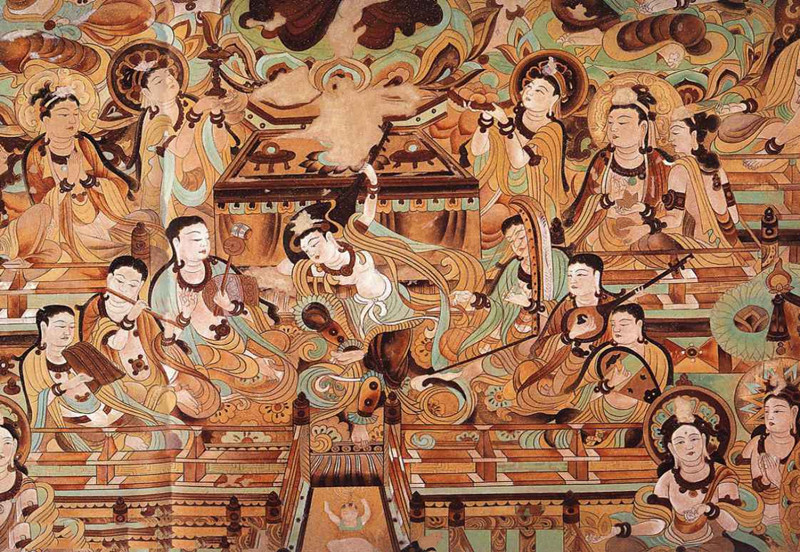
    You step out of the shuttle bus at the base of the Mingsha cliff, and the first thing you notice is the silence. A guide clips a wireless earpiece to your ear, unlocks a padlocked wooden door, and you walk into a cave the size of a small chapel — the ceiling painted with flying apsaras that have been there since the Tang dynasty. There is no artificial light. The guide's flashlight tracks slowly across a wall, and 1,200-year-old blues and greens surface out of the dark.

    Mogao Caves in Dunhuang, GansuMogao Caves cliff face, Dunhuang
    Mogao Caves Tang Dynasty muralsMogao Caves Tang Dynasty murals

    Fact Panel

    • Location: 25 km (15.5 mi) southeast of Dunhuang city, at the base of Mingsha cliff
    • Founded: 366 CE (4th century)
    • Scale: 735 caves, 45,000 m² (484,376 sq ft) of murals, 2,400+ sculptures
    • Standard visit: ~3 hours, including the two Digital Exhibition Center films and the ~15-minute shuttle each way
    • Best time: Late May, mid-September, mid-October (avoid August 1–15 and October 1–3)
    • Ticket types: A-ticket (peak season ¥238, 8 caves + 2 films + shuttle + guide) or B-ticket (¥100, 4 caves only, films not included)
    • Highlights: Cave 96 (35 m Tang-dynasty seated Buddha), Cave 148 (reclining Nirvana Buddha), the Library Cave (Cave 17, discovered 1900)

    Mogao is unlike any other cave complex on the Silk Road. Where Yungang and Longmen are dominated by monumental stone Buddhas, Mogao's genius is its murals — layered, narrative, and preserved by the dry desert air. A single Tang-dynasty cave contains hundreds of tiny figures: musicians, dancers, camel caravans, Central Asian merchants. The digital-era rotation system means every visit is different — you might see cave 45 one day and cave 57 the next, depending on which are open and which have been closed for preservation.

    Booking Mogao is where most independent travelers stumble. The 6,000 A-tickets sell out early, the official WeChat mini-program regularly rejects foreign passport data, and English-language guide slots at 09:30 and 11:30 are the only two options that don't require a translation handset. On A-ticket sold-out days you can queue for the emergency B-ticket, but you'll see only 4 caves, no films, and get very abbreviated commentary.

    💡

    From our experience

    We pre-book A-tickets in the passport-holder queue the moment they release at 07:00 (30 days ahead) and assign a Yaso Trip English-speaking guide alongside the Mogao Academy commentator so you understand the murals in real time — not through a handset. For the once-a-year Silk Road Cultural Expo week (early August) or National Day, book at least 45 days out.
    ⚠️Avoid the Tourist Trap
    The 45-minute "regular" pre-tour documentary at the Digital Exhibition Center is a low-tempo overview you can skip if you're time-pressured — just tell the staff and walk to the shuttle bay. The 30-minute Dream of Buddhist Paradise dome-theater film is the opposite: sit in the middle-back rows and don't miss it. It shows the ceiling detail of caves the public can't enter.

    A dedicated Dunhuang tour with Yaso Trip

    4 Days Dunhuang City Tour

    4 Days Dunhuang City Tour

    Tour Route:Dunhuang
    Tour Type:City Tours
  • 4 Days
  • 3 Places
  • View Detail

    2. Mingsha Sand Dunes & Crescent Lake (鸣沙山·月牙泉)

    At 05:30 in July, the west gate ticket window is still quiet. You walk through a wooden archway, and 300 meters ahead the dunes rise like a wall — 1,700 m (5,577 ft) at the highest crest, still deep purple in the pre-dawn light. By the time you reach the ridge above Crescent Lake, the first camel caravan is already moving across the valley below, silhouetted against a sky turning apricot. This is the Mingsha most photographers chase; the tour buses won't arrive for another two hours.

    Camel caravan crossing Mingsha Sand Dunes at sunriseCamel caravan crossing Mingsha Sand Dunes at sunrise
    The Crescent Moon Spring in DunhuangCrescent Lake oasis surrounded by dunes, Dunhuang

    Fact Panel

    • Location: 6 km (3.7 mi) south of Dunhuang city center
    • Dune height: Up to 1,715 m (5,627 ft) above sea level
    • Crescent Lake dimensions: ~150 m (492 ft) long, 50 m (164 ft) wide, up to 7 m (23 ft) deep
    • Standard visit: 3–5 hours, or a return visit the same day (tickets are valid for 3 days)
    • Camel ride: ~40–60 minutes, standard route from central gate to Crescent Lake back ridge
    • Best time in the day: Enter by 05:30 for sunrise; enter at 16:30–17:00 for sunset; avoid 11:00–16:00 in summer (sand surface can exceed 50 °C / 122 °F)
    • Best gate: West gate or east gate in peak season — the central gate queue can back up over an hour on July–August evenings

    The 3-day ticket is Dunhuang's best-kept practical detail. Locals use it for a dawn visit for photos, retreat to town for the noon heat, and return after 20:30 when the lights around Crescent Lake come on and the crowds thin. In summer, the "night dune" experience — climbing partway up the ridge after 21:00 — is genuinely better than the sunset shift, when the main viewpoint gets standing-room-only.

    Camel rides are regulated by the local Yueya Spring Village cooperative — 2,300 camels working in groups of five. Skip any private "wild camel" offered outside the gate: they're unregulated, priced arbitrarily, and lack the operator's insurance coverage.

    ⚠️Camel safety warning
    Camels stand up back-legs-first and kneel down front-legs-first — both movements throw you forward hard. Keep both hands on the front handle at all times. Do not open an umbrella, scream, or feed the camel: they spook easily. Do not ride if you have high blood pressure, heart conditions, are pregnant, or are over 65. Zip every pocket, put your phone in a dust-sealed sleeve, and be prepared for the handler to charge ¥20 (~$3 USD) for photos.

    The hike up the dune is real work. There is no true shortcut — each step slides you back half a step. Most travelers use the wooden ladder on the way up (much easier) and slide down the loose sand face (fast and fun). You don't need to summit for the best view; two-thirds of the way up is enough to see the entire Crescent Lake curve.

    💡

    From our experience

    Dunhuang has essentially zero light pollution, and 6–8 July offers the best Milky Way viewing of the year — the galactic core is at peak brightness and the moon is new. We take clients to a permitted camp 10 minutes outside town (not into the closed park interior — see the caution below) with tripod setups and blankets. Rating this one from Reddit's China-travel forum consistently as a top-3 memory.[/shortcode_27]

    A Dunhuang-plus-photography angle with Yaso Trip
    [shortcode_3 post_id="93460"]

    3. Yumen Pass (玉门关), the Han Great Wall & Yadan Geopark

    You leave Dunhuang at 13:00 and the city ends abruptly at the edge of an irrigated apricot orchard. For the next 90 minutes there is nothing but Gobi — a flat black gravel plain that looks like the surface of a planet with better weather. Yumen Pass — the Han-dynasty "Jade Gate" — is a single 10-meter square of yellow rammed earth standing alone on that plain. From the observation platform you can see the Han Great Wall extending east and west, still visibly reed-and-mud after 2,000 years.

    [shortcode_8 columns="2"]13868||Yumen Pass Han-dynasty rammed-earth watchtower||
    13801||Yadan National Geopark yardang formations at sunset||[/shortcode_8]

    Fact Panel

    • Location: 90–180 km (56–112 mi) northwest of Dunhuang; single-day loop with Yumen Pass (Han Great Wall) + Yadan
    • Yumen Pass founded: 2nd century BCE (Western Han dynasty)
    • Yadan formations: Wind-carved yardang landforms extending across ~200 km² (77 sq mi)
    • Standard visit: Full day (leave 12:00, return 22:00 in summer for sunset at Yadan)
    • Best time: May–October, with sunset arrival at Yadan the non-negotiable timing
    • In-park transport: Standard park bus (10-minute stops); optional cross-country buggy access to unrestored areas (extra fee ~¥298 per vehicle)
    • Highlights: "Ghost City" at Yadan, "Western Fleet" formation at sunset, the Han Great Wall reed-and-mud walls, Yumen Pass watchtower

    Yadan is the payoff of the day. The standard park loop stops at four viewpoints, each for 10 minutes; the sunset light hits the western yardangs — nicknamed the "Western Fleet" (西海舰队) for their aircraft-carrier silhouettes — around 20:30 in June and July. The regular park bus schedule forces most groups to leave right as the light peaks. This is where a private vehicle changes the trip: waiting for the gold to spread across the yardangs, then driving 350 km back through empty desert at night with no gas stations until morning.

    Yangguan Pass (阳关) is the third Han-frontier site sometimes bundled into this day trip. It's the western pair to Yumen Pass — a smaller ruin with a museum, and honestly a mixed-review addition. If you have a fourth day, add it; otherwise skip in favor of Yulin Caves (below).

    [shortcode_27 type="warning" title="Avoid the Tourist Trap"]The four-viewpoint park bus is fine but not exceptional — you'll be at each stop for exactly 10 minutes and pulled out before the light is best. If the desert-Ghost-City moment is what drew you to Dunhuang, upgrade to the cross-country buggy access. And do not attempt the return drive on your own after dark: there are no gas stations, no cell service, and no shoulder markings between Yadan and town.[/shortcode_27]

    4. Yulin Caves (榆林窟) — Mogao's Quieter Sister

    The road east from Dunhuang to Guazhou runs along the Yulin River for the last 30 minutes, and the caves themselves are cut into the sandstone gorge wall — you park at the top and walk down a wooden staircase into a shaded canyon. Where Mogao is the Louvre, Yulin is the Musée d'Orsay: fewer caves, no crowds, and a guide who can spend twenty minutes on a single Tang-dynasty Bodhisattva without a queue building behind you.

    [shortcode_8 columns="2"]115878||Yulin Caves Tang-dynasty murals||
    13676||Yulin Caves entrance exterior||[/shortcode_8]

    Fact Panel

    • Location: ~170 km (106 mi) east of Dunhuang, in Guazhou County (瓜州县) — ~2.5-hour drive each way
    • Founded: 6th–14th centuries (Northern Wei through Yuan dynasties)
    • Scale: 42 caves, ~250 painted sculptures, 4,200 m² (45,208 sq ft) of murals
    • Standard visit: 3–4 hours on site (plus 5 hours round-trip driving)
    • Ticket structure: Regular caves ~¥40; special caves (Caves 2, 3, 4, 25) ¥550 combined
    • Best paired with: Standalone half-day trip, or added to a Guazhou pass-through en route from Zhangye/Jiayuguan

    Yulin's Cave 25 — a Tang-dynasty mural cycle depicting the Western Pure Land — is one of the finest single-cave experiences in China. Many Yaso Trip clients rate Yulin above Mogao for pure appreciation of the art, because the pace is slower and the crowd pressure disappears. The tradeoff: a 5-hour driving day, and Yulin's real magic is in the special caves, which cost extra and require advance arrangement.

    Western Thousand Buddha Caves (西千佛洞) is a smaller 4-cave site 30 km west of Dunhuang, on the way to Yumen Pass. Worth 45 minutes if you're already driving past — it's a good "warm-up" before Mogao — but not a destination in itself.

    [shortcode_7 title="From our experience" title_color="#1e77bc" bg_color="#eef5fc"]The order we recommend for cave-focused trips is: Western Thousand Buddha Caves (warm-up) → Yulin Caves special caves (deep, unhurried) → Mogao Caves (comprehensive). Doing Mogao first can make Yulin feel small; doing Yulin first makes Mogao's scale land properly.

    Combining Dunhuang with Yulin in a 5-day corridor tour

    5 Days Lanzhou Dunhuang Jiayuguan Tour

    5 Days Lanzhou Dunhuang Jiayuguan Tour

    Tour Route:Lanzhou-Dunhuang-Jiayuguan
  • 5 Days
  • 5 Places
  • View Detail

    5. Dunhuang City, Shazhou Night Market & the Museum

    By 20:00 the temperature in the city drops from 35 °C to something bearable, and the entire population of Dunhuang seems to move to Shazhou Night Market (沙洲夜市). The main strip smells of grilled lamb, cumin, and apricot skin; painted lanterns hang across the alleys; a Uyghur vendor rolls out fresh naan on a wooden board with the practiced speed of someone who has done this ten thousand times.

    Dunhuang Museum Han-dynasty cave paintingDunhuang Museum Han-dynasty cave painting
    Shazhou night market donkey meat yellow noodlesShazhou night market donkey meat yellow noodles

    Fact Panel

    • Shazhou Night Market: East gate area, 7-block strip; busiest 19:00–23:00
    • Dunhuang Museum: ~13,800 artifacts covering the Han-through-Yuan Silk Road period; free admission with ID/passport
    • Standard visit: Museum 1–1.5 hours; Night Market 1–2 hours
    • Must-try foods: Donkey-meat cold noodles (驴肉黄面), lamb-braised naan (胡羊焖饼), red-willow grilled lamb (红柳烤肉), apricot-skin juice (杏皮水), stuffed skin (酿皮子)
    • Souvenir hunting: Wenchuang (cultural-creative) fridge magnets, silk scarves, dried apricots and jujubes

    The recommended food stops most Yaso Trip clients enjoy: Jingyuan Galiu Delicious Lamb (靖远尕六美味羊羔肉) for hand-torn lamb with clear-broth soup; Shazhou Food Court (沙洲食坊) inside the market's east gate — a Tang-style two-story courtyard where you can sample donkey noodles, grilled lamb, apricot-skin juice, and stuffed skin without wandering; Laoyangguan Northwest Lamb King (佬羊倌西北羔王) for the lamb-braised naan portion challenge.

    ⚠️Avoid the Tourist Trap
    Skip the pre-cut fruit trays and cactus-fruit juice at the market entrance — the fruit sits out too long, the "cactus juice" tastes nothing like cactus, and the rainbow cotton candy is a photo prop, not food. For real jujubes, apricots, and sand-date dried fruit at half the market price, walk 10 minutes to Jianrong Market (建荣市场) where locals shop. And be very skeptical of "beef jerky" selling for ¥50–60 per catty (500 g / 1.1 lb) — real Gansu air-dried yak beef costs closer to ¥150; anything cheaper is usually compressed duck meat.

    Dunhuang's Xuanquan Site (悬泉置遗址) is a hidden bonus. It's a Han-dynasty postal-relay station — a UNESCO World Heritage site sitting directly next to the G30 expressway — where 35,000 wooden slips (documents) were excavated. Most guidebooks don't mention it; history-minded clients often cite it as the trip's biggest surprise.

    Dunhuang Sites at a Glance

    Dunhuang core sites overview

    SiteDistance from townTime neededBest time of dayTicket note
    Mogao Caves25 km (15.5 mi) SE3 hoursMorning (English-guide slots 09:30 & 11:30)A-ticket books 30 days out at 07:00
    Mingsha & Crescent Lake6 km (3.7 mi) SHalf-day, or 3-day passSunrise 05:30 or after 20:303-day reusable ticket
    Yumen Pass + Yadan90–180 km (56–112 mi) NWFull day (12:00–22:00 in summer)Yadan sunset at 20:30 in June/July188-yuan west-line combo pass available
    Yulin Caves170 km (106 mi) EFull day (5 hrs driving)Special caves any time — advance booking requiredSpecial-cave add-on costs extra
    Dunhuang Museum & Shazhou Night MarketIn townMuseum 1 hr, Market 2 hrsMuseum daytime; Market 19:00–23:00Museum free with passport

    Sample 3-Day Dunhuang Itinerary

    3-Day Dunhuang Itinerary

    ✈️
    Day 1
    Arrival + Mingsha Sunset
    Fly or high-speed rail into Dunhuang (or Liuyuan South, 2 hrs by car). Late-afternoon check-in, sunset climb at Mingsha and Crescent Lake, dinner at Shazhou Night Market.
    🏛️
    Day 2
    Mogao Caves + Yulin Combo
    English-guided A-ticket at Mogao in the morning (09:30 slot), lunch back in town, drive to Yulin Caves in Guazhou for the Tang-dynasty special caves in the afternoon.
    🏜️
    Day 3
    Yumen Pass + Yadan Desert Loop
    Late-morning start toward the Han Great Wall and Yumen Pass, box lunch on the road, arrive Yadan for the 20:30 sunset over the "Western Fleet" formations, drive back through empty Gobi.

    Add a fourth day if you want to include Yangguan Pass, the Xuanquan Han postal-relay site, or a daytime return to Mingsha for a camel ride (skipped on Day 1 when the priority is sunset light).

    A dedicated Dunhuang tour with Yaso Trip

    4 Days Dunhuang City Tour

    4 Days Dunhuang City Tour

    Tour Route:Dunhuang
    Tour Type:City Tours
  • 4 Days
  • 3 Places
  • View Detail

    Adding the Rainbow Mountains: 6-day Lanzhou–Zhangye–Jiayuguan–Dunhuang combo

    6 Days Lanzhou Zhangye Jiayuguan Dunhuang Tour

    6 Days Lanzhou Zhangye Jiayuguan Dunhuang Tour

    Tour Route:Lanzhou-Zhangye-Jiayuguan-Dunhuang
    Tour Type:Silk Road Tours
  • 6 Days
  • 6 Places
  • View Detail

    Arriving in Dunhuang via Jiayuguan (4-day western-fort combo)

    4 Days Jiayuguan Pass and Dunhuang Silk Road Tour

    4 Days Jiayuguan Pass and Dunhuang Silk Road Tour

    Tour Route:Jiayuguan-Dunhuang
    Tour Type:Silk Road Tours
  • 4 Days
  • 4 Places
  • View Detail

    Practical Logistics

    Best Time to Visit Dunhuang

    Dunhuang has one of the sharpest seasonal profiles in China: crushingly hot summers, freezing winters, and two shoulder windows that Yaso Trip's team consistently recommends over the peak.

    Best time to visit Dunhuang

    WindowConditionsCrowdsNotes
    Late May (20–31)~25 °C (77 °F), low windVery low — pre-summerBest price-to-experience ratio of the year. Mogao A-tickets available; Mingsha camel rides walk-on.
    Mid–late July (11–20)Hot (~35 °C / 95 °F) days, cool nightsHigh but manageableBest week for the Milky Way — new moon aligns with peak galactic-core brightness.
    Mid–late October (15–31)~20 °C (68 °F) days, cool nightsVery low — post-National DayMogao guides are relaxed; Yulin Caves essentially private. Excellent light.
    December–March (winter)–10 to –15 °C (14 to 5 °F)Very lowHalf-price tickets to Mogao and Mingsha in 2026; Mogao rotates 10–12 caves open (vs. 8 in peak). For hardy photographers only.
    AVOID: August 1–15Very hot, expo crowdsExtremeSilk Road International Cultural Expo — hotels 2× normal price, Mogao A-tickets vanish in minutes.
    AVOID: October 1–3Perfect weatherExtremeGolden Week. Mogao queues push 2 hours; the west road is bumper-to-bumper.

    Getting to Dunhuang

    Two arrival options, and the choice matters more than most guides admit:

    • Dunhuang Mogao International Airport (DNH) — 13 km (8 mi) from downtown. New routes added in the 2025 summer/fall schedule include direct Beijing Daxing, Shanghai Pudong, plus Hanoi and Kuala Lumpur international charters; Hong Kong service resumed the same year.
    • Dunhuang Railway Station — 12 km (7.5 mi) from downtown. Direct trains from Lanzhou, Xi'an, and Jiayuguan. Convenient in-town access (¥30 / ~$4 USD taxi, or a ¥5 airport bus).
    • Liuyuan South high-speed rail station (柳园南) — 130 km (81 mi) north of Dunhuang, ~2-hour drive. Connects to Urumqi in ~4.5 hours. This is the routing every experienced Silk Road operator uses for the Dunhuang → Xinjiang leg, but the drive contract matters: some private drivers detour onto gravel roads to save the highway toll. Book through a professional operator to avoid it.

    Permits, Access Rules & 2026 Updates

    • Passport required at every ticket window — Mogao, Mingsha, Yadan, Yulin. Bring the physical passport, not just a scan.
    • Mogao closes in extreme weather. On July 29, 2026, Mogao was closed for the full day due to sustained rain, mudstone humidity, and cliff-face safety. Rainy-season visitors (July–August) must check the "Mogao Cave Reservation" WeChat account the morning of.
    • Mogao special caves (specific numbered caves not on the standard rotation) must be purchased in person, at a manned window near the exit ramp, between 11:00 and 14:30, and only after you've bought a regular A-ticket. ¥150–200 per special cave, quantity limited daily.
    • Mingsha desert camping rules tightened in 2025. Wild camping inside the scenic area is banned. Bonfires and fireworks require advance permits and are canceled on dry, windy days. Use one of the permitted operator camps just outside the park boundary instead.

    For an accurate cost breakdown tailored to your group size, dates, and preferences, contact the Yaso Trip team for a custom quote.

    Where to Stay in Dunhuang

    Dunhuang's hotel scene has improved sharply in the last two years. The current standouts our clients rate highly:

    • Dongyi Dunhuang Hotel (东驿敦煌酒店) — rammed-earth, wabi-sabi aesthetic borrowing directly from Mogao's palette; excellent morning-light photography.
    • Dunhuang Biyue Hotel (敦煌碧玥酒店) — northwest China's first Small Luxury Hotels of the World member; floor-to-ceiling Gobi views.
    • Shazhou Wild Luxury Camp (沙洲野奢营) — high-end glamping in the Mingsha foothills; private desert dinner and campfire arrangements possible.
    • Silk Road Heritage Star Camp (丝路遗产城星空酒店) — stargazing-focused wild-luxury option combining Mongolian yurts with premium camp infrastructure.

    For city-center convenience and easier taxi access to Mogao, stay on Yangguan East Road or Mingshan Road. For desert immersion, choose one of the two wild-luxury camps and plan for a 20-minute in-town commute for meals.

    Practical Experience How-To

    How to actually book Mogao tickets from outside China:

    1. Download the official "Mogao Cave Reservation" WeChat mini-program (search 莫高窟参观预约网). Switch language to English.
    2. Register your passport information the day before ticket release. Attempting to enter passport data at 07:00 when tickets go live will cost you the queue.
    3. Set an alarm for 07:00 Beijing time (China Standard Time, UTC+8), 30 days before your visit date. A-tickets go live in a batch and often disappear within 10–30 minutes in peak season.
    4. If A-tickets sell out: try again at 11:45–12:15 daily (returned/canceled tickets get released back into the pool), or switch to a B-ticket, or use an operator with pre-allocated inventory.
    5. Foreign passport payment sometimes fails — have a China-issued payment method (WeChat Pay, Alipay linked to a Chinese bank card) as backup, or delegate the booking to your tour operator.

    How to spot a "real" Dunhuang restaurant:

    • Look for hand-torn dough and hand-poured broth being made in view of the dining room
    • Chinese-only menus with prices in single ¥XX-digit range signal locals-only pricing
    • The best donkey-meat noodle joints have visible queues at 12:30 and small round metal stools, not chairs

    How to handle the Dunhuang dry-air shock:

    • Bring or buy a heavy moisturizer and lip balm on Day 1 — the desert air causes nosebleeds and cracked lips in most first-time visitors
    • Drink 3+ liters of water per day; carry a bottle everywhere (Mingsha is 6 km from your hotel but effectively a Gobi Desert environment)
    • Skip alcohol on Days 1–2 while your body adapts

    How to communicate at the sites without Chinese:

    • Mogao guides at the English 09:30 and 11:30 slots speak fluent English; special caves do not have English coverage
    • Save Baidu Maps offline for Dunhuang — Google Maps is inaccurate for the desert roads
    • The Pleco dictionary app handles the food names (驴肉黄面 = donkey-meat noodles; 胡羊焖饼 = lamb-braised naan) that most translation apps garble

    Tips & Cautions

    • Book Mogao 30 days out. This is the single most important logistics decision. Peak-season A-tickets do not exist for last-minute travelers unless you buy through an operator with pre-allocated inventory.
    • Never enter Mingsha in the 11:00–16:00 window in July or August. The sand surface can exceed 50 °C (122 °F) — you cannot stand still, let alone climb. Use the 3-day ticket to visit at dawn, retreat, and return at dusk.
    • Camera and phone dust protection is mandatory at Mingsha. Fine sand penetrates every seam. Zip cameras into dust-sealed sleeves and keep phones in inner pockets.
    • Do not attempt the Yadan return drive after dark independently. No gas stations, no cell coverage, no shoulder markings on the return leg. Yaso Trip vehicles are pre-fueled and driver-shifted for this route.
    • Cash is useful. WeChat Pay and Alipay work in most Dunhuang businesses, but the outer sites (Yumen Pass, Yulin) sometimes have connectivity failures. Carry ¥300–500 in small notes.
    • The Xinjiang time-zone effect starts to appear. Dunhuang is on Beijing time officially but locals eat dinner at 20:00–21:00 in summer (functionally on Xinjiang time). Book restaurants for 19:30 to beat the local rush.
    • Photography inside Mogao caves is strictly prohibited. Infrared sensors monitor each cave; guides will stop your visit if you're caught. The exhibition center replicas across from the caves are fully photographable.
    ⚠️Mogao rainy-season closure risk
    Mogao closed for a full day on July 29, 2026 due to persistent rainfall raising humidity above conservation limits. If you're visiting in July or August, check the "Mogao Cave Reservation" WeChat account the morning of and build a buffer day into your itinerary — the closure is unannounced and same-day refunds are not guaranteed.

    Why Travel Dunhuang With Yaso Trip

    Dunhuang looks simple on a map: five sites, one small town, three days. The friction is everywhere else — in the 6,000-ticket daily cap, the English-guide scheduling, the passport-vs-ID-card booking system, the Yadan sunset timing, the Milky Way camp permits, the driver-contract details on the Yadan return leg. This is what a local operator solves.

    silk road self driving tour in Yangguan (1)
    silk road self driving tour in Zhangye (4)
    • Pre-allocated Mogao inventory. Our Dunhuang team holds A-ticket slots for our confirmed clients — no 07:00 queue, no B-ticket downgrade, no waiting for return-ticket luck.
    • Dedicated English-speaking guides who walk with you through Mogao alongside the Mogao Academy commentator, translating the mural narratives in real time — and available at Yulin, where no English commentary exists.
    • Fleet vehicles for the Yadan desert loop — pre-fueled, radio-equipped, and driver-scheduled to hit the "Western Fleet" formation exactly at the golden-hour peak, then return through the empty Gobi with a driver who knows the road.
    • Legitimate camping and permit handling for the Milky Way night at the Mingsha foothills — one of the highest-rated Dunhuang experiences our clients report, and one you cannot arrange from outside China.
    • Corridor integration. Dunhuang is rarely a single-destination trip. We combine it seamlessly with the Zhangye Danxia rainbow mountains, Jiayuguan's Great Wall western fort, and — for travelers continuing west — the Dunhuang→Turpan bridge into Xinjiang. Route timing, connections, and permits are covered in our Silk Road transportation guide.

    Ready to Plan Your Dunhuang Trip?

    The best Dunhuang trips are booked 4–6 weeks in advance so Mogao A-tickets, Yadan sunset timing, and shoulder-season hotels all line up. Tell us your dates, group size, and how many days you can spare, and we'll build a custom Dunhuang itinerary — from a 1-day highlights loop to the 12-day Gansu grand tour.

    Expand All
    1. Is Dunhuang worth a special trip if I'm already visiting Xi'an?

    Yes. Xi'an and Dunhuang cover completely different chapters of the Silk Road — Xi'an is the imperial capital and the road's eastern origin, Dunhuang is the desert-frontier oasis where Buddhism entered China. The Mogao murals have no equivalent in Xi'an, and the desert landscape at Yadan and Mingsha is unlike anything east of the Hexi Corridor. Most travelers combine both cities in a single Silk Road trip.

    2. How many days do I need in Dunhuang?

    Three full days is the standard: one for Mogao and Mingsha, one for the Yumen Pass and Yadan desert loop, and one for Yulin Caves. Two days is tight but workable if you cut Yulin. Four days lets you add Yangguan Pass, the Xuanquan Han postal-relay site, or a second visit to Mingsha for camel riding and stargazing.

    3. Can I visit Dunhuang independently, or do I need a tour?

    Independent travel to Dunhuang is possible but has real friction: the Mogao A-ticket booking system rejects foreign passports intermittently, English-guide slots are limited to two per day, and the Yadan sunset day trip requires a private vehicle and a driver willing to return through unlit Gobi. In-town sightseeing (Shazhou Market, Dunhuang Museum) is easy solo; the outer sites benefit heavily from a local operator.

    4. Is Dunhuang safe for foreign travelers?

    Dunhuang city is very safe — a small oasis town where crime is rare and locals are used to international visitors. The desert routes (Yadan, Lop Nur direction) require professional driving and vehicle preparation; do not attempt them independently. Xinjiang-adjacent border zones west of Dunhuang have restricted-area regulations that apply if you continue that direction.

    5. When is the best time to visit Dunhuang?

    Late May (May 20–31) and mid-October (October 15–31) offer the best combination of warm weather, low crowds, and available Mogao tickets. Mid-July (July 11–20) is peak Milky Way viewing. Avoid August 1–15 (Silk Road Cultural Expo) and October 1–3 (Golden Week) when hotels double in price and Mogao A-tickets vanish within minutes.

    6. What's the difference between Mogao's A-ticket and B-ticket?

    The A-ticket (¥238 peak season) includes 8 caves in rotation, both films at the Digital Exhibition Center, the shuttle bus, and a professional guide — 3 hours total. The B-ticket (¥100) is an emergency same-day ticket sold when A-tickets sell out; it includes only 4 caves, no films, and abbreviated guide commentary. A-tickets are limited to 6,000 per day and go on sale 30 days in advance at 07:00 Beijing time.

    More About

    •Kanas Lake & Northern Xinjiang Travel Guide 2026/2027 •Urumqi Travel Guide: Tianshan Heavenly Lake & the City •Silk Road History: Routes, Trade & Why It Mattered •Taklamakan Desert Highway & Southern Xinjiang Route Guide 2026/2027 •Silk Road Desert Adventures: Lop Nur, Loulan & Badain Jaran •How to Travel the Silk Road: Group, Self-Drive, Train & Bike •Zhangye Danxia: The Rainbow Mountains Guide 2026/2027 •Turpan Travel Guide: Flaming Mountains, Karez & Jiaohe 2026/2027 •Kashgar Travel Guide: Old Town, Sunday Bazaar & Id Kah 2026/2027 •Silk Road Self-Drive: Routes, Rentals & Logistics 2026/2027 •Silk Road Photography Tour Guide: Where & When to Shoot •Silk Road Map & Routes: Classic, Northern & Southern •Where to Stay on the Silk Road: City-by-City Hotel Guide •Silk Road Food Guide: What to Eat from Xi'an to Kashgar •Silk Road Transportation Guide: Trains, Flights & Distances 2026/2027 •Best Time to Visit the Silk Road: Month-by-Month 2026/2027 •Best Silk Road Itineraries 2026: 5 Days to 3 Weeks •Xinjiang Travel Guide: Kashgar, Kanas & the Silk Road 2026/2027 •Gansu Silk Road: Complete Hexi Corridor Travel Guide 2026/2027 •China Silk Road Travel Guide •Silk Road Attractions: The 18 Must-See Sights from Xi'an to Kashgar •Food along Silk Road •How to Plan a China Silk Road Tour: 6-Step Guide (2026/2027) •Memorabilia along the Silk Road •Silk Road in Yuan Dynasty •Silk Road in Tang Dynasty •Silk Road in Han Dynasty •Silk Routes Chronology •What goods were traded on the Silk Road? •Silk Road FAQs
    ENQUIRY
    Have a question before booking? Message us to learn more.
    Click to change

    Share Your Trip Experience

    Help future travelers by reviewing your journey with Yaso Trip.