China Travel Agency, China Tours 2026/2027 | Yaso Trip
Theme Tours
View All China Theme Tours by Interest
Travel Guide
  • Travel Guide
  • Travel Tips
  • Tour Planning
  • Ethnic Culture
  • China Climate
  • Golf Courses
  • Yangtze Cruise
  • Travel Articles
  • Baishan City Overview

    Baishan City (白山市), also historically known as Hunjiang (浑江), is a prefecture-level city in southeastern Jilin Province and one of the core gateway cities to Changbai Mountain.

    The city covers a total area of 17,505 km² and administers 6 county-level divisions:
    Hunjiang District (浑江区), Jiangyuan District (江源区), Fusong County (抚松县), Jingyu County (靖宇县), Changbai Korean Autonomous County (长白朝鲜族自治县), and Linjiang City (临江市).

    Baishan borders North Korea (朝鲜) across the Yalu River with a 433.2 km border line, faces Yanbian Prefecture (延边州) to the east, Tonghua City (通化市) to the west, and Jilin City (吉林市) to the north.

    As of 2024, it has a permanent population of about 888,800 and is widely known as:
    China’s Ginseng Capital (人参之乡), Songhua Stone Origin (松花石之乡), Forest Frog Source (林蛙之乡), and Mineral Water Homeland (矿泉水之乡).


    Geography & Natural Landscape

    Baishan lies on the western slopes of Changbai Mountain, formed by the intersection of the Longgang Mountains (龙岗山脉) and Laoling Mountains (老岭山脉). The terrain is higher in the southeast and lower in the northwest, consisting of volcanic cones, basalt plateaus, and mid-to-low mountain systems.

    The city features 432 rivers, with major waterways including the Yalu River (鸭绿江), the First Songhua River (头道松花江), and the Hunjiang River (浑江), creating a signature landscape pattern of “One Mountain, Two Rivers” (一山两江) centered on Changbai Mountain, Yalu River, and Songhua River.

    Forest coverage reaches 84.6%, placing Baishan among China’s top forested prefecture-level cities. The region is rich in negative oxygen ions, forming a natural ecological “forest oxygen bar.”


    Climate Characteristics

    Baishan has a temperate continental monsoon climate with four clearly defined seasons:

    • Spring: Rapid warming, frequent mountain winds, blooming flowers from April to May
    • Summer: Cool and humid, average temperature around 22°C, a top Northeast China summer escape destination
    • Autumn: Stable weather, clear skies, September–October forests turn into red and golden landscapes
    • Winter: Long and cold, snow season lasts up to 6 months, rich powder snow resources

    Annual average temperature: 4.3°C
    Annual precipitation: 750–850 mm
    Mountain climate variation is strong, with high-altitude zones 5–8°C colder than urban areas.


    History & Cultural Heritage

    Historical Background

    Baishan has deep historical layers:

    • Ancient periods: part of Liaodong region, later ruled by Goguryeo (高句丽) and Balhae Kingdom (渤海国)
    • Tang dynasty relics preserved in Changbai Lingguang Pagoda (长白灵光塔)
    • Ming–Qing era: sacred Changbai Mountain restricted zone and Silk Road-style frontier station system
    • Modern history: key base of Northeast Anti-Japanese United Army, site of the Four Defenses of Linjiang campaign (四保临江战役), and Korean War logistics support area
    • Jingyu County (靖宇县): memorial site of General Yang Jingyu (杨靖宇), an important Red tourism destination

    Ethnic Culture

    Baishan is a multi-ethnic region dominated by Korean (朝鲜族), Manchu (满族), and Han Chinese cultures.

    Key cultural highlights include:

    • Korean folk traditions: dance, singing, kimchi fermentation (辣白菜), and board swing festivals (跳板秋千) in Changbai County
    • Manchu heritage: preserved wooden house villages such as Jinjiang Woodhouse Village (锦江木屋村)
    • Intangible heritage: Songhua stone carving (松花砚), ginseng cultivation, and forest frog farming techniques

    Natural Resources

    Baishan is one of Northeast China’s most resource-rich ecological cities:

    • Biodiversity: 2,850+ species of wild plants and animals
    • Medicinal resources: over 1,000 wild medicinal plant species, especially Changbai ginseng (长白山人参)
    • Signature products: wild blueberries, mountain vegetables, forest frogs
    • Mineral water: world-class natural mineral water zone comparable to Vichy (France)
    • Stone resources: Songhua stone (松花石), historically used for imperial inkstones
    • Hot springs: Xianrenqiao radon hot springs, rare therapeutic geothermal resource in Northeast China

    Economy & Development

    Baishan’s economy is built on four major pillars:
    ecological tourism, ginseng health industry, mineral water processing, and green agriculture & forestry.

    Key development drivers include:

    • Shenbei High-Speed Railway (沈白高铁)
    • G331 border highway (G331国道)
    • Changbai Mountain International Resort system

    The city is actively developing three major tourism clusters:

    • Ice & snow holiday tourism
    • Border sightseeing tourism
    • Forest wellness and rehabilitation tourism

    Major Attractions & Landmarks

    World-Class Natural Landmark

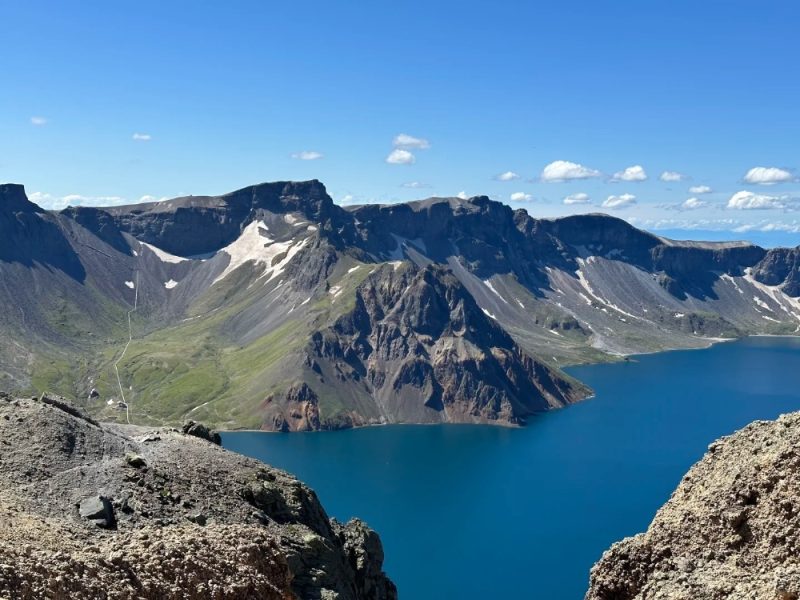
    Changbai Mountain Scenic Area (长白山景区, 5A) is Baishan’s most important tourism icon and a UNESCO World Natural Heritage site.
    It features Tianchi Lake (天池), volcanic crater landscapes, alpine gardens, Julong Hot Springs (聚龙温泉), summer hiking routes, and winter ski resorts.


    Natural Scenic Highlights

    Wangtian’e Scenic Area (望天鹅景区, 4A) is known as the “Northeast Little Jiuzhaigou,” featuring basalt stone forests and dense waterfall systems.

    Other key landscapes include:

    • Laotudingzi Mountain (老秃顶子)
    • Xianren Valley Stone Forest (仙人谷石林)
    • Longshan Lake (龙山湖 / 鸭绿江湖区景观)

    Cultural & Border Heritage Sites

    • Jinjiang Woodhouse Village (锦江木屋村): century-old Manchu wooden settlement
    • Neyin Ancient City (讷殷古城): Jurchen tribal archaeological site
    • Changbai Cliff City (长白千年崖城): dramatic border cliff viewpoint overlooking North Korea
    • Jingyu Martyrs Cemetery (靖宇陵园): Red tourism memorial site
    • Lingguang Pagoda (灵光塔): Balhae-era ancient structure

    Tourism Structure & Travel Routes

    Baishan follows a clear four-season tourism model:

    • Spring: flower viewing, forest hiking, river thaw scenery
    • Summer: Tianchi trekking, forest rafting, ecological exploration
    • Autumn: G331 border self-driving tours and “Five-Colored Mountain” photography
    • Winter: skiing, hot springs, ice fishing, border snow tourism

    Core Travel Circuits

    • Ice & Snow Resort Loop
    • Summer Cooling & Wellness Loop
    • Red Heritage Education Loop
    • Sino–North Korea Border Scenic Loop
    ENQUIRY
    Have a question before booking? Message us to learn more.
    Click to change
    Tonghua

    Tonghua

    Tonghua City (通化市) is located in southeastern Jilin Province (吉林省) and is known for its combination of mountains, rivers, forests, border culture, and traditional Chinese medicine industries. As an important city in Northeast China, Tonghua is famous for Koguryo historical heritage, ice wine production, ginseng culture, and winter tourism, offering diverse experiences from cultural exploration to outdoor adventures. Why Visit Tonghua City? Koguryo World Heritage Sites: Ji’an Koguryo Relics Scenic Area (集安高句丽遗址景区) preserves important remains of the ancient Koguryo Kingdom (高句丽王国), including royal tombs, stone inscriptions, and ancient city ruins. These sites reveal the history and civilization of early Northeast Asia and are part of the UNESCO World Heritage-listed Capital Cities and Tombs of the Ancient Koguryo Kingdom (高句丽王城、王陵及贵族墓葬). Ice Wine and Grape Culture: Tonghua (通化) is known as China’s “Ice Wine Capital” and has a long tradition of mountain wild grape wine production. The region’s cold climate vineyards and underground cellars create ideal conditions for ice wine making. Visitors can join winery tours, taste local wines, and learn about traditional wine production processes. Yalu River Border Scenery: The Yalu...
  • China Travel Agency, China Tours 2026/2027 | Yaso TripJilin
  • Songyuan

    Songyuan

    Songyuan City (松原市) is a prefecture-level city located in the central-western part of Jilin Province (吉林省), at the intersection of Jilin (吉林省), Heilongjiang (黑龙江省), and Inner Mongolia (内蒙古自治区). Situated in the heart of Northeast China, Songyuan covers about 22,000 square kilometers and has a population of approximately 2.8 million. Known for its vast grasslands, rivers, wetlands, agricultural landscapes, and Mongolian cultural influences, Songyuan is an important destination for experiencing the natural beauty and traditional lifestyle of western Jilin. Why Visit Songyuan City? Songhua River Riverside Scenery: The Second Songhua River (第二松花江) flows through Songyuan (松原), creating one of the city’s most distinctive landscapes. Unlike many rapidly developed riverside cities, Songyuan preserves large areas of natural river scenery, offering visitors opportunities for riverside walks, photography, fishing experiences, and enjoying peaceful waterfront views. Chagan Lake Wetland and Winter Fishing Culture: Chagan Lake (查干湖) is the most famous natural attraction in Songyuan and one of the largest freshwater lakes in Northeast China. The lake is known for its wetlands, bird habitats, and traditional winter fishing culture. The annual Chagan Lake Winter Fishing Festival...
  • China Travel Agency, China Tours 2026/2027 | Yaso TripJilin
  • Siping

    Siping

    Siping City (四平市) is a prefecture-level city located in western Jilin Province (吉林省), at the intersection of Jilin (吉林省), Liaoning (辽宁省), and Inner Mongolia (内蒙古自治区). Situated in the heart of the Songliao Plain (松辽平原), Siping covers about 14,323 square kilometers and is an important transportation and economic hub in central Northeast China. With a landscape combining plains, hills, rivers, and historical sites, Siping offers visitors experiences centered on regional culture, revolutionary history, and Northeast China’s rural scenery. Why Visit Siping City? Songliao Plain Landscapes and Rural Scenery: Located between plains and hilly areas, Siping (四平) features a diverse landscape with the vast Songliao Plain (松辽平原) stretching to the northwest and rolling hills in the southeast. The open farmland, seasonal agricultural scenery, and peaceful countryside provide opportunities for photography, rural tourism, and experiencing traditional Northeast Chinese lifestyles. Historical and Revolutionary Culture: Siping (四平) is an important city in modern Chinese history and is known for the Siping Campaign (四平战役) during the Chinese Civil War period. Visitors interested in history can explore local memorial sites and museums to learn about the city’s...
  • China Travel Agency, China Tours 2026/2027 | Yaso TripJilin
  • Liaoyuan

    Liaoyuan

    Liaoyuan (辽源) is a charming prefecture-level city in central Jilin Province (吉林省), located about 100 kilometers south of Changchun (长春). Surrounded by mountains, forests, and grasslands, Liaoyuan combines Northeast China’s natural landscapes with a rich history of mining, farming, and local folk culture. As the smallest prefecture-level city in Jilin by area, it offers travelers a quieter destination with authentic Northeast character. Why Visit Liaoyuan? Dongfeng County and Rural Landscapes Showcase Northeast China’s Countryside Liaoyuan is surrounded by rolling hills, forests, and agricultural landscapes, making it an ideal destination for visitors seeking peaceful countryside experiences. The region’s fertile land supports traditional farming culture, while villages, rivers, and forest areas provide opportunities for hiking, photography, and rural exploration. The countryside around Dongfeng County (东丰县) is especially known for its natural scenery and traditional lifestyle. Visitors can experience local farming culture, enjoy seasonal landscapes, and explore the slower pace of life typical of Northeast China. Liaohe River and Forest Scenery Offer Relaxing Nature Experiences The Liaohe River (辽河) and surrounding natural areas form an important ecological landscape in Liaoyuan. The city’s rivers,...
  • China Travel Agency, China Tours 2026/2027 | Yaso TripJilin
  • Baicheng

    Baicheng

    Baicheng (白城) is a prefecture-level city in northwestern Jilin Province (吉林省), located on the eastern edge of the Horqin Grassland (科尔沁草原) and bordering Inner Mongolia (内蒙古) and Heilongjiang Province (黑龙江省). Known for its vast grasslands, wetlands, lakes, forests, and nomadic cultural heritage, Baicheng offers travelers an authentic experience of the natural landscapes and ethnic traditions of Northeast China. Why Visit Baicheng? Chagan Lake Wetlands and Birdwatching Paradise: Baicheng is home to extensive wetland ecosystems, including important lakes and nature reserves that provide habitats for migratory birds. The region is an excellent destination for birdwatching, photography, and eco-tourism, especially during spring and autumn when large numbers of birds pass through the wetlands. Momoge National Nature Reserve (莫莫格国家级自然保护区): Located in Baicheng, Momoge is one of the most important wetland reserves in Northeast China. The reserve features rivers, lakes, reed marshes, and grasslands, and is especially famous as a habitat for rare birds such as the red-crowned crane (丹顶鹤). Visitors can enjoy wildlife observation, wetland walks, and nature photography. Horqin Grassland Scenery (科尔沁草原): The grasslands around Baicheng represent the classic scenery of northern...
  • China Travel Agency, China Tours 2026/2027 | Yaso TripJilin
  • Changbai Mountains
    Popular
    ★★★★

    Changbai Mountains

    Changbai Mountains (长白山) are one of the most spectacular natural destinations in Northeast Asia, located on the border between Jilin Province (吉林省), China and North Korea. Famous for volcanic landscapes, alpine ecosystems, ancient forests, waterfalls, hot springs, snow resorts, and diverse ethnic cultures, Changbai Mountains offer unique travel experiences throughout the year. The region is often described as “one mountain, four seasons, ten climate zones”, reflecting the dramatic changes in scenery caused by its elevation and ecological diversity. Why Visit Changbai Mountains? Heaven Lake (Tianchi 天池) – The Iconic Volcanic Crater Lake: Heaven Lake (天池) is the heart of Changbai Mountains and one of China’s most famous natural landmarks. Formed inside a massive volcanic crater, the lake sits at an altitude of 2,189 meters and reaches a maximum depth of 373 meters, surrounded by 16 magnificent peaks. Its water changes color with weather and sunlight, creating different shades from deep blue to silver reflections. Clear mornings, especially around 8:00–10:00, often provide the best viewing conditions. Because each mountain slope offers a different perspective, Heaven Lake can be experienced from multiple...
  • China Travel Agency, China Tours 2026/2027 | Yaso TripJilin
  • Changchun
    ★★★★

    Changchun

    Lying in the center of the Songliao Plain, Changchun, the spring city in North, called “Xidu (喜都)”, ”Cha’achong (茶啊冲)”, “Huanglongfu (黄龙府)” in the ancient time, is the capital and largest city of Jilin Province, the central city of Northeastern Asian Economic Circle, and one of the famous historical and cultural cities of China. “Changchun” means “long spring” in Chinese, and it is a modern city with a profound inside story, and the earliest automotive and film industrial bases of China, known as the “Detroit of China” and “Hollywood in China”. Apart from this industrial and film aspects, Changchun is also one of four "Landscape Garden Cities" in China. Changchun (Jilin) Travel Guide introduces useful travel information of Changchun including travel tips, attractions, top things to do, tours, transportation, weather, climate, food, restaurants, accommodation, festivals, nightlife, activities, education, shopping, photos and maps. Highlights Tourist Attractions: Changchun, one of the outstanding tourist cities in China and one of the top ten cities for ice and snow tourism, owns a great number of tourist attractions, including Songhua Lake, Shengli Park, Nanhu Park, Changchun...
  • China Travel Agency, China Tours 2026/2027 | Yaso TripJilin
  • Baishan City

    Baishan City

    Baishan (白山市) is one of the most scenic destinations in Jilin Province (吉林省), located in the southeastern part of Northeast China along the western and southern foothills of Changbai Mountain (长白山). Known for its pristine forests, alpine landscapes, snow resorts, border scenery, ethnic culture, and revolutionary heritage, Baishan combines natural wonders, cultural traditions, and outdoor adventures. The city is often described through the concept of “One Mountain, Two Rivers, Three Tourism Themes”, representing green ecology, white snow tourism, and red cultural heritage. Why Visit Baishan? Changbai Mountain Natural Wonders: Baishan is one of the best gateways to explore Changbai Mountain (长白山), a UNESCO World Natural Heritage site and one of China’s most famous mountain destinations. The Changbai Mountain West Scenic Area (长白山西景区) offers spectacular views of Heaven Lake (天池), alpine meadows, volcanic valleys, and Jinjiang Grand Canyon. The region is suitable for hiking, photography, forest exploration, and enjoying seasonal scenery from summer greenery to winter snow landscapes. Wangtian’e Scenic Area and Volcanic Landscapes: Wangtian’e Scenic Area (望天鹅景区) in Changbai County is known as the “Little Jiuzhaigou of Northeast China” for...
  • China Travel Agency, China Tours 2026/2027 | Yaso TripJilin
  • Jilin City
    ★★★★

    Jilin City

    Jilin City (吉林市), formerly the capital of Jilin Province (吉林省), is one of the most beautiful destinations in Northeast China. Located along the Songhua River (松花江) and surrounded by mountains, the city combines spectacular natural scenery, winter landscapes, Buddhist culture, and historical heritage. Known as the “River City”, Jilin is especially famous for its magical rime ice scenery, which attracts photographers and winter travelers from around the world. Why Visit Jilin City? Songhua River and Mountain Landscapes Create a Unique River City Jilin City enjoys a unique geographical setting, with the Songhua River (松花江) flowing through the urban area and four surrounding mountains creating a harmonious landscape. Beishan Mountain (北山) to the west, Longtan Mountain (龙潭山) to the east, Zhuque Mountain (朱雀山) to the north, and Turtle Mountain (龟山) to the south form one of the city’s most distinctive natural patterns. Among them, Beishan Mountain (北山) is the most famous scenic area, combining forest scenery, ancient temples, and local religious culture. Visitors can explore Buddhist temples, enjoy panoramic views of the city, and experience the peaceful atmosphere of this historic...
  • China Travel Agency, China Tours 2026/2027 | Yaso TripJilin
  • Yanbian
    ★★★★

    Yanbian

    Yanbian Korean Autonomous Prefecture, situated in east of Jilin Province in the Northeast China, is the birthplace of the Manchus and their ancestors Sushen(肃慎). It was praised as “the Ground of Dragon Rising” in Qing Dynasty. Located on the border between China and North Korea, Yanbian is the only Korean autonomous prefecture and the largest habitation of the Korean ethnic minority.There you can enjoy the unique Korean customs and the delicious Korean foods. It is a famous tourism area in China, including Changbaishan National Nature Reserve, Tumen Border Port, and beautiful Yanbian Eight Sights, etc. Yanbian has the jurisdiction over six cities including Yanji, Tumen, Dunhua,  Hunchun, Longjing, and Helong, and two counties of Wangqing and Antu. Highlights Korean Culture: As the main resident community of the Korean ethnic minority, Yanbian is full of splendid Korean folk customs. There you can see Korean-style villages, enjoy unique Korean dances and music. And you can enjoy their special festivals such as Liutou Fesival(流头节). Changbai Mountain: Yanbian is situated in the mountainous area of Changbai Mountain, which is one of the ten most famous mountains...
  • China Travel Agency, China Tours 2026/2027 | Yaso TripJilin