Dengfeng (登封市) is one of China's most concentrated cultural heritage destinations. Set beneath Mount Song (嵩山), the central mountain of China's traditional Five Great Mountains, Dengfeng brings together ancient astronomy, early-state archaeology, imperial ritual, Buddhism, Daoism, Confucian education, Shaolin Kung Fu, traditional villages and living folk arts within a relatively compact area. Its cultural identity is best summarized by the ancient concept of “The Centre of Heaven and Earth” (天地之中)—the belief that the Mount Song region occupied a central position in the traditional Chinese understanding of heaven, earth and political order.
Dengfeng has an exceptionally dense concentration of protected heritage. Municipal records identify 1,497 cultural relic sites, including 24 National Key Cultural Relics Protection Units covering 26 items and 19 provincial-level protected sites. Most importantly, the Historic Monuments of Dengfeng in “The Centre of Heaven and Earth” were inscribed on the UNESCO World Heritage List in 2010.
Historical Development: From Ancient Yangcheng to Dengfeng
Dengfeng's earliest cultural importance is closely associated with Gaocheng (告成) and the ancient Yangcheng region. Archaeological sites including Wangchenggang (王城岗遗址) and Yangcheng have long been studied in connection with early Chinese state formation and traditions concerning the Xia dynasty. Archaeologists have proposed that the Wangchenggang walled settlement may correspond to the historical tradition of Yu's capital at Yangcheng, although this should be presented as an archaeological interpretation rather than as an entirely settled historical identification.
The idea of Dengfeng as the “centre” became especially important through ancient astronomical traditions. Chinese historical accounts associate the area with the Duke of Zhou measuring the sun's shadow to determine the centre of the realm. The surviving stone Zhougong Sundial Platform is a later reconstruction of this tradition, while the nearby Yuan-dynasty Observatory represents a much more sophisticated continuation of astronomical observation.
The modern name Dengfeng dates to 696, when Empress Wu Zetian conducted important ceremonies at Mount Song and renamed Songyang County as Dengfeng. The name traditionally conveys the idea of “ascending Mount Song and enfeoffing the Central Mountain,” while nearby Gaocheng carries the associated meaning of successful completion.
UNESCO World Heritage: The Centre of Heaven and Earth
UNESCO describes the Dengfeng monuments as outstanding examples of ancient Chinese architecture related to ritual, religion, science, technology and education. Constructed and transformed over nine dynasties, they demonstrate how the concept of a sacred geographical centre influenced Chinese architecture and cultural institutions for centuries.
The World Heritage property consists of eight groups containing eleven principal monuments or components.
| Cultural Heritage |
Chinese Name |
Main Cultural Meaning |
| Taishi Que and Zhongyue Temple |
太室阙、中岳庙 |
Imperial mountain worship and Daoist culture |
| Shaoshi Que |
少室阙 |
Eastern Han ritual architecture |
| Qimu Que |
启母阙 |
Han stone carving, ritual traditions and Yu-related legends |
| Songyue Temple Pagoda |
嵩岳寺塔 |
Early Chinese Buddhist architecture |
| Shaolin Temple Kernel Compound |
少林寺常住院 |
Chan Buddhist monastic culture |
| Chuzu Temple |
初祖庵 |
Traditions associated with early Chan Buddhism |
| Pagoda Forest |
少林寺塔林 |
Historical burial pagodas of Buddhist monks |
| Huishan Temple |
会善寺 |
Buddhist architectural and monastic history |
| Songyang Academy |
嵩阳书院 |
Confucian education and Neo-Confucian scholarship |
| Zhougong Sundial Platform |
周公测景台 |
Ancient shadow-measurement tradition |
| Dengfeng Observatory |
登封观星台 |
Yuan-dynasty astronomy and calendrical science |
Together, these monuments make Dengfeng unusual even by Chinese standards: Buddhist, Daoist, Confucian, astronomical and state-ritual heritage survive around the same sacred mountain rather than being separated into different historical cities. UNESCO specifically identifies this relationship between the monuments and the long-lived idea of the “centre of heaven and earth” as fundamental to the site's significance.
Shaolin Area: Chan Buddhism and Kung Fu Culture
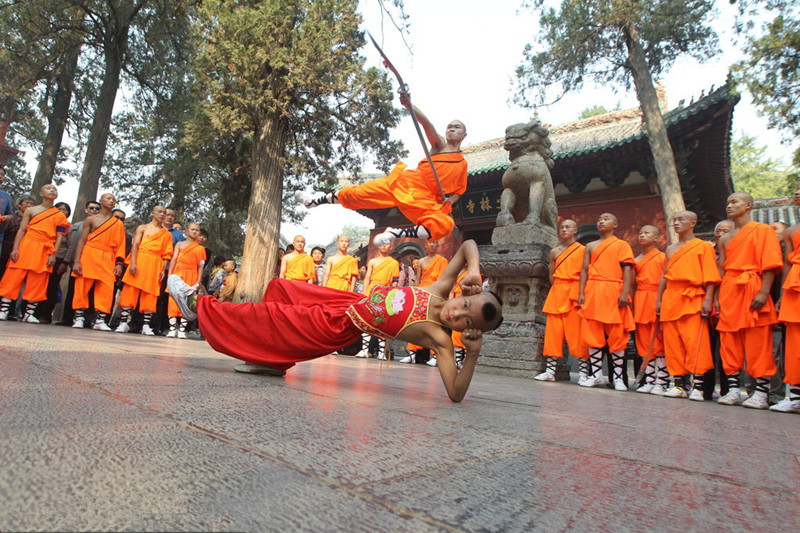
The western side of Dengfeng around Shaoshi Mountain and Shaolin Temple (少林寺) is the city's internationally best-known cultural zone. Shaolin culture is not simply a martial-arts performance tradition; it developed within a particular Buddhist monastic environment and combines Chan Buddhist thought, physical cultivation, martial practice and monastic discipline.
Shaolin Kung Fu (少林功夫) was included in China's first group of National Intangible Cultural Heritage projects in 2006, with Dengfeng listed as the place of nomination. China's official intangible-heritage database describes it as a cultural system historically formed in the Buddhist environment of Shaolin Temple and deeply influenced by Chan thought.
For cultural travelers, the strongest experience is therefore not simply watching a short Kung Fu show. A deeper visit connects the Shaolin Temple compound, Chuzu Temple, Pagoda Forest, inscriptions, Chan culture and martial traditions, helping explain why Shaolin became an internationally recognizable symbol of Chinese culture.
Songyang Area: Confucian Learning and Ancient Architecture
Songyang Academy (嵩阳书院) represents another side of Dengfeng. It became one of the important academies of traditional China and was particularly influential during the Song dynasty, when scholars associated with Confucian and Neo-Confucian learning taught in the Mount Song region. Municipal historical material also associates figures such as Cheng Hao, Cheng Yi and Sima Guang with the academy.
The grounds preserve the famous General Cypresses (将军柏), whose great age is part of the academy's cultural identity, together with historic inscriptions and traditional academy architecture. Rather than visiting it as simply another old building, travelers should understand Songyang Academy as a surviving landscape of classical education, scholarship and Confucian intellectual culture.
Nearby Songyue Temple Pagoda (嵩岳寺塔) dates to the Northern Wei period and is officially described as China's oldest surviving brick pagoda. Its twelve-sided form and dense-eave structure also make it one of the most important early Buddhist architectural survivals in East Asia.
Zhongyue Area: Daoism and Imperial Mountain Worship
The Zhongyue Temple (中岳庙) area represents Dengfeng's Daoist and state-ritual traditions. Mount Song's status as the Central Mountain of the Five Great Mountains made it an important place for imperial sacrifice and mountain worship over many dynasties.
Together with the nearby Taishi Que (太室阙), Zhongyue Temple forms one component of the UNESCO World Heritage property. Dengfeng's three surviving Han-period que gates—Taishi Que, Shaoshi Que and Qimu Que—are exceptionally important examples of Eastern Han ritual architecture and carved stone art.
The area also preserves a living ritual tradition through the Zhongyue Temple Fair (中岳庙会), which Dengfeng lists among its provincial-level intangible cultural heritage. For visitors, this makes Zhongyue more than an architectural site: it connects ancient mountain worship with continuing folk religious and festival traditions.
Gaocheng: Astronomy, Calendars and Early Civilization
Gaocheng Town (告成镇) is essential for visitors who want to understand why Dengfeng is called the “Centre of Heaven and Earth.” Here, cultural tourism moves away from temples and toward astronomy, archaeology and the intellectual history of timekeeping.
The Dengfeng Observatory (观星台) was constructed in the Yuan dynasty in 1276 during the astronomical work associated with Guo Shoujing. The surviving observatory was used for solar-shadow measurements that contributed to calendrical calculations and the development of the Shoushi Calendar (授时历).
The nearby Zhougong Sundial Platform (周公测景台) represents the much older tradition of locating the geographical and cosmic centre by observing the sun's shadow. Together with Wangchenggang and Yangcheng archaeological resources, Gaocheng provides Dengfeng's strongest route for travelers interested in early Chinese civilization, ancient science and concepts of space and time.
The Twenty-Four Solar Terms
Dengfeng frequently promotes the Twenty-Four Solar Terms (二十四节气) as one of its world-class cultural resources because the Observatory is an important historical carrier of Chinese solar observation and calendrical knowledge. The Twenty-Four Solar Terms were inscribed on UNESCO's Representative List of the Intangible Cultural Heritage of Humanity in 2016.
For accuracy, however, the UNESCO inscription belongs to China as a national cultural tradition, not exclusively to Dengfeng. Dengfeng's particular significance lies in its ancient astronomical monuments and local traditions connected with observing the sun, calendars and seasonal cycles.
Intangible Cultural Heritage of Dengfeng
Dengfeng has developed a particularly broad intangible-heritage system. An official 2023 municipal summary recorded 2 national-level, 20 provincial-level, 45 Zhengzhou-level and 162 Dengfeng-level projects at that time; the county-level inventory has continued to expand subsequently.
| Level |
Representative Heritage |
Chinese Name |
Cultural Focus |
| National |
Shaolin Kung Fu |
少林功夫 |
Martial arts, Chan culture |
| National |
Dengfeng Kiln Ceramic Firing Techniques |
登封窑陶瓷烧制技艺 |
Traditional ceramics |
| UNESCO / China-wide tradition with important Dengfeng connections |
Twenty-Four Solar Terms |
二十四节气 |
Astronomy, seasonal knowledge |
| Provincial |
Zhongyue Temple Fair |
中岳庙会 |
Folk religion and festival culture |
| Provincial |
Yingyang Naoge |
颍阳闹歌 |
Folk music and performance |
| Provincial |
Songshan Woodblock New Year Pictures |
嵩山木版年画 |
Traditional visual art |
| Provincial |
Songshan “Niren Liu” Clay Sculpture |
嵩山“泥人刘” |
Clay sculpture |
| Provincial |
Songyang Sword Forging |
嵩阳宝剑锻造技艺 |
Traditional metalworking |
| Provincial |
Songshan Woodcarving |
嵩山木雕 |
Wood craftsmanship |
| Local / Zhengzhou-level traditions |
Lion dancing, Xingxingguai, folk martial arts, paper cutting and food crafts |
舞狮、猩猩怪、剪纸等 |
Festival and community traditions |
The municipal heritage directory also records traditions such as the Xuyou legend, Songshan marriage customs, Dujiao Dance and Momo Fair, illustrating how Dengfeng's heritage extends far beyond Shaolin Kung Fu.
The local Xingxingguai (猩猩怪) is especially interesting to cultural travelers. It appears in Dengfeng's official festival programming alongside lion dancing and other local folk performances, combining masked or costumed performance with the energetic atmosphere of local martial and festival culture.
Recent local-level heritage work has also brought traditional food and craft skills into the protection system, including flower-bun making, traditional medicinal preparation, local banquet traditions, martial routines and regional food-making techniques. This illustrates a broader change in Dengfeng tourism: heritage is increasingly presented as something visitors can watch, learn and participate in, rather than only observe behind museum glass.
Traditional Villages and Rural Heritage
Dengfeng's cultural landscape continues beyond the famous temples. Several mountain villages preserve stone houses, fortified settlement patterns, old courtyards, folk traditions and revolutionary heritage.
Yuanqiao Village (袁桥村) in Dajindian Town and Zhaidong Village (寨东村) in Baiping were included in the sixth group of Chinese Traditional Villages announced in 2023.
Yuanqiao Village preserves prehistoric archaeological remains alongside Ming-Qing and later architecture, including ancestral halls, courtyard houses, an old theatre, fortified structures, wells and sections of old village walls. Official local documentation lists more than 60 protected traditional structures or groups and also highlights its revolutionary history, including the former residence of Yuan Yi and a site associated with the first Dengfeng County Party Congress in 1939.
Zhaidong Village, set around the high mountain settlement of Tianxiongzhai, is characterized by cliffs, stone dwellings, traditional farming landscapes and a large body of local legends. Its location and mountain environment make it more suitable for travelers interested in rural landscape and folk memory than formal monumental architecture.
Another important traditional settlement is Baishiya Village (柏石崖村) in Xuzhuang Town, which was included in an earlier, third batch of nationally recognized traditional villages. The settlement is known for its mountain stone architecture, village traditions and red-history resources.
Ethnic and Community Culture
Dengfeng is predominantly Han Chinese, but official background material has recorded residents belonging to 24 ethnic groups. Unlike destinations where minority traditions form the principal tourism identity, Dengfeng's cultural landscape is more strongly defined by the shared traditions of the Central Plains—Buddhism, Daoism, Confucianism, martial arts, temple fairs, village culture and crafts.
For cultural-tourism writing, minority communities should therefore be presented as part of modern Dengfeng's social diversity, rather than artificially turning the city into an ethnic-minority destination. The strongest cultural experiences remain those connected with Mount Song and the living religious, martial, craft and village traditions surrounding it.
Cultural Highlights by Area
| Area |
Cultural Identity |
Recommended Heritage |
| Shaolin Area |
Chan Buddhism and martial culture |
Shaolin Temple, Pagoda Forest, Chuzu Temple, Shaoshi Que, Shaolin Kung Fu |
| Songyang Area |
Confucian scholarship |
Songyang Academy, General Cypresses, Qimu Que, Songyue Temple Pagoda |
| Zhongyue Area |
Daoism and mountain worship |
Zhongyue Temple, Taishi Que, temple-fair traditions |
| Gaocheng Town |
Astronomy and early civilization |
Observatory, Zhougong Sundial Platform, Wangchenggang and Yangcheng heritage |
| Dajindian Town |
Traditional villages and folk culture |
Yuanqiao Village, martial and food traditions |
| Baiping |
Mountain-village culture |
Zhaidong Village, Tianxiongzhai landscape |
| Xuzhuang Town |
Stone villages and rural heritage |
Baishiya Village |
| Shidao and surrounding countryside |
Folk performance and food heritage |
Lion dancing, traditional cuisine and village festivals |
| Central Dengfeng |
Contemporary heritage interpretation |
Museums, non-heritage workshops, cultural markets and local crafts |
History and Culture Tour with Yaso Trip
For a first cultural journey, 2 days is enough for the essential monuments, while 3 days gives visitors time to understand traditional villages and intangible heritage rather than simply moving between famous sites.
| Day |
Cultural Route |
Main Theme |
| Day 1 |
Shaolin Temple → Chuzu Temple / Pagoda Forest → Shaoshi cultural landscape |
Chan Buddhism and Shaolin Kung Fu |
| Day 2 |
Songyang Academy → Zhongyue Temple → Gaocheng Observatory → Zhougong Sundial Platform |
Confucianism, Daoism and ancient astronomy |
| Day 3 |
Yuanqiao Village → local intangible-heritage workshop → Zhaidong or Baishiya Village |
Traditional villages and living folk culture |
Visitors primarily interested in the UNESCO site should focus on the eight World Heritage groups, while archaeology specialists should spend more time around Gaocheng and Wangchenggang. Martial-arts travelers will naturally require more time in the Shaolin area, whereas photographers and rural-culture travelers can add Yuanqiao, Zhaidong or Baishiya.
Dengfeng's own cultural-tourism planning follows a similar pattern, organizing major cultural zones around Shaolin and Shaoshi Mountain, Zhongyue Temple and Taishi Mountain, Songyang Academy and Qimu Que, and the Observatory–Wangchenggang area.
Practical Cultural Travel Tips
The most rewarding way to visit Dengfeng is to avoid treating Shaolin Temple as the entire destination. Shaolin may be internationally famous, but Songyang Academy, Zhongyue Temple and the Observatory are essential for understanding why UNESCO uses the phrase “Centre of Heaven and Earth.”
Religious sites remain functioning cultural spaces, so visitors should speak quietly, follow photography restrictions and avoid interrupting worship or monastic activities. At traditional villages, respect private homes and farming areas; not every historic courtyard is a public attraction. Current opening hours and reservation requirements for protected monuments should also be checked shortly before travel, as access arrangements can change.
For intangible heritage, experiences are much more valuable when arranged around an actual craftsperson, workshop, festival or demonstration. Dengfeng has increasingly integrated pottery, woodcarving, paper cutting, martial arts and other heritage activities into cultural-tourism programs.