Longyan (龙岩), commonly known as Minxi or Western Fujian (闽西), is a prefecture-level city in southwestern Fujian Province. Positioned where Fujian meets Guangdong and Jiangxi, it is an important inland gateway connecting the southeastern coast with the mountainous interior of southern China.
Longyan is best understood through three defining identities: it is a major center of Hakka culture, one of China’s best-known revolutionary base areas, and one of Fujian’s most heavily forested ecological regions. Modern Longyan is also an important industrial city built around mining, metallurgy, advanced materials, machinery manufacturing, environmental technology and regional services.
Basic Information
| Item |
Information |
| Chinese Name |
Longyan City (龙岩市) |
| Common Regional Name |
Minxi / Western Fujian (闽西) |
| Province |
Fujian Province (福建省) |
| Administrative Code |
350800 |
| Administrative Status |
Prefecture-level city |
| Municipal Seat |
Xinluo District (新罗区) |
| Administrative Divisions |
Xinluo District, Yongding District, Changting County, Shanghang County, Wuping County, Liancheng County and Zhangping City |
| Total Area |
Approximately 19,028 square kilometres |
| Resident Population |
2.668 million at the end of 2025 |
| Telephone Area Code |
0597 |
| Postal Code |
364000 |
| Vehicle Registration Code |
闽F |
| Official City Brand |
Fresh Fujian · Colorful Longyan (清新福建·五彩龙岩) |
Longyan administers two urban districts, four counties and one county-level city. Its territory covers approximately 19,028 square kilometres, but settlements are widely separated by hills, forests, river valleys and mountain basins.
The name “Longyan” is traditionally associated with Longyan Cave (龙岩洞) near Cuiping Mountain, whose rock formations were said to resemble dragon scales. The former Longyan Prefecture was reorganized as a prefecture-level city in 1997.
Geographic Location
Longyan lies in southwestern Fujian between the southeastern coastal economic zone and the inland regions of southern China. It borders Quanzhou and Zhangzhou to the east, Ganzhou in Jiangxi Province to the west, Meizhou in Guangdong Province to the south and Sanming to the north. This location has historically made Longyan a corridor for migration, trade and cultural exchange between Fujian, Guangdong and Jiangxi.
The city is particularly closely connected with the Hakka-speaking regions of eastern Guangdong and southern Jiangxi. Its western counties belong culturally and geographically to the wider Hakka heartland, while Zhangping and eastern Longyan display stronger connections with southern Fujian culture.
Landforms and Natural Environment
Longyan is overwhelmingly mountainous. Its terrain generally descends from the northeast toward the southwest, with an official average elevation of about 652 metres. Mountains and hills account for approximately 94.95% of the municipal territory, leaving comparatively limited areas of flat land around river valleys and urban basins.
The city’s waterways belong mainly to the Ting River (汀江) and Jiulong River (九龙江) systems. The Ting River flows southward through the Hakka heartland before entering Guangdong, while tributaries of the Jiulong River connect eastern Longyan with Zhangzhou and the Fujian coast. The combination of mountains, abundant rainfall and extensive forests has given Longyan rich water, woodland and biodiversity resources.
Forest coverage stands at 79.21%, ranking Longyan among China’s most forested prefecture-level cities and first in Fujian for many consecutive years. The city is recognized as a national ecological-civilization demonstration area and an important center for forestry reform and forest-carbon initiatives.
Climate
Longyan has a humid subtropical monsoon climate characterized by warm temperatures, plentiful rainfall and four distinguishable seasons. Recent official summaries record an annual mean temperature of around 20.8°C, while annual precipitation varies considerably by year and location, commonly falling within a broad range of approximately 1,600–1,900 millimetres.
Spring is mild but frequently rainy. Summer is hot and humid in the lower urban basins, although forested highlands and mountain counties are cooler. Autumn generally provides the driest and most comfortable weather, while winter is mild compared with northern China but can feel damp and chilly in mountain communities.
Local differences are significant. Xinluo and Yongding tend to be warmer, while higher areas of Liancheng, Changting, Wuping and Shanghang experience cooler mornings, stronger temperature differences and occasional frost during winter cold waves.
Population and Ethnic Communities
Longyan had a permanent resident population of 2.668 million at the end of 2025, including 1.814 million urban residents. Its resident urbanization rate reached 67.99%.
The population is predominantly Han Chinese, with Hakka communities forming the principal cultural population across much of western Longyan. Changting, Shanghang, Wuping, Liancheng and Yongding are particularly important centers of Hakka settlement, language, clan traditions and ancestral culture.
The She ethnic group (畲族) is the most locally distinctive minority community. Concentrations are found in parts of Shanghang and other rural areas, including Guanzhuang She Ethnic Township (官庄畲族乡) and Lufeng She Ethnic Township (庐丰畲族乡). She songs, clothing, food customs and the lunar “Third Day of the Third Month” celebrations contribute to the cultural diversity of the region.
Longyan also has extensive historical connections with overseas Hakka communities and families in Hong Kong, Macao, Taiwan and Southeast Asia.
Historical and Cultural Identity
Hakka Ancestral Homeland
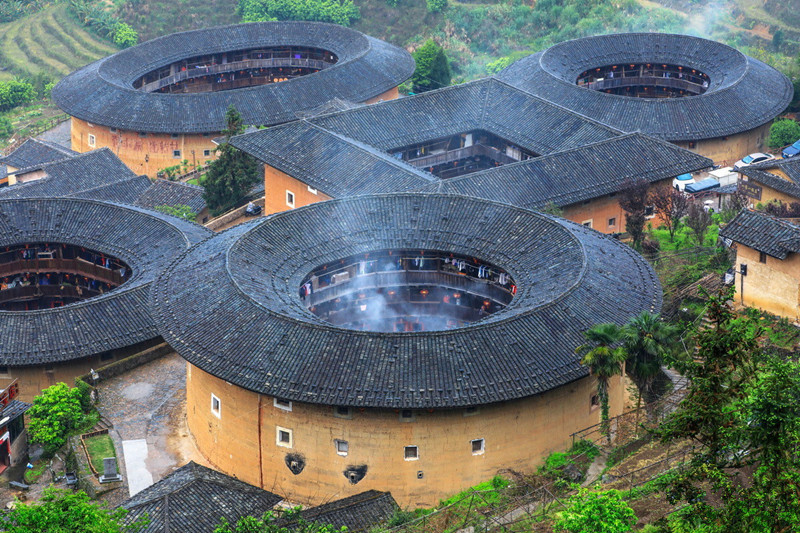
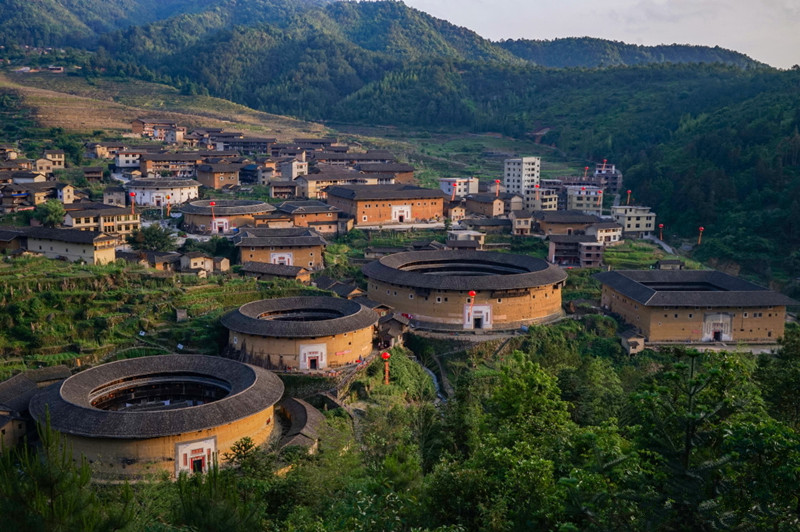
Longyan is widely regarded as one of the ancestral homelands of the Hakka people. Generations of migration created a cultural landscape characterized by clan halls, fortified residences, tulou architecture, traditional villages, family genealogies and strong ancestral connections.
The city is part of the national Hakka Culture (Minxi) Ecological Protection Area, established to safeguard traditional architecture, music, drama, handicrafts, rituals, food and community customs as an interconnected living cultural system.
Revolutionary Heritage
Longyan was a core area of the former Central Soviet Area and an important base for the Chinese Red Army. The Gutian Conference of 1929 gave Longyan a particularly important place in modern Chinese revolutionary history.
Parts of Longyan were associated with early revolutionary organization, military training, land reform and the beginning stages of the Long March. This historical legacy remains central to local education, research, commemorative activities and red-culture tourism.
Traditional Arts and Intangible Heritage
Longyan’s representative cultural traditions include Minxi Han Opera, Hakka mountain songs, puppet theatre, woodcarving, paper-making, festival dragon performances, traditional food production and tea processing.
The city has 10 national-level representative intangible cultural heritage projects, alongside numerous provincial and municipal traditions. The national Hakka cultural protection area passed national evaluation, while new heritage workshops, inheritors and community programs continued to receive recognition in 2025.
Traditional tea culture is especially important in Zhangping, where compressed Narcissus tea represents a distinctive local production tradition. Hakka food culture, village ceremonies and clan customs remain strongly rooted in everyday life throughout the western counties.
Transportation Overview
Longyan has developed into a regional transport hub connecting inland Fujian with Guangdong, Jiangxi and the southeastern coast. Railways link the city with Xiamen, Zhangzhou, Fuzhou, Ganzhou, Shenzhen, Guangzhou and other major destinations. Important passenger stations include Longyan Railway Station, Changting South Station, Gutianhuizhi Station, Wuping Station and stations serving Zhangping and Liancheng.
The city’s railway network has expanded through the Longyan–Xiamen Railway, Ganzhou–Ruijin–Longyan Railway, Nanping–Sanming–Longyan Railway and sections of the Longyan–Longchuan high-speed railway. The Wuping–Meizhou section is under construction, strengthening future connections between western Fujian and eastern Guangdong.
Road transport is supported by a dense network of expressways and national highways. At the end of 2025, Longyan had 805 kilometres of operational expressways and more than 704 kilometres of operating railway lines.
Regional air travel is provided by Longyan Guanzhaishan Airport (龙岩冠豸山机场) in Liancheng County. Most international visitors also enter through the larger airports in Xiamen, Fuzhou, Ganzhou or Meizhou before continuing by train or road.
Economic Development
Longyan recorded a gross domestic product of RMB 357.855 billion in 2025, an increase of 4.5% over the previous year. The primary, secondary and tertiary sectors accounted for 9.0%, 41.3% and 49.7% of the economy respectively, while GDP per capita reached RMB 133,628.
The city has long been an important mineral-resource base. Major reserves include copper, gold, iron, coal, manganese, kaolin and other industrial minerals. Mining and metallurgy remain influential, but Longyan is developing a broader industrial structure based on:
- Non-ferrous metals and advanced materials
- Machinery and specialist equipment manufacturing
- Environmental-protection technology
- Energy storage and new-energy industries
- Tobacco and food processing
- Forestry, bamboo and agricultural products
- Digitalized manufacturing and modern services
Major locally connected companies include Zijin Mining, Longking Environmental Protection, Lonking Holdings and major tobacco and industrial-material enterprises. In recent years, greater attention has been placed on transforming mineral resources into higher-value materials, improving environmental standards and developing specialized manufacturing.
Tourism Development
Tourism is increasingly important to Longyan’s transition from a traditional resource-based economy toward a more diversified service economy. The city promotes the “Fresh Fujian · Colorful Longyan” brand, using red, green, ancient, golden and blue themes to represent revolutionary history, ecology, Hakka civilization, industry and contemporary urban life.
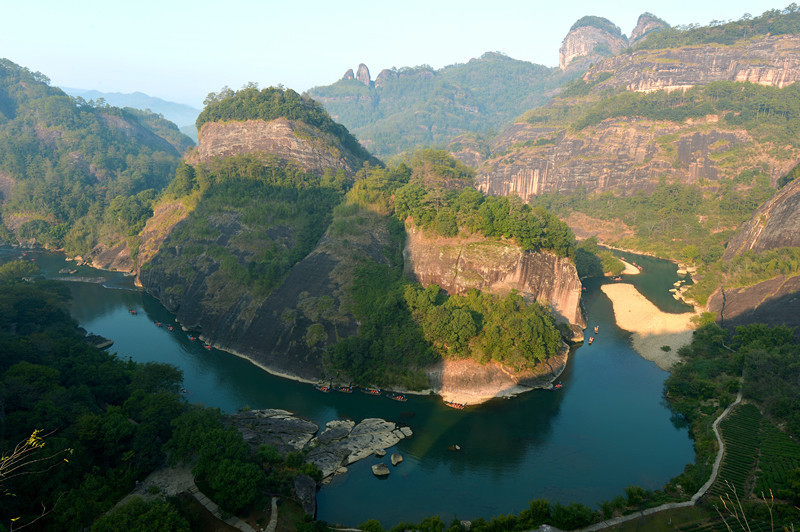
Longyan has developed five broad tourism brands centered on revolutionary heritage, Hakka architecture, historic urban culture, Danxia landscapes and hot springs, and ecological recreation. These themes allow the city to connect its different counties without depending on a single tourism destination.
In 2025, Longyan received 79.275 million tourist visits, generating total tourism expenditure of RMB 77.685 billion. The city also reported three national 5A tourist areas, giving it the largest number among Fujian’s prefecture-level cities at that time.
Current tourism development emphasizes cultural-heritage conservation, red-culture education, traditional-village renewal, Hakka food, ecological holidays, hot-spring resorts, study tours and self-driving travel. Rather than functioning as a conventional single-center destination, Longyan is developing as a multi-county cultural region suited to slow travel and themed journeys through western Fujian.