Longyan (龙岩) lies in western Fujian at the meeting point of Fujian, Guangdong and Jiangxi. Its cultural identity is built around three closely connected traditions: Hakka civilisation, revolutionary history and ecological culture. The region contains the World Heritage tulou of Yongding, the historic city of Changting, the Gutian Conference heritage of Shanghang, the traditional villages of Liancheng and the prehistoric Qihe Cave Site in Zhangping.
Longyan forms the principal part of the Hakka Culture of Western Fujian National Cultural Ecological Protection Area, which officially passed national evaluation in 2025. This status promotes integrated protection of dialects, traditional settlements, ancestral rituals, opera, music, crafts, cuisine and community life rather than preserving individual monuments in isolation.
The city currently has ten national-level intangible cultural heritage projects, one National Historical and Cultural City, three national historical and cultural towns, 14 national historical and cultural villages and 73 nationally listed Chinese Traditional Villages. These resources are distributed across Xinluo District, Yongding District, Shanghang County, Wuping County, Changting County, Liancheng County and Zhangping City.
Historical and Cultural Foundations of Longyan
Prehistoric Civilisation and Archaeological Heritage
The Qihe Cave Site (奇和洞遗址) in Xianghu Town, Zhangping, is a nationally protected archaeological site representing the transition from the Late Palaeolithic to the Early Neolithic period. Archaeological discoveries have provided important evidence for studying prehistoric settlement, food production, toolmaking and the early human history of southeastern China. Longyan has enacted dedicated local regulations to protect the site and is advancing museum and archaeological-park development.
The fossil sites of Shanghang add a much earlier geological dimension to the region. Dinosaur track discoveries in the Longxiang area are being protected and studied together with Longyan Cave and Qihe Cave as important prehistoric and palaeontological resources. These sites are better suited to specialist archaeology, geology and educational programmes than conventional sightseeing until formal visitor facilities are fully developed.
Hakka Migration and the Formation of Western Fujian Culture
Western Fujian became an important settlement area during successive migrations from northern and central China. Mountain valleys provided security and agricultural land, while family clans developed strong systems of ancestral worship, communal education, mutual assistance and defensive settlement construction.
Hakka culture remains visible in the local dialects, genealogies, ancestral halls, enclosed residences, seasonal ceremonies, folk songs, food and clan-based villages of Yongding, Changting, Shanghang, Liancheng, Wuping and parts of Xinluo. The designation of the national cultural ecological protection area recognises these traditions as a connected living system rather than a collection of isolated heritage objects.
Fujian Tulou and Communal Architecture
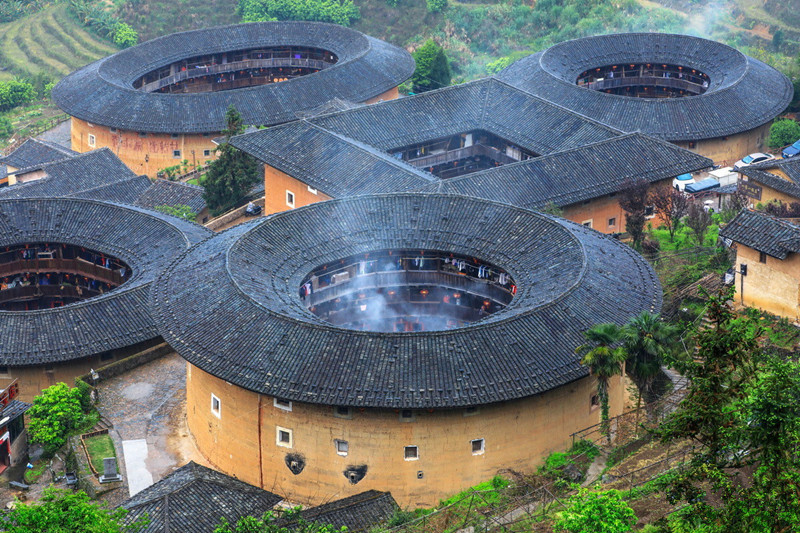
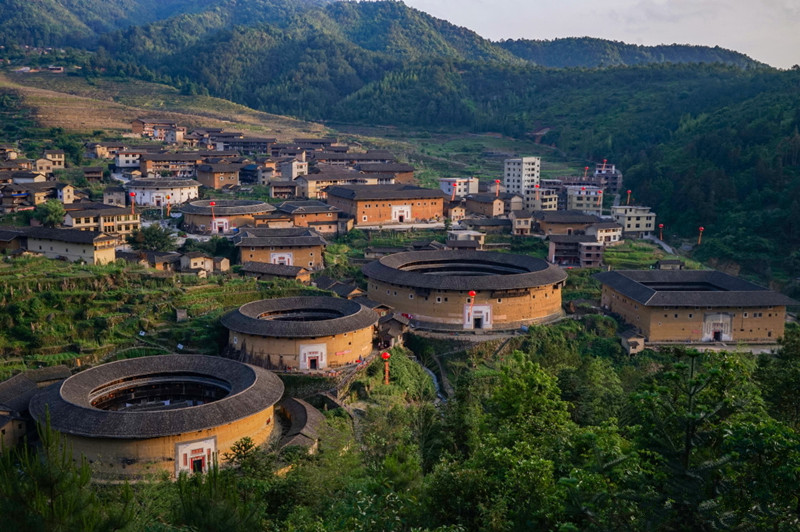
The Fujian Tulou (福建土楼) World Heritage property comprises 46 representative earthen buildings and clusters constructed between the 15th and 20th centuries. The property includes major Yongding components such as the Chuxi, Hongkeng and Gaobei tulou clusters and the Yanxiang and Zhenfu buildings. These fortified communal residences were organised around central courtyards and could accommodate entire clans.
The architecture reflects more than defence. Shared wells, ancestral halls, kitchens, stairways and family rooms reveal a social structure based on clan unity, ritual order and mutual responsibility. Hakka Tulou Construction Techniques (客家土楼营造技艺) are protected as a national-level Chinese intangible cultural heritage project. However, the technique itself is not a separate UNESCO intangible-heritage inscription; it is the physical Fujian Tulou property that holds UNESCO World Heritage status.
Changting and the Historic Capital of Hakka Culture
Changting (长汀), historically known as Tingzhou, developed into an important administrative, commercial and cultural centre of western Fujian. Today it is a National Historical and Cultural City and is commonly described as a cultural capital of the Hakka people.
Its historic urban landscape includes surviving city walls, old gates, traditional streets, temples, ancestral buildings and neighbourhoods beside the Ting River. Unlike a reconstructed theme park, much of Changting remains integrated with ordinary shops, homes, markets and local food culture. Recent conservation programmes are strengthening historic neighbourhoods such as South Street while introducing performances, craft exhibitions and community cultural spaces.
Red Culture and the Gutian Legacy
Longyan was a central area of the former Central Soviet region and is widely associated with the expressions “home of the Red Army,” “cradle of revolution” and “the red flag never fell.” The best-known site is the Gutian Conference Site (古田会议会址) in Shanghang, where the 1929 conference established influential principles concerning ideological and political development within the Chinese Red Army.
The wider revolutionary landscape includes former headquarters, army hospitals, training sites, transport stations, financial institutions and villages across Shanghang, Changting, Yongding, Liancheng and Xinluo. Longyan is continuing the conservation of the Gutian heritage group, the western Fujian section of the Central Red Transport Route and sites incorporated into the Long March National Cultural Park.
Intangible Cultural Heritage of Longyan
Longyan’s ten national-level projects are supported by extensive provincial, municipal and county inventories. The city announced a recommended ninth municipal batch in early 2026, while nine Longyan projects entered Fujian’s eighth provincial list later that year. The latest additions cover folk literature, traditional fine arts, martial arts, tea and food production, lantern rituals, ethnic songs and clothing techniques.
Representative Intangible Cultural Heritage
| Heritage Project |
Principal Area |
Cultural Value |
| Western Fujian Han Opera (闽西汉剧) |
Longyan-wide, especially Shanghang and central Longyan |
A major regional opera combining Hakka language, historical drama, vocal performance and elaborate stage conventions |
| Western Fujian Hakka Shifan Music (闽西客家十番音乐) |
Yongding and other Hakka communities |
Traditional instrumental ensemble music used during festivals, processions, weddings and community rituals |
| Longyan Tea-Picking Lantern Dance (龙岩采茶灯) |
Xinluo District |
A folk performance combining dance, singing, dialogue and theatrical movements derived from tea-country life |
| Hakka Tulou Construction Techniques (客家土楼营造技艺) |
Yongding District |
Traditional knowledge of rammed-earth walls, timber structures, drainage, site selection and clan-oriented residential design |
| Sibao Woodblock Printing Techniques (四堡雕版印刷技艺) |
Liancheng County |
Printing, carving, typesetting and book-production traditions associated with one of southern China’s historic publishing centres |
| Western Fujian Hakka Puppetry (闽西客家木偶戏) |
Shanghang and neighbouring counties |
String-puppet performance combining carving, manipulation, music and traditional dramatic stories |
| Gutian Grand Dragon Procession (姑田游大龙) |
Liancheng County |
A spectacular festival dragon assembled from multiple sections and paraded through villages during traditional celebrations |
| Traditional Wanying Tea Preparation (永定万应茶制作技艺) |
Yongding District |
A traditional medicinal tea connected with local knowledge of herbs, processing and household healthcare |
| Zhangping Shuixian Tea Processing (漳平水仙茶制作技艺) |
Zhangping City |
A distinctive oolong-tea process producing compressed square tea cakes |
| Hakka Lantern and Seasonal Festival Traditions |
Yongding, Liancheng and other Hakka areas |
Community ceremonies combining lanterns, processions, ancestral worship, music and village participation |
Zhangping Shuixian tea processing is one of the 44 Chinese tea-related practices included in UNESCO’s 2022 inscription, “Traditional Tea Processing Techniques and Associated Social Practices in China.” Its inclusion should be distinguished from the national protection of Hakka tulou construction techniques.
Recent provincial additions from Longyan include Tingzhou Hakka nursery rhymes, Zhangping She mountain songs, Zhangping farmers’ lacquer painting, Wuping Shijia boxing, Shanghang preserved-plum techniques and the Bizhou Second-Day-of-the-Second-Month lantern procession in Liancheng. These projects demonstrate that Longyan’s cultural heritage extends well beyond tulou and red-tourism sites.
History and Cultural Heritage by District and County
| Area |
Core Cultural Identity |
Representative Heritage |
| Xinluo District (新罗区) |
Urban Longyan, tea traditions and the meeting of Hakka and Minnan cultures |
Longyan Tea-Picking Lantern Dance, traditional tea production, Longyan Cave, Zhuguan Ancient Village, Dongxiao revolutionary sites, local food and urban industrial memory |
| Yongding District (永定区) |
World Heritage tulou and clan-based Hakka culture |
Hongkeng, Gaobei and Chuxi Tulou Clusters, Zhencheng Lou, Chengqi Lou, Hakka tulou construction, Shifan music, Wanying tea, ancestral halls and Hakka family traditions |
| Shanghang County (上杭县) |
Gutian revolutionary heritage, Hakka genealogy and She culture |
Gutian Conference Site, revolutionary museums, Caixi Township investigation heritage, Hakka clan halls, genealogical collections, Hakka puppetry and Guanzhuang She Ethnic Township |
| Wuping County (武平县) |
Hakka market towns, surname culture and martial traditions |
Zhongshan Ancient Town, Baijia surname culture, Shijia boxing, woodcut art, traditional couplets, ancient villages and forest-reform heritage |
| Changting County (长汀县) |
Historic Tingzhou and the cultural capital of the Hakka people |
Ancient city walls and gates, traditional streets, former Soviet institutions, Hakka nursery rhymes, incense making, paper flowers, cuisine and Ting River culture |
| Liancheng County (连城县) |
Traditional villages, publishing history and festival culture |
Peitian Ancient Village, Sibao historic publishing buildings, woodblock printing, Gutian Grand Dragon, lantern festivals, traditional residences and Hakka clan culture |
| Zhangping City (漳平市) |
Prehistoric archaeology, tea and multi-ethnic rural culture |
Qihe Cave Site, Zhangping Shuixian tea, She mountain songs, farmers’ painting and lacquer painting, traditional tea villages and cross-Strait agricultural connections |
Chinese Traditional Villages and Historic Settlements
Longyan has 73 Chinese Traditional Villages, alongside three national historical and cultural towns and 14 national historical and cultural villages. It also has seven provincial historical and cultural towns, 12 provincial historical and cultural villages and numerous protected historic streets and buildings.
The following table presents representative villages and settlement groups rather than reproducing the complete 73-village national inventory.
| Area |
Representative Traditional Villages and Historic Settlements |
| Xinluo District |
Zhuguan Village (竹贯村), Meicun Village in Wan’an (万安镇梅村村) and mountain settlements preserving clan halls, red-brick houses and rural trade routes |
| Yongding District |
Chuxi (初溪), Hongkeng (洪坑), Gaobei (高北), Nanxi (南溪) and Gaodong Village (高东村), representing dense tulou landscapes and inhabited Hakka communities |
| Shanghang County |
Guan田 Village in Rentian (稔田镇官田村), Huajia Village (华家村) and villages connected with Hakka ancestral halls and revolutionary routes |
| Wuping County |
Traditional communities around Zhongshan Town, surname-based settlements and Hakka mountain villages |
| Changting County |
Historic communities along the Ting River, including Tangwu Village in Sidu (四都镇汤屋村) and villages preserving wooden houses, ancestral halls and covered bridges |
| Liancheng County |
Peitian Village (培田村), Xinquan Village (新泉村), Chendi Village (陈地村), Tiancha Village in Sibao (田茶村) and other villages preserving “nine halls and eighteen wells” residences |
| Zhangping City |
Tea-growing villages, She communities and settlements around Xianghu and the Qihe Cave cultural landscape |
Peitian Ancient Village (培田古村落) is among the strongest choices for architectural study. Its streets, waterways, ancestral buildings and large courtyard residences preserve the spatial organisation of a prosperous Hakka community. Sibao (四堡) is more specialised, focusing on publishing, bookshops and woodblock printing, while the Yongding villages demonstrate communal earthen architecture on a much larger scale.
She Ethnic Culture in Longyan
The She people (畲族) form Longyan’s most visible ethnic-minority community. Their principal concentration is Guanzhuang She Ethnic Township (官庄畲族乡) in Shanghang, while smaller communities are found in Zhangping and other rural areas.
The third day of the third lunar month is an important period for She cultural gatherings. Activities may include ancestral ceremonies, mountain-song exchanges, drum and lantern performances, bamboo-pole dancing, embroidery, traditional clothing and the preparation of dark glutinous rice. Guanzhuang also maintains cultural exhibition and craft spaces introducing She farming, domestic life, belief systems and costume traditions.
She cultural performances should be understood as community traditions rather than entertainment available every day. Festival dates follow the lunar calendar, and visits involving songs, ceremonies or costume demonstrations require confirmation with the host community.
Major Cultural Tourism Routes with Yaso Trip
World Heritage Tulou and Hakka Life
Suggested route: Longyan → Hongkeng Tulou Cluster → Gaobei Tulou Cluster → Chuxi Tulou Cluster → Yongding village stay
Allow two days rather than attempting all three clusters in one rushed day. The journey should combine architecture with an ancestral-hall visit, Hakka food, family history and an explanation of how residents continue to use the buildings.
Gutian and Western Fujian Red Heritage
Suggested route: Longyan → Gutian Conference Site → Gutian Conference Memorial Museum → Caixi Township → Changting
This route connects the ideological history of the Gutian Conference with rural investigation, Central Soviet institutions and the revolutionary landscape of Tingzhou. Two to three days provide enough time for interpretation instead of rapid monument photography.
Changting Hakka Cultural Journey
Suggested route: Changting Ancient City Wall → Jichuan Gate → Sanyuan Pavilion → Diantou Street → Ting River neighbourhoods → Hakka craft or food workshop
Changting is best explored partly on foot and partly through resident-led cultural experiences. Evening walks are atmospheric, but the programme should also include daytime access to museums, historic interiors and craft workshops.
Liancheng Architecture and Printing Heritage
Suggested route: Peitian Ancient Village → Sibao Historic Publishing Buildings → traditional woodblock-printing workshop → Xinquan
This journey is suitable for architecture students, cultural associations and educational groups. A hands-on printing class provides a clearer understanding of book production than simply viewing carved blocks behind glass.
Archaeology and Tea Culture
Suggested route: Zhangping Qihe Cave → Zhangping Shuixian tea gardens → tea-processing workshop → She cultural community
The archaeological site and specialised tea heritage create one of Longyan’s most distinctive study-tour combinations. Access to excavation areas, working tea factories and ethnic villages must be arranged in advance.
She Culture and Hakka Genealogy
Suggested route: Shanghang clan and genealogy resources → Guanzhuang She Ethnic Township → cultural exhibition → song, embroidery or food experience
This route allows students to compare Hakka lineage culture with She identity and oral traditions. It is particularly suitable around a confirmed community festival but should avoid turning private ceremonies into staged tourist performances.