China Travel Agency, China Tours 2026/2027 | Yaso Trip
Theme Tours
View All China Theme Tours by Interest
Travel Guide
  • Travel Guide
  • Travel Tips
  • Tour Planning
  • Ethnic Culture
  • China Climate
  • Golf Courses
  • Yangtze Cruise
  • Travel Articles
  • Self-Drive the Silk Road: Xi'an to Urumqi Road Trip Guide

    2026-09-11•Xu Yang Fan•29977 words•About 100 minutes

    Quick Answer: Can You Self-Drive the Silk Road in China?

    Yes — with a temporary Chinese driving licence and a licensed guide-escort arranged through a registered agency like Yaso Trip, foreign drivers can self-drive the classic Silk Road route from Xi'an (西安) to Urumqi (乌鲁木齐). The 14-day journey covers roughly 3,200 km (1,988 mi) through four provinces — Shaanxi, Ningxia, Gansu, and Xinjiang — following well-paved national highways through the Hexi Corridor (河西走廊) past Zhangye Danxia (张掖丹霞), Dunhuang's Mogao Grottoes (莫高窟), Turpan's Flaming Mountain (火焰山), and Tianshan's Heavenly Lake (天池). International Driving Permits are not valid in mainland China; a temporary Chinese licence is mandatory, and no foreign driver may operate without an agency-assigned guide in the vehicle.

    Key Takeaways

    ✔ The Xi'an-to-Urumqi Silk Road self-drive covers approximately 3,200 km (1,988 mi) across Shaanxi, Ningxia, Gansu, and Xinjiang on well-maintained highways — the challenge is distance, not road difficulty.

    ✔ Foreign drivers need a temporary Chinese driving licence (International Driving Permits are not valid) and a licensed guide-escort arranged through a registered agency — solo self-driving is not legally permitted.

    ✔ The best driving windows are mid-June and mid-September through mid-October, when temperatures are mild, crowds thin, and the Hexi Corridor's desert light is at its most dramatic.

    ✔ Daily driving legs range from 120 km to 550 km, with the longest stretch between Jiayuguan (嘉峪关) and Dunhuang (敦煌) — plan fuel stops carefully on desert segments where stations can be 100+ km apart.

    ✔ Highlights include Zhangye's rainbow-layered Danxia landform, the Mogao Grottoes' 1,600-year-old Buddhist cave art, Jiayuguan's Great Wall fortress, and Turpan's surreal Flaming Mountain.

    ✔ The route can be driven in reverse — Urumqi to Xi'an — with identical infrastructure and a slightly different perspective on the landscape transition from grassland steppe to Hexi Corridor desert.

    ✔ Xinjiang's highway checkpoints require all passengers to present passports for identity verification; a bilingual guide-escort streamlines this process significantly.

    14 Days China Silk Road Self-Driving Tour from Xi'an to Urumqi (Xian-Ningxia-Gansu-Xinjiang)

    14 Days China Silk Road Self-Driving Tour from Xi'an to Urumqi (Xian-Ningxia-Gansu-Xinjiang)

    Tour Route:Xian-Guyuan-Zhongwei-Yinchuan-Wuwei-Zhangye-Jiayuguan-Dunhuang-Hami-Turpan-Urumqi
  • Self-Drive the Silk Road: Xi'an to Urumqi Road Trip Guide 14 Days
  • Self-Drive the Silk Road: Xi'an to Urumqi Road Trip Guide 15 Places
  • View Detail

    Why Drive the Silk Road Yourself

    The Silk Road between Xi'an and Urumqi is one of the world's great overland corridors — but driving it yourself changes everything about the experience. Here's why self-driving wins over a tour bus:

    • You control the pace. Spend an extra hour watching sunset paint the Danxia hills red, or push through to Dunhuang early enough for desert stargazing. No fixed group schedule.
    • The road is the destination. China's G30 Lianhuo Expressway (连霍高速) and G312 National Highway deliver some of the most dramatic driving anywhere — ruler-straight desert stretches, mountain passes above 3,000 m (9,843 ft), and the visual shock of Ningxia's Tengger Desert meeting the Yellow River.
    • Hidden stops only self-drivers reach. Pull off for lamb soup at a roadside stall in Hami's Yiwu County (伊吾县), or detour into Huoyungu (火云谷) — a three-coloured canyon near Turpan that most tour buses skip entirely.
    • The Hexi Corridor is a driver's highway. Wide, well-paved, lightly trafficked outside cities — with fuel, service areas, and rest stops at regular intervals along most segments.
    • Four provinces, four landscapes. In 14 days you cross the Wei River farmland of Shaanxi, the dune-river boundary of Ningxia, the arid corridor of Gansu, and the basin-and-range terrain of Xinjiang — a transition no airport hop can replicate.
    • A story only you can tell. No group selfie at a scenic viewpoint. You drove 3,200 km across the spine of the old Silk Road. That's a narrative nobody can manufacture.
    Self-driving Silk Road through Gansu desertSelf-driving Silk Road through Gansu desert
    Zhangye Danxia Platform Silk RoadZhangye Danxia Platform Silk Road

    Xi'an — The Eastern Terminus (Days 1–2)

    Morning light fills the gaps between Xi'an's ancient city wall battlements, casting long shadows across the moat. Below, commuters on electric scooters weave through streets that have carried travellers westward for over two thousand years. This is where your Silk Road begins — not with sand and camels, but with the hum of a modern Chinese city layered on top of imperial history.

    Xi'an the ancient city in winter snowXi'an the ancient city in winter snow
    Terracotta Warriors Xi'an archaeological siteTerracotta Warriors Xi'an archaeological site

    Day 1 is an arrival and preparation day. If you land early, your guide-escort coordinates the temporary Chinese driving licence pickup — a process that typically takes half a day at the local vehicle management office. The afternoon is free to explore. The Terracotta Warriors (秦始皇兵马俑), 40 minutes east of the city centre, remain one of the world's most staggering archaeological sites: three excavation pits containing thousands of life-sized clay soldiers, horses, and chariots buried to protect Emperor Qin Shi Huang in the afterlife.

    Day 2 begins at Huaqing Palace (华清宫), a hot-spring complex at the base of Lishan Mountain (骊山) where Tang Dynasty emperors bathed. The afternoon is yours: cycle the 13.7 km (8.5 mi) loop atop the Ming-era City Wall (西安城墙), or lose yourself in the Muslim Quarter (回民街) — a narrow-lane food market where lamb skewers sizzle over charcoal and roujiamo (肉夹馍, a cumin-spiced meat sandwich) costs a few yuan.

    Driving note: Xi'an is a major urban centre with heavy traffic. You won't be driving today — save the wheel for tomorrow's highway departure.

    Ningxia — Desert Oasis and Silk Road Heritage (Days 3–5)

    The highway west from Xi'an climbs through the wheat-stubbled Guanzhong Plain, over the Liupan Mountains (六盘山), and into a landscape that sharpens with every hour: ochre cliffs, terraced hillsides drying in the sun, and the first hints of the arid plateau that will define the next twelve days. Ningxia (宁夏) is the Silk Road's quiet overture — fewer tourists, deeper history, and a desert that eases you into the Gobi to come.

    Shapotou Scenic Area in ZhongweiShapotou Scenic Area in Zhongwei
    Ningxia Zhongwei Route 66 scenic roadNingxia Zhongwei Route 66 scenic road

    Day 3: Xi'an to Guyuan (固原) — 350 km, 4.5–5 hours

    The drive follows National Highway G310, well-paved throughout with some winding mountain sections approaching Guyuan. Traffic thins rapidly once you leave Xi'an's orbital expressways. In Guyuan, visit the Guyuan Museum — a compact but rich collection of Silk Road frontier garrison artefacts and Buddhist relics that contextualise the region's role as a military and trading hub during the Northern Wei and Tang Dynasties. Then drive 30 minutes to the Mount Sumeru Caves (须弥山石窟), a 1,400-year-old Buddhist grotto complex carved into red sandstone cliffs, with sculptures influenced by early Central Asian artistic exchanges.

    Day 4: Guyuan to Yinchuan (银川) — 250 km, 3.5–4 hours

    Smooth asphalt on G312 with light traffic. The landscape opens into the Yellow River basin as you approach Yinchuan, the capital of Ningxia Hui Autonomous Region (宁夏回族自治区). Afternoon stop: a wine-tasting session at one of the Helan Mountain (贺兰山) foothills wineries. Ningxia's Cabernet Sauvignon and Marselan varieties have won international recognition — and few visitors expect world-class wine on the edge of the Gobi.

    Day 5: Yinchuan to Zhongwei (中卫) via Shapotou (沙坡头) — 200 km, 2 hours

    Short driving day with a long highlight. Shapotou Scenic Area sits at the point where the Tengger Desert (腾格里沙漠) meets the Yellow River — dunes dropping straight into flowing water. Activities include camel rides, sandboarding, and a desert off-road driving session under professional guidance.

    ⚠️Avoid the Tourist Trap: Shapotou Taxi Redirect
    When driving to Shapotou from Zhongwei (中卫), some local taxi drivers aggressively steer passengers away from the official scenic area, claiming long queues or high prices. They redirect to lower-quality desert parks nearby — Donganhu (东安湖) or Jinshahai (金沙海) — where they earn commission. These unlicensed sites have poor safety standards and limited recourse if something goes wrong. Drive directly to the official Shapotou entrance. If you have a guide-escort, this isn't an issue — they handle navigation and entry logistics.

    Evening: check into a desert tent hotel in Zhongwei for stargazing over the Tengger sands — minimal light pollution and reliably clear skies.

    Zhangye and the Hexi Corridor (Days 6–7)

    Dawn breaks over a desert highway so straight it seems to narrow into a single vanishing point. This is the Hexi Corridor — a 1,000 km (621 mi) strip of land squeezed between the Qilian Mountains (祁连山) to the south and the Gobi to the north, the same geographic funnel that channelled Silk Road caravans for two millennia. The tarmac is excellent, the traffic is sparse, and the sky is absurdly wide.

    Zhangye Seven-Colour Danxia rainbow mountains at sunset GansuZhangye Seven-Colour Danxia rainbow mountains at sunset Gansu
    Hexi Corridor highway stretching toward Qilian Mountains GansuHexi Corridor highway stretching toward Qilian Mountains Gansu

    Day 6: Zhongwei to Zhangye (张掖) via "China Route 66" — 450 km, 5–5.5 hours

    The morning begins with a last desert off-road session at Shapotou, then you hit the highway. The stretch from Zhongwei toward Zhangye is sometimes called "China's Route 66" — long straight lines across open desert plateaus with dramatic sky views. Road conditions: high-quality asphalt, wide lanes, clear markings, light traffic, service areas at major junctions.

    Hidden detour — Wushaoling Pass (乌鞘岭): If you take G312 instead of the expressway between Lanzhou (兰州) and Wuwei (武威), you climb to 3,500 m (11,483 ft) where three landscapes collide — Ma Ya Snow Mountain (马牙雪山), the Loess Plateau (黄土高原), and the Mongolian Plateau (蒙古高原). Free entry, summer wildflowers, and almost no other visitors.

    Day 7: Zhangye — Seven-Colour Danxia (七彩丹霞)

    The Seven-Colour Danxia National Geopark needs no introduction, but it still surprises in person — layered sedimentary rock banded in red, orange, cream, and green, carved by 24 million years of erosion into ridges that glow differently with each hour of sunlight. Visit early morning or late afternoon for the best colour saturation. Autumn light (September–October) produces the richest hues.

    Insider pick — Binggou Danxia (冰沟丹霞): Most visitors go only to the main Danxia park. Binggou, 20 km away, offers more dramatic erosion pillars with a fraction of the crowds. Stay at a guesthouse near Binggou to catch the first light hitting the red rock without driving from Zhangye city centre.

    Insider pick — Mati Temple (马蹄寺): Thirty-three tiers of Buddhist caves carved into a sheer cliff face, connected by vertigo-inducing walkways. More visually intense than the standard Danxia visit, and often skipped by tour groups because the access road is rough. Your own vehicle makes it easy.

    Jiayuguan — The Great Wall's Western End (Days 7–8)

    A fortress gate rises from the desert floor, its watchtowers framed by the Qilian Mountains on one side and the black Gobi gravel on the other. Jiayuguan (嘉峪关) is where the Great Wall ends — or begins, depending on your perspective — and standing at its western gate at sunset, with nothing but desert beyond, is one of those moments that recalibrates your sense of scale.

    Driving: Zhangye to Jiayuguan — 550 km, 5.5 hours. The entire stretch follows G30, well-paved, with the terrain shifting from irrigated farmland near Zhangye to increasingly arid steppe as you approach Jiayuguan. Fuel and service areas are available at regular intervals.

    The Jiayuguan Fortress (嘉峪关关城), built in 1372 during the Ming Dynasty, is the best-preserved pass fortress on the entire Great Wall — a triple-walled compound with corner towers, an inner courtyard, and the celebrated "First Pass Under Heaven" (天下第一雄关) gate. Time your visit for late afternoon when the desert light turns the rammed-earth walls golden.

    Dunhuang — Silk Road Spiritual Capital (Days 8–9)

    Dunhuang Mingsha sand dunes with Yueya crescent spring oasisDunhuang Mingsha sand dunes with Yueya crescent spring oasis
    Mogao Caves in Dunhuang, GansuMogao Grottoes Buddhist cave murals Dunhuang UNESCO Silk Road
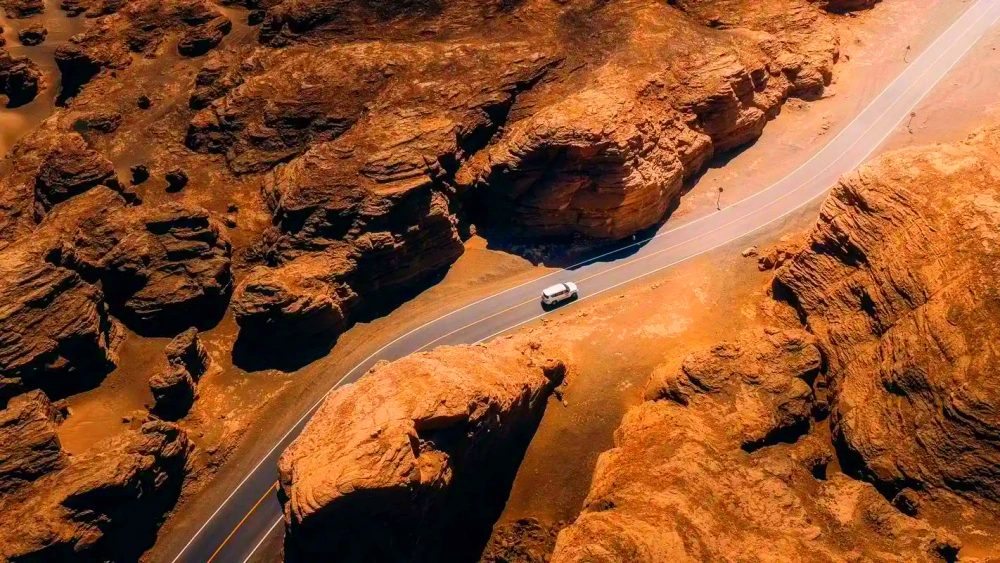
    Sand hisses against the base of crescent-shaped dunes that rise 250 m (820 ft) above a spring-fed oasis. The air smells of dry heat and mineral dust. Dunhuang (敦煌) has drawn pilgrims, merchants, and artists for sixteen centuries — and behind the tourist-facing dune rides, the spiritual and artistic weight of this place is staggering.

    Day 8: Jiayuguan to Dunhuang via Mingsha Dunes — 380 km, 4–5 hours

    Well-paved national highway the entire way. Arrive by early afternoon and head straight to Mingsha Mountain and Yueya Spring (鸣沙山月牙泉) — the "Singing Sand Dunes" named for the low hum the sand produces when the wind catches the ridgeline. Walk, take a camel, or sandboard the dunes. The crescent-shaped spring at the base has survived in the middle of the desert for centuries. Evening at the dunes is best: the low sun ignites the sand into copper and gold.

    Day 9: Mogao Grottoes, Yumen Pass, Yadan Devil City

    Morning: Mogao Grottoes (莫高窟), a UNESCO World Heritage Site containing over 700 caves with Buddhist murals and sculptures spanning a thousand years of artistic production. This is the Silk Road's single most important cultural site.

    ⚠️Mogao Grottoes: Book Official Tickets Only
    During peak season (July–August), A-type tickets — which grant access to eight caves with a professional guide and two digital-experience films — sell out days or weeks in advance. Only 6,000 A-type tickets are released per day. Foreign visitors cannot use the standard WeChat Mini-Program booking system; tickets must be purchased with a passport at the on-site ticket office (same-day only) or pre-arranged through an authorised agency. If A-type tickets are unavailable, purchase a B-type emergency ticket at the window — it covers four caves without the films, at a lower price. Do not buy from street touts claiming to have "insider tickets" or "VIP cave access." Your guide-escort arranges Mogao tickets in advance to ensure access.

    Afternoon: drive west to Yumen Pass (玉门关), the ancient frontier gate that marked the Silk Road's passage into the Western Regions, then continue to Yadan Devil City (雅丹魔鬼城) — a wind-eroded landscape of sandstone spires and bizarre rock formations that look like a ruined alien city at sunset.

    14 Days China Silk Road Self-Driving Tour from Xi'an to Urumqi (Xian-Ningxia-Gansu-Xinjiang)

    14 Days China Silk Road Self-Driving Tour from Xi'an to Urumqi (Xian-Ningxia-Gansu-Xinjiang)

    Tour Route:Xian-Guyuan-Zhongwei-Yinchuan-Wuwei-Zhangye-Jiayuguan-Dunhuang-Hami-Turpan-Urumqi
  • Self-Drive the Silk Road: Xi'an to Urumqi Road Trip Guide 14 Days
  • Self-Drive the Silk Road: Xi'an to Urumqi Road Trip Guide 15 Places
  • View Detail

    Into Xinjiang — Hami, Dahaidao and Turpan (Days 10–12)

    You cross the provincial border and the landscape sharpens into something more extreme — flat-bottomed basins rimmed by snow peaks, black gravel plains stretching to vanishing horizons, and heat shimmer thick enough to bend the road ahead into liquid. Welcome to Xinjiang (新疆).

    Dahaidao yardang geopark wind-carved rock formationsDahaidao yardang geopark wind-carved rock formations
    Turpan Flaming Mountaindesert heat Xinjiang self-driveTurpan Flaming Mountaindesert heat Xinjiang self-drive

    Day 10: Dunhuang to Hami (哈密) via Yangguan — 430 km, 5 hours

    Before leaving Dunhuang, a quick stop at Yangguan (阳关) — the ancient Silk Road frontier post and customs point for westbound travellers during the Han Dynasty. Then push into the desert toward Hami. Road conditions: well-paved with remote stretches. Fuel up before leaving Dunhuang — the gap between stations on this segment can exceed 100 km (62 mi).

    Xinjiang checkpoint reality: After crossing into Xinjiang, expect highway checkpoints where all passengers must exit the vehicle, present passports, and undergo facial-recognition identity verification. Keep passports in a grab-bag, not buried in luggage. With a bilingual guide-escort, the process typically takes 10–15 minutes per stop. Without one, it can stretch to 30–60 minutes due to language barriers and additional questioning.

    Day 11: Hami to Shanshan (鄯善) via Dahaidao — 330 km, 4 hours

    Dahaidao (大海道) — literally "the Great Sea Route" — is one of China's most dramatic wilderness landscapes: a yardang geopark of wind-carved rock formations, black gravel plains, and absolute silence. The core area requires a 4WD vehicle with high clearance. If you're driving a standard SUV, your guide-escort can arrange a local 4WD shuttle into the geopark for the morning.

    Evening: arrive in Shanshan and visit the Kumutage Desert (库木塔格沙漠), where towering dunes press right against the edge of town — one of the few places in China where desert meets urban settlement with no buffer.

    19 Days China Silk Road Self Driving Tour from Dunhuang to Northern Xinjiang Via Dahaidao

    19 Days China Silk Road Self Driving Tour from Dunhuang to Northern Xinjiang Via Dahaidao

    Tour Route:Dunhuang-Hami-Dahaidao Scenic Area in Hami-Kumtag Desert in Shanshan County, Turpan-Turpan-Korla-Bayingolin-Nalati Grassland (Nalati Scenic Area) in Xinjiang-Kalajun Grassland in Ili-Yining City-Sayram Lake in Bortala-Dushanzi Grand Canyon in Karamay-Karamay-Kanas Lake-Hemu Grassland in Burqin County, Altay-Altay-Heavenly Lake (Tianchi) in Xinjiang-Urumqi
  • Self-Drive the Silk Road: Xi'an to Urumqi Road Trip Guide 19 Days
  • Self-Drive the Silk Road: Xi'an to Urumqi Road Trip Guide 8 Places
  • View Detail

    Insider pick — Huoyungu Fire Cloud Valley (火云谷): Skip the crowded Flaming Mountain tourist area and navigate to Huoyungu instead. This 38 km (24 mi) canyon near Turpan features layered red, ochre, and green sedimentary rock that looks like a Martian landscape. You can drive a standard vehicle through at low speed, stopping at viewpoints along the way. No entrance fee, almost no visitors, and no mobile signal — download offline maps before entering. Best light: early morning or after 18:00 to avoid midday heat.

    Day 12: Shanshan to Turpan (吐鲁番) — 120 km, 2 hours

    Short driving day, heavy on sightseeing. Flaming Mountain (火焰山) earns its name — the reddish-brown peaks genuinely appear to burn when the afternoon sun hits them, and summer surface temperatures regularly exceed 70°C (158°F). Then visit Karez Wells (坎儿井) — an ancient underground irrigation system that has channelled snowmelt from the Tianshan Mountains to Turpan's vineyards for over 2,000 years — and Jiaohe Ancient City (交河故城), a 2,300-year-old ruined city carved into a plateau between two river valleys.

    Insider pick — Tuyugou Mazha Village (吐峪沟麻扎村): One of Xinjiang's oldest Uyghur settlements — mud-brick houses stacked on a red canyon wall, with no commercial overlay. Visit in September–October for the best atmosphere. Respect local customs: ask before photographing residents, and do not enter homes uninvited.

    Urumqi and Heavenly Lake — The Grand Finale (Days 13–14)

    Tianchi Heavenly Lake of Tianshan in XinjiangHeavenly Lake Tianchi alpine lake Xinjiang
    Xinjiang Urumqi International Grand BazaarXinjiang Urumqi International Grand Bazaar

    The Tianshan Mountains (天山) rise on the northern horizon like a wall of snow and granite, and suddenly the desert gives way to alpine meadow. After twelve days of arid highway, the visual shock of Heavenly Lake — cobalt water cupped between 5,000 m peaks and black spruce forest — is the Silk Road's perfect closing act.

    Day 13: Turpan to Urumqi via Heavenly Lake — 280 km, 3.5 hours (plus lake excursion)

    Drive north from Turpan toward the Tianshan foothills. The road climbs through gorges and past Kazakh herding camps before reaching Heavenly Lake (天池), an alpine lake at 1,910 m (6,266 ft) elevation ringed by snow peaks reaching 5,445 m (17,864 ft). Spend the morning hiking the lakeshore or taking the scenic boat crossing. Then descend to Urumqi, the capital of Xinjiang.

    Day 14: Urumqi and Departure

    Morning: explore the Xinjiang Regional Museum (新疆维吾尔自治区博物馆), which houses Silk Road artefacts including the Loulan mummies — preserved human remains dating back nearly 4,000 years. Or visit Hongguangshan Great Buddha Temple (红光山大佛寺) in the Midong district — a local favourite with a 40.8 m gilded Buddha, quiet grounds, free entry, and panoramic views of the entire city from the upper terraces.

    For a final cultural stop, seek out the Shaanxi Mosque (陕西大寺) — a 200-year-old wooden mosque hidden in a central Urumqi alley, with blue-brick-and-timber architecture that feels more like a Beijing hutong courtyard than a modern Xinjiang city block. A quiet reminder of how many cultures the Silk Road braided together.

    Farewell dinner: Uyghur cuisine at a local restaurant — hand-pulled laghman noodles, lamb kebabs, and naan fresh from a tandoor oven.

    Afternoon: transfer to Urumqi Diwopu International Airport (乌鲁木齐地窝堡国际机场) for departure.

    Want to continue beyond Urumqi? Extend the journey another four days to Kashgar (喀什), adding the Tianshan Mountains, Kuqa Grand Canyon, and the ancient Kashgar Old City to the route.

    18 Days Grand China Silk Road Self-Driving Tour from Xian to Kashgar

    18 Days Grand China Silk Road Self-Driving Tour from Xian to Kashgar

    Tour Route:Xian-Baoji-Tianshui-Lanzhou-Wuwei-Zhangye-Jiayuguan-Dunhuang-Hami-Dahaidao Scenic Area in Hami-Shanshan-Turpan-Korla-Kuqa City-Minfeng County-Hotan Prefecture-Kashgar
  • Self-Drive the Silk Road: Xi'an to Urumqi Road Trip Guide 18 Days
  • Self-Drive the Silk Road: Xi'an to Urumqi Road Trip Guide 22 Places
  • View Detail

    Driving It in Reverse — Urumqi to Xi'an

    The same route works in reverse — Urumqi to Xi'an — with identical road infrastructure and driving times. The experience shifts in tone: instead of building toward the desert climax, the reverse direction opens with alpine drama at Heavenly Lake and gradually transitions through desert, corridor, and plateau before arriving in Xi'an's imperial density.

    Some drivers prefer this direction because it front-loads the Xinjiang checkpoints (you're fresher and more patient on Days 1–3 than on Days 10–12) and because the Hexi Corridor's scenery unfolds eastward with the afternoon sun behind you rather than in your eyes.

    A dedicated reverse-direction itinerary covers the same highlights in the opposite sequence.

    14 Days China Silk Road Self-Driving Tour from Urumqi to Xian (Xinjiang-Gansu-Ningxia-Xian)

    14 Days China Silk Road Self-Driving Tour from Urumqi to Xian (Xinjiang-Gansu-Ningxia-Xian)

    Tour Route:Urumqi-Turpan-Hami-Dunhuang-Jiayuguan-Zhangye-Wuwei-Zhongwei-Yinchuan-Wuzhong-Guyuan-Xian
  • Self-Drive the Silk Road: Xi'an to Urumqi Road Trip Guide 14 Days
  • Self-Drive the Silk Road: Xi'an to Urumqi Road Trip Guide 16 Places
  • View Detail

    For the full Silk Road corridor — including both directions and extended variants — see our Silk Road and Xinjiang self-drive hub.

    Day-by-Day Driving Overview

    Day-by-Day Driving Summary: Xi'an to Urumqi

    DaySegmentDistanceDrive TimeKey AttractionsRoad Notes
    1Xi'an arrival——Driving licence pickup; Terracotta Warriors (optional)No driving — arrival day
    2Xi'an sightseeing40 km local1 hr localHuaqing Palace; City Wall; Muslim QuarterCity driving only
    3Xi'an → Guyuan350 km (217 mi)4.5–5 hrsGuyuan Museum; Mount Sumeru CavesG310; well-paved; mountain curves near Guyuan
    4Guyuan → Yinchuan250 km (155 mi)3.5–4 hrsGao Temple; Helan Mountain wine regionG312; smooth asphalt; light traffic
    5Yinchuan → Zhongwei200 km (124 mi)2 hrsShapotou desert; Tengger DesertG110; excellent conditions
    6Zhongwei → Zhangye450 km (280 mi)5–5.5 hrsChina Route 66; Wushaoling Pass (optional detour)G30/G312; long straight desert highway
    7Zhangye → Jiayuguan550 km (342 mi)5.5 hrsSeven-Colour Danxia; Jiayuguan Fortress sunsetG30; terrain shifts to arid steppe
    8Jiayuguan → Dunhuang380 km (236 mi)4–5 hrsMingsha Dunes; Yueya SpringNational highway; well-paved
    9Dunhuang full day150 km (93 mi)1.5–2 hrsMogao Grottoes; Yumen Pass; Yadan Devil CityLocal roads; good condition
    10Dunhuang → Hami430 km (267 mi)5 hrsYangguan site; Xinjiang entry checkpointWell-paved; fuel gap 100+ km — fill up before leaving Dunhuang
    11Hami → Shanshan330 km (205 mi)4 hrsDahaidao yardang geopark; Kumutage DesertPaved highway; Dahaidao detour requires 4WD
    12Shanshan → Turpan120 km (75 mi)2 hrsFlaming Mountain; Karez Wells; Jiaohe Ancient CityPaved; extreme heat in summer
    13Turpan → Urumqi280 km (174 mi)3.5 hrsHeavenly Lake (Tianchi); Urumqi museumMountain roads approaching Tianchi — winding, drive cautiously
    14Urumqi departure——Xinjiang Museum; Hongguangshan temple; Grand BazaarAirport transfer

    Sample 14-Day Silk Road Self-Drive Itinerary

    14-Day Xi'an to Urumqi Silk Road Self-Drive

    🏛️
    Days 1–2
    Xi'an: Silk Road Starting Point
    Arrive, pick up temporary driving licence, explore the Terracotta Warriors, Huaqing Palace, and the Muslim Quarter's street food scene.
    🏜️
    Days 3–5
    Ningxia: Desert Oasis and Heritage
    Drive through the Liupan Mountains to Guyuan's Buddhist caves, taste Helan Mountain wines in Yinchuan, and sandboard the Tengger Desert at Shapotou.
    🌄
    Days 6–7
    Hexi Corridor and Zhangye Danxia
    Cruise "China Route 66" across the Gobi, then witness the rainbow-layered Danxia landform at golden hour — one of China's most photographed natural wonders.
    🏯
    Days 7–8
    Jiayuguan: The Great Wall's Western Gate
    Stand at the Great Wall's final fortress, where rammed-earth ramparts meet empty desert — then push on to Dunhuang.
    🎨
    Days 8–9
    Dunhuang: Caves, Dunes, and Desert Ruins
    Explore 1,600 years of Buddhist cave art at the Mogao Grottoes, ride camels at Mingsha Dunes, and watch sunset turn Yadan Devil City into a stone-forest silhouette.
    🔥
    Days 10–12
    Xinjiang: Hami, Dahaidao, and Turpan
    Cross into Xinjiang, navigate yardang badlands at Dahaidao, walk the ancient streets of Jiaohe, and feel the Flaming Mountain's radiant heat.
    🏔️
    Days 13–14
    Urumqi and Heavenly Lake Finale
    Ascend the Tianshan to Heavenly Lake's alpine waters, then close the journey with Uyghur cuisine and Silk Road artefacts in Urumqi.

    Practical Logistics — Permits, Driving Licence and Road Conditions

    This section covers the operational realities that separate a successful Silk Road self-drive from a frustrating one. Most of these logistics are handled by your guide-escort and agency — but knowing them makes you a better driver and a more relaxed traveller.

    Temporary Chinese Driving Licence

    International Driving Permits (IDPs) are not valid in mainland China. All foreign drivers must obtain a temporary Chinese driving licence (临时驾驶证), issued by the local vehicle management office (车管所). The process requires your passport, visa, a translated copy of your home-country licence, accommodation registration, and a basic health declaration. The licence is valid for the duration of your visa stay, up to 90 days.

    With an agency-arranged self-drive tour, the licence application is handled before your first driving day — a bilingual staff member accompanies you to the designated office, usually near the airport, and the process takes approximately half a day.

    For the step-by-step licence process, see our complete guide to China's temporary driving licence.

    The Guide-Escort Requirement

    Foreign drivers cannot legally self-drive in China without a registered agency and a licensed guide-escort in the vehicle. This is not a recommendation — it is a regulatory requirement enforced at checkpoints, fuel stations, and hotel check-ins across the route. The guide-escort handles checkpoint communication, fuel-station identity registration (Xinjiang stations require a Chinese ID to activate the pump — your guide uses theirs), hotel booking at foreigner-approved properties, and real-time navigation in areas with no mobile signal.

    For the full explanation of why solo self-driving is not an option, see our guide to the guide-escort regulation.

    Road Conditions

    The Xi'an-to-Urumqi corridor runs primarily on G30 Lianhuo Expressway and G312 National Highway — both well-maintained, multi-lane, asphalt-surfaced roads. No segment requires off-road capability unless you detour to Dahaidao (4WD required) or venture into backcountry canyons.

    Speed enforcement: Gansu and Xinjiang use interval speed cameras (区间测速) extensively on Gobi highway stretches. Typical limits are 60–80 km/h (37–50 mph) on open desert roads that feel designed for 120 km/h. Do not speed — fines are steep, and in remote areas, high-speed driving risks fatigue-related accidents with no emergency services nearby.

    Fuel and Charging

    Petrol stations are available at regular intervals along G30 and G312, with the longest gap between stations on the Dunhuang-to-Hami stretch — roughly 100–150 km (62–93 mi) between stops. Top up whenever your tank drops below half.

    Xinjiang fuel-station ID requirement: Gas stations in Xinjiang require a Chinese national ID card to activate the fuel pump. Foreign drivers without a Chinese ID must rely on their guide-escort to register at the attendant window or use their ID for pump activation. This is a universal requirement, not a checkpoint — every station enforces it.

    EV drivers: Charging infrastructure is improving along the Hexi Corridor but remains sparse in remote segments. If driving an electric vehicle, plan charging stops carefully and confirm station availability with your agency before departure.

    How to Get to Xi'an (Starting Point)

    Getting to Xi'an

    ModeFromDurationNotes
    Direct flightBeijing (PEK/PKX)~2.5 hrsMultiple daily flights
    Direct flightShanghai (PVG/SHA)~2.5 hrsMultiple daily flights
    Direct flightGuangzhou (CAN)~2.5 hrsMultiple daily flights
    Direct flightChengdu (TFU)~1.5 hrsMultiple daily flights
    High-speed railBeijing West~4.5 hrsG-trains every 30 min; comfortable, scenic
    High-speed railShanghai Hongqiao~6 hrsSeveral daily
    International flightHong Kong (HKG)~3 hrsDirect to Xi'an Xianyang (XIY)

    Best Driving Season

    Silk Road Self-Drive Season Guide

    WindowMonthsConditionsVerdict
    Sweet spotMid-June20°C (68°F) avg; oil-seed flowers blooming; Mogao tickets easier to secure; accommodation 40–50% cheaper than July✔ Recommended
    Prime autumnMid-Sep to mid-OctDanxia colours at peak saturation; crowds gone; Populus euphratica trees golden; accommodation prices drop 30%✔ Best overall
    Post-holiday gapOct 8–20Landscapes nearly empty; cold nights near 0°C (32°F) in Gobi; bring a down jacket✔ Adventurous pick
    AvoidLate Apr – MayHexi Corridor sandstorm season; highway closures possible; visibility near zero during storms✗
    AvoidLate Jul – mid-AugTurpan exceeds 45°C (113°F); Mogao tickets sell out 30 days ahead; peak crowds everywhere✗
    AvoidNov – MarMany scenic areas closed; mountain passes snow-blocked; accommodation scarce outside cities✗

    Tips, Cautions and Avoid the Tourist Trap

    • Download offline maps before entering the Gobi. Google Maps drifts or fails across western China. Install Amap (高德地图) or Baidu Maps (百度地图) and download the full Gansu and Xinjiang offline map packs. Mobile signal disappears entirely on many desert stretches.
    • Keep passports in a grab-bag, not in the boot. Xinjiang checkpoints require all passengers to exit and present identification. Digging through luggage at a checkpoint creates delays and frustration.
    • Carry cash in small denominations. While Alipay (支付宝) and WeChat Pay work in cities, some desert service areas and small-town restaurants only accept cash. ¥10 and ¥20 notes are ideal.
    • Wear closed shoes in all desert areas. Sand is hot and loose at Shapotou, Mingsha, and Kumutage. Sandals invite burns and blisters.
    • Grip the wheel in crosswinds. The Gobi and Hexi Corridor generate powerful lateral gusts, especially in spring. Even an SUV can drift — reduce speed when you feel the wind push the vehicle sideways.
    • Respect Ramadan timing in Xinjiang. During the fasting month (dates shift annually), tourist-facing restaurants and hotels operate normally. However, avoid eating, drinking, or smoking openly near mosques or in residential Uyghur neighbourhoods during daylight hours as a sign of respect.
    • Do not fly drones without prior authorisation. Xinjiang enforces strict drone regulations. Many areas near Turpan, Hami, and border zones are classified as restricted airspace. Flying without a registered flight plan risks equipment confiscation and fines. Apply through the local public security bureau before departure.
    • Carry 2+ litres of drinking water per person at all times. Desert heat dehydrates faster than you expect, and breakdowns in remote areas mean waiting for assistance with no shade.
    ⚠️Xinjiang Checkpoints: What to Expect
    Highway checkpoints in Xinjiang require all vehicle occupants to exit, present passports, and pass through facial-recognition scanners. Processing times vary from 10 minutes to over an hour during peak travel periods. Carry your passport on your person — not in your suitcase. Do not display frustration or impatience; cooperate calmly with officers. A bilingual guide-escort dramatically reduces processing time by communicating your itinerary and travel documents in Mandarin.
    ⚠️Foreigner-Restricted Areas Along This Route
    Some areas in Qinghai and western Gansu — including Dachaidan (大柴旦), Delingha (德令哈), and associated scenic spots like Emerald Lake (翡翠湖) and Water Yardang (水上雅丹) — do not admit foreign nationals. Hotels in these areas cannot register foreign guests, and scenic spots will deny entry. A properly planned route avoids these restricted zones entirely, but if you modify the itinerary independently, confirm foreigner access at every overnight stop before arrival.
    ⚠️Avoid the Tourist Trap: Dunhuang and Mingsha Approaches
    On the road to Mingsha Mountain (鸣沙山), touts may intercept vehicles offering "discount camel rides" or "desert jeep tours" at seemingly low prices. Once you arrive at their location, you discover it's an unofficial peripheral area — not the main scenic zone — and additional fees are demanded to enter the real site. Drive directly to the official Mingsha Mountain entrance gate. Purchase tickets at the gate or through the official booking platform.

    Why Travel the Silk Road With Yaso Trip

    Yaso China Self-Driving Grand TourYaso China Self-Driving Grand Tour
    Yaso Trip self-driving vehicles Tank 300Yaso Trip self-driving vehicles Tank 300

    The Silk Road between Xi'an and Urumqi is one of the most rewarding drives in Asia — but for foreign drivers, the operational barriers are real. Yaso Trip removes them without taking away your autonomy behind the wheel.

    • Licence and permit handling. Your temporary Chinese driving licence is arranged before you arrive. A bilingual team member accompanies you to the vehicle management office on Day 1, handles all translation and paperwork, and ensures the licence is valid for the full duration of your trip.
    • Fuel and checkpoint coordination. In Xinjiang, every fuel stop requires a Chinese national ID. Your guide-escort carries theirs and handles pump activation at every station. At highway checkpoints, they communicate your itinerary and travel documentation in Mandarin, cutting processing time from an hour to minutes.
    • Foreigner-approved accommodation. Not every hotel in western China can legally register foreign guests. Yaso Trip's route planning pre-verifies every property for foreign-guest registration — so you never arrive at a front desk only to be turned away at midnight in a remote desert town.
    • Navigation and real-time road intelligence. Your vehicle is equipped with a pre-loaded tablet running Amap with full offline maps for Gansu and Xinjiang. The guide-escort provides live updates on road closures, weather conditions, and checkpoint wait times — the kind of intelligence no app can deliver.

    Start Planning Your Silk Road Self-Drive

    Fourteen days. Four provinces. One ancient trade route, driven on your terms. The Silk Road from Xi'an to Urumqi is the self-drive journey that other road trips get measured against — and with the right agency handling the logistics, all you need to bring is a valid driving licence and a willingness to cover 3,200 km of the most varied terrain in China.

    For an accurate cost breakdown tailored to your group size, dates, and preferences, contact the Yaso Trip team for a custom quote.

    Expand All
    1. Can foreigners self-drive the Silk Road in China?

    Yes. Foreign nationals can drive in China with a temporary Chinese driving licence issued by the local vehicle management office. International Driving Permits are not valid on the Chinese mainland. All foreign self-drive trips must be arranged through a registered travel agency and accompanied by a licensed guide-escort — solo self-driving is not legally permitted. The licence application, guide-escort assignment, and route permitting are handled as part of the agency arrangement.

    2. How long does it take to drive from Xi'an to Urumqi?

    The standard itinerary covers 14 days with daily driving legs ranging from 120 km to 550 km (75–342 mi). Total driving distance is approximately 3,200 km (1,988 mi). Compressed versions covering 10–12 days are possible by skipping the Ningxia segment and reducing sightseeing stops, though the pace becomes less comfortable. Extended 18-day and 24-day variants add Kashgar, the Duku Highway, or the Northern Xinjiang grasslands.

    3. What are the road conditions on the Chinese Silk Road?

    The entire Xi'an-to-Urumqi corridor runs on well-maintained highways — primarily G30 Lianhuo Expressway and G312 National Highway. Road surfaces are asphalt throughout; no segment requires off-road capability. The main driving challenges are distance (long daily legs), desert heat (Turpan regularly exceeds 45°C / 113°F in summer), and Xinjiang's interval speed cameras that enforce limits of 60–80 km/h (37–50 mph) on long desert straights.

    4. Do I need a special permit to drive in Xinjiang?

    No additional permit is required beyond the temporary Chinese driving licence that covers all of mainland China. However, if you extend the trip to Tashkurgan County (塔什库尔干县) near the Pakistan border or to Kanas Lake (喀纳斯湖) near the Mongolia/Kazakhstan border, a border area travel permit (边防证) is mandatory. This must be applied for in advance with accurate destination names — incorrect destination wording on the permit will result in being turned back at checkpoints.

    5. What is the best time of year to self-drive the Silk Road?

    Mid-June and mid-September through mid-October offer the best combination of mild weather, manageable crowds, and vibrant landscapes. Mid-June brings wildflowers and green grassland with lower accommodation prices. September–October delivers the richest Danxia colours, golden poplar forests, and post-summer quiet. Avoid late July through mid-August (extreme Turpan heat, sold-out Mogao tickets, peak pricing) and November through March (scenic area closures, snow-blocked mountain passes, scarce accommodation outside cities).

    6. Can I drive the Silk Road from Urumqi to Xi'an instead?

    Yes — the route works equally well in reverse. Some drivers prefer starting in Urumqi because it front-loads the Xinjiang checkpoints when energy and patience are highest, and the Hexi Corridor's desert scenery unfolds with the afternoon sun at your back. A dedicated reverse-direction itinerary with identical infrastructure and support is available.

    7. Is it safe for foreign drivers on the Silk Road highway?

    The highway infrastructure is modern and well-maintained. The primary risks are desert heat (carry water, monitor tyre pressure), fuel gaps on remote segments (never let the tank drop below half), and fatigue on long straight desert stretches. Xinjiang checkpoints are security measures, not safety threats — cooperate calmly and expect routine processing. With a guide-escort, communication barriers at checkpoints, fuel stations, and emergency situations are eliminated.

    8. What cities and attractions are along the Silk Road driving route?

    The 14-day route passes through Xi'an (Terracotta Warriors, City Wall), Guyuan (Mount Sumeru Caves), Yinchuan (Helan Mountain wine country), Zhongwei (Shapotou Desert), Zhangye (Seven-Colour Danxia), Jiayuguan (Great Wall fortress), Dunhuang (Mogao Grottoes, Mingsha Dunes, Yumen Pass), Hami (Dahaidao yardang geopark), Turpan (Flaming Mountain, Karez Wells, Jiaohe Ancient City), and Urumqi (Heavenly Lake, Grand Bazaar).

    More About

    •China Photography Self-Drive: Best Routes & Timing •China Family Self-Drive: Routes, Safety & What to Expect •China Self-Drive Tour: What's Included & a Typical Day •Self Driving in Yunnan: Three Parallel Rivers & Tea Trail 2026/2027 •Cross-Border Self-Drive Travel Across China: 2026/2027 Guide •China Silk Road Self Drive & Xinjiang Guide 2026/2027 •G318 Self Drive Travel: Sichuan Tibet Highway Guide 2026/2027 •Northeast China Self-Drive: Frontier & Border Route Guide •Ningxia Inner Mongolia Desert Self-Drive: Full Route Guide •Cross-Border Self-Drive: Kazakhstan to Yunnan via the Silk Road •Northern Xinjiang Self-Drive: Kanas, Grasslands & Mountains •Best Time to Self-Drive China: Month-by-Month Regional Guide •Own Vehicle vs Rental vs RV: China Self-Drive Options •Best China Self-Drive Itineraries: 7 to 60 Days 2026/2027 •How to Get a Temporary Driving Licence in China 2026/2027 •How to Import Your Car to China for a Self-Drive Tour 2026/2027 •Can Foreigners Drive in China? Guide-Escort Rule Explained •Tibet Self-Drive Permit Guide: Three Permits Explained •G318 Sichuan-Tibet Highway Self-Drive: Chengdu to Lhasa 2026/2027 •Sichuan Yunnan Tibet Self-Drive via Daocheng Yading 2026/2027 •Qinghai Sichuan Grasslands Self-Drive: Gannan & Jiuzhaigou 2026/2027 •Why You Can't Ride a Motorcycle Solo in China: The Rule •G318 Motorcycle Travel: Chengdu to Lhasa Sichuan-Tibet Guide •Cross-Border Motorbike Travel Across China: 2026/2027 Guide •Silk Road Motorcycle Travel: Xinjiang, Gansu & Northwest 2026/2027 •Xinjiang Motorbike Loop: Duku Highway & the Pamirsa •Yunnan Motorbike Ride from Laos: Xishuangbanna to Shangri-La 2026/2027 •Yunnan Motorcycle Loop: Kunming, Dali, Lijiang, Shangri-La 2026/2027 •Best Time for a Motorcycle Travel in China: Month-by-Month •Motorcycle Touring in China: A First-Timer's Guide (2026/2027)
    ENQUIRY
    Have a question before booking? Message us to learn more.
    Click to change

    Share Your Trip Experience

    Help future travelers by reviewing your journey with Yaso Trip.