Yungang Grottoes: 1,500 Years of Buddhist Art Carved into the Mountainside
On the southern slopes of Wuzhou Mountain, about 16 kilometers west of Datong, a cliff stretching for nearly one kilometer holds one of China's greatest collections of ancient Buddhist art.
More than 51,000 Buddhist statues have remained here for over 1,500 years. They have witnessed the banners of the Northern Wei Dynasty, the incense of the Liao and Jin periods, the winds of the Ming and Qing dynasties, and, today, visitors raising their phones toward the famous open-air Buddha in Cave 20.
This is the Yungang Grottoes (云冈石窟)—China's first major imperial Buddhist cave complex, a UNESCO World Heritage Site, and one of the finest surviving achievements of 5th-century Buddhist cave art in China.
But Yungang is more than a collection of ancient statues.
The grottoes tell the story of a powerful dynasty embracing Buddhism, craftsmen bringing artistic traditions from across Asia into northern China, and a civilization expressing its beliefs through thousands of tons of carved stone.
If you are looking for a place where the pace of travel naturally slows down, come to Yungang.
Stand before a Buddha carved more than 1,500 years ago, and look closely at the hands, robes, faces, and tiny details left behind by craftsmen whose names have long been forgotten.
The Five Tan Yao Caves: When Emperors Became Buddhas
The story of Yungang begins with a Buddhist monk named Tan Yao (昙曜).
In 460 AD, Emperor Wencheng of the Northern Wei Dynasty ordered Tan Yao, the senior Buddhist monk of the kingdom, to create five monumental caves at Wuzhou Mountain. These are now known as Caves 16–20, collectively called the Five Tan Yao Caves.
Each cave features a monumental central Buddha representing one of five Northern Wei rulers: Emperor Daowu, Emperor Mingyuan, Emperor Taiwu, Emperor Jingmu, and Emperor Wencheng.
The idea was deeply political as well as religious.
By giving the emperors the physical forms of Buddhas, the Northern Wei court connected imperial authority with Buddhist faith. The result was not simply religious sculpture, but a powerful visual statement about the relationship between kingship, religion, and the state.
Among the five caves, Cave 18 is particularly remarkable.
Its principal Buddha stands about 15.5 meters high, wearing what is often described as a “Thousand-Buddha Robe.” Hundreds of miniature seated Buddhas are carved across the robe, following the folds of the fabric.
But the most famous face at Yungang belongs to Cave 20.
Cave 20: The Open-Air Buddha and Yungang's Most Famous Face
The seated Shakyamuni Buddha in Cave 20 is approximately 13.7 meters high.
He sits cross-legged in meditation, with a calm, symmetrical face, elongated eyes, a high nose, long earlobes, and a distinctive moustache. His robe falls naturally across his body, combining elements associated with Gandharan Buddhist art with the artistic character of the Northern Wei and the Tuoba Xianbei ruling elite.
Behind the Buddha is an elaborate halo.
Flame patterns surround the head, while the larger boat-shaped back halo features lotus motifs and flying celestial figures carrying lotus buds.
Yet the most fascinating part of Cave 20 is something you cannot see anymore.
The Buddha Was Not Always Exposed to the Sky
The famous Buddha was originally inside a complete cave with a roof and front wall.
Around 512 AD, a major earthquake caused the front section of the cave to collapse, leaving the central Buddha exposed to the open air.
For centuries, the lower part of the statue was buried beneath accumulated earth. It was not fully uncovered until excavations in the early 1940s.
Today, the weathering on the statue's surface is clearly visible.
Rather than seeing these marks simply as damage, look at them as traces of time.
The Buddha has spent more than fifteen centuries beneath the changing sky of northern China.
Every weathered surface is another line in the story of the statue.
Cave 6 and Cave 12: Yungang at Its Artistic Peak
If the Five Tan Yao Caves represent the beginning of Yungang's great sculptural tradition, Caves 6 and 12 reveal how far Northern Wei Buddhist art eventually developed.
Cave 6: The “Greatest Cave” at Yungang
Often described as **Yungang's “Greatest Cave,” Cave 6 was completed before the Northern Wei moved its capital from Datong to Luoyang.
It is one of the largest, most complete, and most elaborately decorated caves in the complex.
More than 2,900 Buddhist figures and decorative images survive inside.
At the center stands a remarkable 15-meter-high square pagoda pillar rising through the cave. The surrounding walls are covered with reliefs depicting episodes from the life of the Buddha, creating an extensive visual narrative from his birth through his enlightenment.
The cave's architecture is equally impressive.
Its carefully planned spatial structure and distinctive Northern Wei clothing styles provide valuable evidence for understanding both Buddhist art and the broader cultural transformation taking place in northern China during the 5th century.
Take your time here.
Rather than trying to photograph every carving, choose one wall or one group of figures and examine it closely. Faces, clothing, architectural details, and miniature Buddhas appear everywhere you look.
Cave 12: The Music Cave
If Cave 6 is the architectural masterpiece, Cave 12 may be Yungang's most musical space.
Often called the Music Cave, it is filled with flying celestial musicians and images of performers holding instruments.
The carvings preserve representations of musical traditions from Xiliang, Kucha, India, and the Chinese heartland, offering a remarkable glimpse into the cultural exchanges of the Northern Wei period.
According to the supplied visitor information, the cave contains representations of 14 types of musical instruments, with around 50 instruments in total.
Among them are instruments such as the pipa, konghou harp, and transverse flute.
Look carefully toward the ceiling and surrounding walls.
The celestial musicians appear to be frozen in the middle of a performance, their instruments permanently suspended in stone.
It is one of the clearest places at Yungang where you can see that ancient Buddhist art was not isolated from the wider world.
Music, religion, sculpture, and cultural exchange all meet inside this single cave.
Travel Tips for Visiting Yungang Grottoes
Best Time to Visit
Spring and autumn, particularly April–May and September–October, offer comfortable temperatures for exploring the grottoes and surrounding grounds.
For the best atmosphere, arrive around 8:30 AM when the site opens. The early morning light is gentle, and visitor numbers are generally lower.
Another good option is after 3:00 PM, when the afternoon light can create warm tones across the open-air Buddha in Cave 20.
If possible, avoid the busiest period between approximately 10:00 AM and 3:00 PM, when organized tour groups are more common.
Opening Hours and Reservations
According to the supplied visitor information:
- April–October: 8:30 AM–5:30 PM
- Last admission: 4:30 PM
- July 11–August 31: 7:30 AM–6:00 PM
There is no on-site ticket sales under the stated reservation system. Visitors need to make a real-name reservation 1–7 days in advance through the Yungang Research Institute mini-program, including visitors who qualify for free admission.
Because opening hours and reservation procedures can change seasonally, check the official visitor information before your trip.
How Long Should You Spend at Yungang?
Allow at least 2.5–3 hours for the highlights.
If you are particularly interested in Buddhist art, architecture, archaeology, or photography, reserve 4–5 hours for a slower visit.
Yungang rewards visitors who look carefully rather than simply moving from cave to cave.
How to Get There
From Datong Ancient City, local buses including Bus 3 and the 603 tourist line can take visitors toward the Yungang Grottoes. The fare is relatively inexpensive.
A taxi from the old city generally takes around 30 minutes, depending on traffic.
For travelers driving themselves, search for “Yungang Grottoes Parking Lot” in your navigation app.
A scenic-area shuttle bus is also available for visitors who prefer to reduce the amount of walking.
Recommended Route
A practical route for a first visit is:
Tan Yao Square → Worshipping Buddha Avenue → Lingyan Temple → Caves 1–4 → Caves 5 & 6 → Caves 9–13 → Caves 16–20 → Cave 20 Open-Air Buddha → Yungang Grottoes Museum
The sequence allows you to gradually move from the earlier caves toward the most famous imperial grottoes and finish with the iconic open-air Buddha.
Photography Tips
For the most complete side view of the Cave 20 Buddha, the viewing area to the west of the cave provides a particularly good angle.
The lake around Lingyan Temple can create beautiful reflections, especially when the weather is calm.
The entrance of Cave 6 is also worth photographing, as the contrast between sunlight and carved surfaces can reveal the depth of the reliefs.
Remember that flash photography is prohibited inside the caves. More importantly, avoid touching the sculptures or leaning against the cave walls.
These carvings have survived for more than a millennium. A good photograph should never come at the expense of their preservation.
What to Wear
The caves can feel around 3–5°C cooler than the outdoor temperature, so carrying a light jacket is useful even during warmer months.
The site involves considerable walking over uneven surfaces, so comfortable walking shoes are recommended.
A guide or audio guide can also make a major difference.
Without some historical and artistic context, it is easy to look at Yungang as simply a collection of stone statues. Once you understand who commissioned them, how they were carved, and what the imagery represents, the grottoes become much more meaningful.
What to See Around Datong
Yungang Grottoes can easily be combined with several of Datong's major historical attractions.
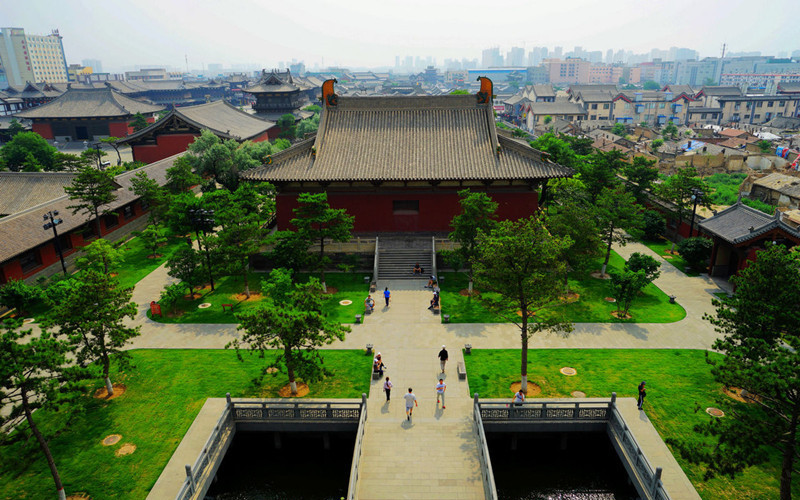
Huayan Temple (华严寺) is a magnificent Liao Dynasty Buddhist complex in the old city. Inside the Bhagavad Treasury Hall, the famous “Palms-Joined, Teeth-Showing Bodhisattva” is celebrated for its elegant expression and graceful form.
Shanhua Temple (善化寺) preserves strong architectural characteristics from the Tang tradition and is generally quieter than some of Datong's better-known attractions.
For an evening walk, head to Datong Ancient City Wall. The wall is open to visitors, and cycling around it around sunset offers a different perspective on the historic city.
Nine-Dragon Wall (九龙壁) is another convenient stop inside the old city. It is one of China's most impressive surviving glazed-tile dragon screens.
Extend Your Trip: The Ancient Architecture Route
If you have more time, consider combining Yungang Grottoes with two of northern China's most extraordinary architectural landmarks:
- Hanging Temple (悬空寺)
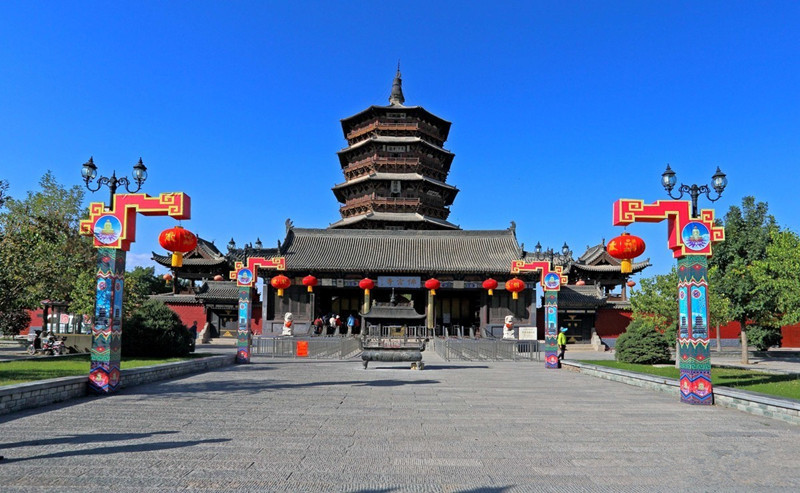
- Yingxian Wooden Pagoda (应县木塔)
Together, Yungang Grottoes, Hanging Temple, and Yingxian Wooden Pagoda create an exceptional journey through the religious art and architectural history of northern China.
What to Eat in Datong
Datong's cuisine reflects the hearty character of northern Shanxi.
Datong Knife-Cut Noodles (大同刀削面) are a local staple, with hand-cut noodles served with savory meat sauce.
Yangza (羊杂割) is a rich mutton offal soup that is particularly satisfying on a cool day.
For dessert or a sweet snack, try Yellow Millet Cold Cake (黄米凉糕), a soft and sticky traditional specialty.
For a more local dining experience, explore the restaurants around the Drum Tower area and try Datong Shaomai (大同烧麦) together with other Shanxi specialties.
A Classic Two-Day Datong Itinerary
Day 1: Yungang and Datong Ancient City
Morning:
Arrive at Yungang Grottoes early and follow the main cave route. Spend extra time at Caves 5, 6, 12, and 20.
Lunch:
Return toward Datong and try a bowl of Datong Knife-Cut Noodles.
Afternoon:
Visit Huayan Temple and Shanhua Temple.
Evening:
Walk or cycle along Datong Ancient City Wall around sunset, then explore the food streets around the Drum Tower.
Day 2: Hanging Temple and Yingxian Wooden Pagoda
Morning:
Leave early for the Hanging Temple to avoid the busiest visitor period.
Afternoon:
Continue toward Yingxian Wooden Pagoda, then return to Datong or continue your onward journey.
This itinerary combines Buddhist sculpture, ancient architecture, city history, and mountain landscapes into a compact northern Shanxi journey.
Yungang Grottoes: A Northern Wei Epic Carved in Stone
Yungang Grottoes is not simply a UNESCO World Heritage Site.
It is an epic carved into the mountainside by the Northern Wei Dynasty.
The Five Tan Yao Caves are its opening chapter.
Cave 6 is its architectural climax.
Cave 12 is its musical interlude.
And the open-air Buddha of Cave 20 is its unforgettable face.
More than 1,500 years ago, craftsmen stood against the cliffs of Wuzhou Mountain with chisels and hammers, transforming stone into a monumental expression of faith, imperial power, artistic ambition, and cultural exchange.
Today, their names are mostly forgotten.
Their work remains.
The Buddhas continue to look out across the northern landscape, their expressions remarkably calm after fifteen centuries of wind, rain, political change, and human footsteps.
If you want to experience a place where history does not feel distant, spend some quiet time in front of Cave 20.
Put down your camera for a moment. Look at the Buddha's face.
You do not need to say anything.
Just stand there.
For a brief moment, 1,500 years of history may feel as though it is passing quietly over your shoulders.