China Travel Agency, China Tours 2026/2027 | Yaso Trip
Theme Tours
View All China Theme Tours by Interest
Travel Guide
  • Travel Guide
  • Travel Tips
  • Tour Planning
  • Ethnic Culture
  • China Climate
  • Golf Courses
  • Yangtze Cruise
  • Travel Articles
  • Nanjing Ancient City Wall

    AAAAA
    ★★★
    Nanjing Ancient City Wall南京明城墙
    (江苏省南京市)
    22°C
    +86 25 86625435

    Nanjing Ming City Wall: The World’s Longest Ancient City Wall and a 600-Year Urban Epic

    In Nanjing, there is a city wall that is far more than an isolated historical monument. It is the surviving skeleton of a city that is still very much alive.

    Stretching 35.267 kilometers, with 25.091 kilometers still preserved today, the Nanjing Ming City Wall is the longest surviving brick-and-stone city wall in the world. Construction began in 1366, and it took nearly 28 years and the labor of close to a million workers to complete.

    You might think of an ancient city wall as little more than a backdrop for photographs. Nanjing’s Ming City Wall is different. Standing on it, you can genuinely feel the scale of what was built here.

    How long is more than 35 kilometers? The straight-line distance between Nanjing South Railway Station and Nanjing Railway Station is only a little over ten kilometers. Six centuries ago, people used an estimated 100 million bricks to enclose and protect an entire city.

    If you want to experience the historical “bones” of Nanjing rather than simply visit another monument, this is the place to come. Feel the wind above Xuanwu Lake from the Taicheng section, explore the old military chambers inside Zhonghua Gate Barbican, and look closely at the inscriptions on the bricks to discover the names of ordinary people who lived six centuries ago.

    More Than a Wall: The Four-Layer Structure of Nanjing’s Ming City

    The layout of Nanjing’s Ming City Wall is more complex than many visitors expect. It was not simply a single ring of fortifications. Instead, the Ming capital consisted of four layers of defensive walls: the Palace City, Imperial City, Capital City and Outer City.

    The Capital City Wall stretched 35.267 kilometers and had 13 city gates, while the Outer City extended for approximately 60 kilometers and enclosed an area of about 230 square kilometers.

    The scale of Nanjing’s historic fortifications is extraordinary, making its city-wall system one of the largest surviving examples of its kind anywhere in the world.

    Its shape is equally distinctive.

    Unlike many northern Chinese cities built around rigid rectangular grids, Nanjing’s walls were constructed according to the natural landscape. Hills, lakes and rivers were incorporated directly into the defensive system, including Lion Hill, Fugui Mountain, Xuanwu Lake and the Qinhuai River.

    That is why walking along the wall never feels repetitive. One section opens onto a broad lake view, another looks toward wooded hills, while another overlooks the tiled rooftops of southern Nanjing. Every stretch has its own character.

    A Name on a Brick Can Tell a Story Better Than a History Book

    Perhaps the most fascinating part of Nanjing’s Ming City Wall is not its enormous scale, but the traces of ordinary people hidden among its bricks.

    Many bricks bear inscriptions created under the Ming Dynasty system known as “wu le gong ming” (物勒工名), which required craftsmen to mark their names and other identifying information on the bricks they produced. If construction problems were discovered, responsibility could be traced back to the people involved.

    At least 16 bricks bearing the name “Liu Dehua” (刘德华) have been identified at different sections of the wall, including Zhonghua Gate, Shence Gate and Yifeng Gate.

    This Liu Dehua was not the modern celebrity who shares the same name, but a man from Shanggao County in Ruizhou Prefecture during the early Ming Dynasty. He served both as a local production supervisor, or jia shou, and as a brick-making laborer, meaning that someone responsible for overseeing production could also participate directly in the work.

    The inscriptions contain many other fascinating details. Researchers have identified more than 300 vernacular characters on the bricks, including forms such as “时,” “万” and “宝,” which happen to be identical to characters used in modern simplified Chinese.

    And then there is perhaps the most charming “inscription” of all: researchers discovered a clear cat paw print on another brick. A cat apparently walked across the clay while the brick was still soft, leaving behind a six-century-old signature.

    Look down at the bricks and you are not simply looking at historical artifacts. You are looking at traces left behind by real people who lived, worked and passed through this city hundreds of years ago.

    How to Explore Nanjing’s Ming City Wall: Two Routes, Two Different Sides of Nanjing

    The accessible sections of Nanjing’s Ming City Wall are generally divided into a northern route, from Shence Gate to Taiping Gate, and a southern route, from Dongshuiguan Gate to Jiqing Gate.

    The atmosphere of the two routes is very different. Rather than trying to walk everything in one day, choose one section and take your time.

    Northern Route: Taicheng Section and Xuanwu Lake

    The Taicheng Section (台城段) is one of the most popular choices for visitors.

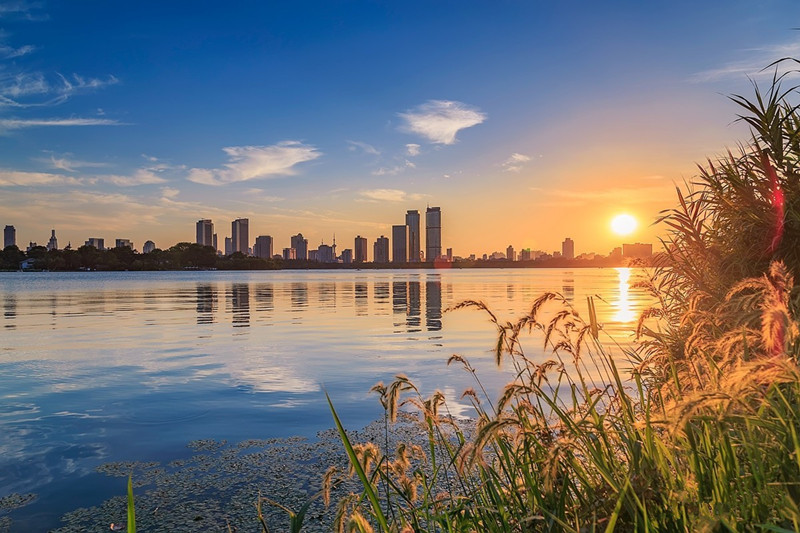
    Enter the wall through Jiefang Gate (解放门) and walk north. From the top, you can look across the broad waters of Xuanwu Lake (玄武湖), with Purple Mountain and Nanjing’s modern skyline forming the backdrop.

    This is also one of the best viewpoints for Jiming Temple (鸡鸣寺). After entering through Jiefang Gate, turn right and walk about 100 meters. The temple’s distinctive yellow walls and Yaoshi Pagoda appear below the city wall.

    During the spring cherry blossom season, photographers gather here to capture the classic combination of ancient architecture, pink blossoms and the historic city wall.

    The route is also particularly convenient by public transportation. Jiming Temple Station on Metro Line 3 is within walking distance of Jiefang Gate.

    Southern Route: Zhonghua Gate and the Old City

    The Zhonghua Gate Section (中华门段) has a completely different atmosphere.

    The massive Zhonghua Gate Barbican (中华门瓮城) is one of the highlights of Nanjing’s fortifications. Its layered defensive structure was designed to slow down and trap attacking forces, while numerous military chambers were built directly into the walls.

    Walking through these enclosed spaces gives you a strong sense of how formidable a major city fortress could have been during the age of traditional warfare.

    The southern route also connects several of Nanjing’s best-known historic areas, including Laomendong Historical and Cultural District (老门东), Dabao’en Temple (大报恩寺) and Confucius Temple (夫子庙).

    From the wall, the gray-tiled rooftops and traditional buildings of southern Nanjing spread out below, revealing one of the city’s most recognizable historic urban landscapes.

    You can reach this section from Zhonghuamen Station on Metro Line 1 or Wudingmen Station on Metro Line 3.

    Nanjing Ming City Wall Travel Tips

    Best Time to Visit

    Spring and autumn are the most comfortable seasons for walking on the wall, with pleasant temperatures and attractive scenery.

    From March to April, the cherry blossoms around Jiming Temple are in bloom, making the Taicheng section particularly popular with photographers.

    From October to November, the weather is generally crisp and clear, offering excellent visibility from the top of the wall.

    During summer, consider visiting between 6:00 and 8:00 in the morning or in the evening to avoid the strongest midday heat.

    Opening Hours

    • Daytime: 8:30–17:00, with ticket sales ending at 17:00
    • Evening: Some sections remain open until 22:00, with ticket sales ending at 21:30
    • Evening access: Currently limited to the Zhonghua Gate section

    Opening arrangements can change seasonally, so check the latest official information before visiting.

    How to Get There

    Taicheng Section:
    Take Metro Line 3 to Jiming Temple Station, then walk to the Jiefang Gate entrance.

    Zhonghua Gate Section:
    Take Metro Line 1 to Zhonghuamen Station, or Metro Line 3 to Wudingmen Station.

    Parking is available around both areas, but spaces can be limited during weekends and public holidays. Public transportation is recommended, particularly during peak travel periods.

    Recommended Routes

    Northern Route – Taicheng Section:
    Jiefang Gate → Xuanwu Lake viewpoint → Jiming Temple viewpoint → descend at Xuanwu Gate or Taiping Gate.

    The route is approximately 2 kilometers and takes about 1.5–2 hours at a relaxed pace.

    Southern Route – Zhonghua Gate Section:
    Dongshuiguan → Wuding Gate → Zhonghua Gate → Jiqing Gate.

    This route is approximately 6 kilometers and can take 3–4 hours if you also explore Laomendong and the surrounding historic districts.

    Photography Tips

    The Taicheng section becomes especially atmospheric after around 4:30 p.m., when warm evening light falls across the old bricks. This is an excellent time for backlit portraits and photographs of the wall itself.

    For the classic Jiming Temple viewpoint, turn right after entering through Jiefang Gate and walk about 100 meters. During cherry blossom season, the combination of blossoms and Yaoshi Pagoda is one of Nanjing’s most recognizable photographic scenes.

    At Zhonghua Gate Barbican, try shooting upward to emphasize the massive scale of the fortifications. Inside the military chambers, the contrast between light and shadow creates a particularly atmospheric setting.

    Things to Keep in Mind

    The surface of the wall includes uneven steps and weathered bricks. Comfortable, non-slip shoes are strongly recommended.

    It can also be surprisingly windy on top of the wall, and temperatures may drop noticeably in the morning and evening, so carrying a light jacket is useful.

    The northern and southern sections are far apart. Do not try to walk the entire city wall in a single day. Choosing one section and exploring it slowly will give you a much better experience.

    There are relatively few shops on the wall itself, so bring your own drinking water.

    Explore More Around Nanjing Ming City Wall

    After descending from Zhonghua Gate, you can reach Laomendong (老门东) within a few minutes on foot.

    This historic district stretches between the Ming City Wall and the Qinhuai River and offers a slightly more artistic and local atmosphere than the busier Confucius Temple area.

    Traditional gray-brick buildings and narrow lanes are filled with local snacks and old-fashioned flavors, including Jiang Youji Guotie (蒋有记锅贴), Lan Laoda Tangzhou Ou (蓝老大糖粥藕) and Xiaozheng Su Shaobing (小郑酥烧饼).

    Jiang Youji’s beef potstickers are particularly popular, with crisp golden bottoms and a juicy savory filling. They are also associated with the traditional Eight Delicacies of Qinhuai.

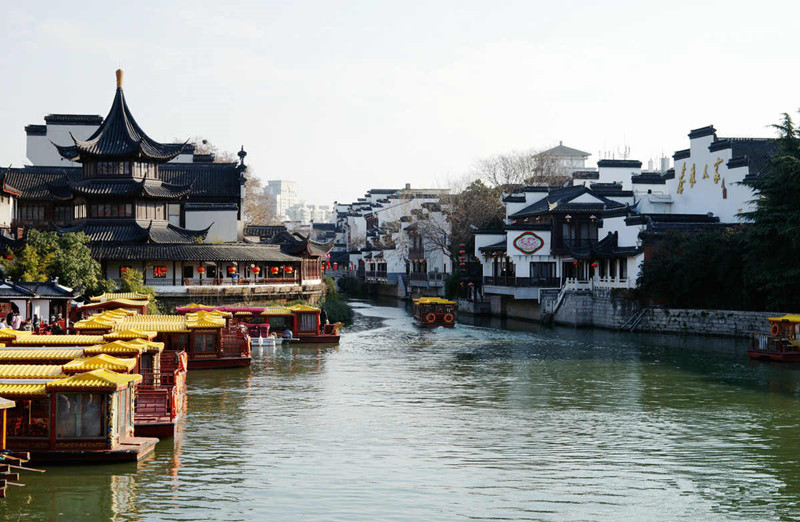
    If you have more time, follow the Qinhuai River (秦淮河) toward Confucius Temple, where you can take an evening cruise on a traditional-style sightseeing boat.

    Alternatively, head toward the Nanjing City Wall Museum (南京城墙博物馆). Admission is free, and the museum is closed on Mondays. It provides useful background on the construction of the city wall, its brick inscriptions and the engineering behind the enormous fortification system.

    For an atmospheric evening, you could descend from Zhonghua Gate, enjoy a bowl of duck blood vermicelli soup in Laomendong, then walk along the foot of the city wall toward the Dabao’en Temple Heritage and Scenic Area to see the illuminated historic architecture.

    From a 600-year-old fortress to the everyday food and street life of modern Nanjing, the city’s history unfolds around you.

    Experience Nanjing Through Its Living City Wall

    The most remarkable thing about Nanjing’s Ming City Wall is not simply how long it is or how old it is. It is the fact that the wall remains part of the city’s everyday life.

    As you walk along its ancient surface, the bricks beneath your feet date back hundreds of years, while the view ahead may include the shimmering waters of Xuanwu Lake, the incense rising from Jiming Temple, or the tiled rooftops of southern Nanjing.

    The history has not been sealed away inside a museum. It is right beneath your feet.

    If you want to experience a truly living ancient city wall, come to Nanjing. Feel the wind above the waters of Xuanwu Lake from Taicheng, search for an ordinary name carved into a brick at Zhonghua Gate, and walk alongside the surviving stone-and-brick skeleton of a city shaped by more than six centuries of history.

  • Zoom in and view
  • ENQUIRY

    Have a question before booking? Message us to learn more.
    Click to change

    Share Your Trip Experience

    Help future travelers by reviewing your journey with Yaso Trip.