Huangdi Mausoleum: Walk Beneath 80,000 Ancient Cypress Trees into the Roots of Chinese Civilization
On Qiaoshan Mountain in Huangling County, Shaanxi, lies one of the largest and best-preserved ancient cypress forests in the world.
More than 83,000 ancient cypress trees grow across the mountain, including over 30,000 trees believed to be more than 1,000 years old. Some have stood here for centuries upon centuries, silently watching over the same sacred place:
the Huangdi Mausoleum (黄帝陵), the Mausoleum of the Yellow Emperor.
This is the place recorded by the ancient historian Sima Qian in the Records of the Grand Historian: “The Yellow Emperor died and was buried at Qiaoshan.”
It is also regarded as No. 1 among the ancient tombs in China's first batch of nationally protected major cultural heritage sites, and is traditionally honored as the “First Mausoleum Under Heaven.”
But Huangdi Mausoleum is more than an archaeological site.
For many Chinese people, the Yellow Emperor—Huangdi—is remembered as a legendary ancestor and cultural symbol of the Chinese civilization.
Walking through Huangdi Mausoleum therefore feels less like visiting an ordinary historic attraction and more like entering a landscape of 5,000 years of cultural memory.
Xuanyuan Temple: Ancient Cypress Trees and a 2,000-Year-Old “Footprint”
The Huangdi Mausoleum scenic area is divided into two main sections: Xuanyuan Temple (轩辕庙) and the Huangdi Mausoleum Garden (黄帝陵园).
They are connected by a sightseeing shuttle bus.
Xuanyuan Temple stands on the eastern foothills of Qiaoshan and is traditionally traced back to the Han Dynasty. It has long served as a place for worshipping and commemorating Xuanyuan Huangdi, the Yellow Emperor.
As you enter the temple, one of the first sights is the legendary Cypress Planted by the Yellow Emperor (黄帝手植柏).
The Cypress Planted by the Yellow Emperor
According to tradition, this enormous cypress was planted personally by the Yellow Emperor.
The tree is said to be more than 5,000 years old, standing approximately 19.3 meters high, with a trunk circumference of about 11.6 meters. It takes seven or eight adults holding hands to encircle it.
In 1998, it was selected by the Chinese Famous Trees Selection and Conservation Committee as the No. 1 of the “Top 100 Famous Trees of China”, earning the poetic nickname “Crown of the World’s Cypress Trees.”
Whether you view the tree as a historical survivor or as a symbol of Chinese civilization, standing beneath its enormous branches provides a remarkable sense of time.
The Yellow Emperor’s Footprint
Not far from the Cypress Planted by the Yellow Emperor, near the northwest corner of the Stele Pavilion, lies a large stone bearing what is traditionally known as the Yellow Emperor’s Footprint (黄帝脚印石).
The footprint measures approximately 62 centimeters long and 2 centimeters deep.
It has been identified as a Han Dynasty cultural relic, making it more than 2,000 years old.
For generations, the footprint has been interpreted as a symbolic expression of people's respect for the legendary Yellow Emperor and his achievements. The enormous impression in stone has also come to represent the idea of leaving a lasting mark through determination and hard work.
The Cypress of the Hanging Armor
Another famous tree within the temple is the Cypress of the Hanging Armor (挂甲柏).
Its trunk is covered with distinctive marks, and according to legend, Emperor Wu of the Han Dynasty hung his armor on this tree after returning victorious from a military campaign in the north.
Continue through the stele corridor and you will encounter 46 imperial sacrificial inscriptions.
These stone tablets record ritual texts issued by emperors throughout different dynasties, providing a rare physical record of the long-standing tradition of state ceremonies honoring the Yellow Emperor.
Xuanyuan Hall
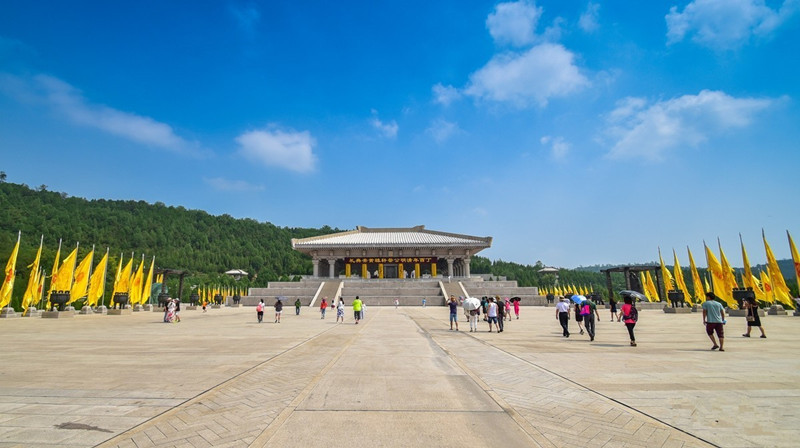
At the center of the temple stands Xuanyuan Hall (轩辕殿).
Its design incorporates the traditional Chinese concept of “a round heaven and a square earth,” with 40 massive stone columns surrounding the hall.
Every year, the grand Qingming Ceremony for the Public Worship of the Yellow Emperor is held here.
The ceremony attracts government representatives as well as descendants and cultural representatives from across China and overseas, making it one of the most significant public commemorations of the Yellow Emperor.
Huangdi Mausoleum Garden: Walk Around the Tomb and Through Two Millennia of Tradition
Take the sightseeing bus up Qiaoshan and you will reach the Huangdi Mausoleum Garden.
Pass through the Lingxing Gate (棂星门) and you will arrive at the Sacrificial Pavilion.
At the center of the pavilion stands a stone stele bearing the three characters “Huangdi Mausoleum” (黄帝陵), written by the renowned Chinese writer and scholar Guo Moruo.
The mausoleum mound itself is remarkably modest.
It is approximately 3.6 meters high, with a circumference of about 48 meters, and retains a simple appearance rather than resembling the monumental imperial tombs found elsewhere in China.
Walk Around the Mausoleum
One of the most meaningful rituals here is to walk around the mausoleum counterclockwise.
Traditionally, this direction symbolizes looking back through time, remembering the past, and honoring one's ancestors.
As you slowly walk around the mound, the ritual creates a powerful sense of connection with history—as though you are moving backward through the centuries toward the legendary beginnings of Chinese civilization.
You do not need to be religious to appreciate the experience.
The quiet forest, ancient trees, and slow pace naturally encourage visitors to lower their voices and walk more deliberately.
Han Wuxian Terrace: A View Over the Ancient Cypress Forest
To the left of the mausoleum garden is the site of the Han Wuxian Terrace (汉武仙台).
Historical records state that in 110 BC, Emperor Wu of the Han Dynasty led an army of approximately 180,000 troops on a northern expedition. After returning, he came to Qiaoshan to perform a ritual honoring the Yellow Emperor and built this terrace as a place associated with prayers for immortality.
From the Han Wuxian Terrace, you can look across the ancient cypress forest.
More than 80,000 cypress trees stretch across the landscape, creating what looks like a vast, silent green sea.
It is one of the most impressive viewpoints in the entire scenic area.
The Dragon-Horn Cypress Trees
Behind the mausoleum mound, on Panlong Ridge, stand two unusual cypress trees.
Their trunks twist upward like the horns of mythical beasts.
Because of their position on either side behind the mausoleum mound, they are known as the “Dragon-Horn Cypresses” (龙角柏).
Their unusual forms add another layer of mystery to an already highly symbolic landscape.
Huangdi Mausoleum Travel Tips
Best Time to Visit
Spring and autumn (March–May and September–November) offer the most pleasant weather.
April is particularly beautiful, when the willows of Qiaoshan turn green and flowers begin to bloom.
The Qingming Festival period is the most solemn time to visit because of the annual public worship ceremony, but it is also the busiest.
Opening Hours
From April 1 to September 30, ticket sales generally run from 7:30 AM to 5:30 PM.
From October 1 to March 31, ticket sales generally run from 7:50 AM to 5:00 PM.
Arriving at around 8:30 AM is recommended. The morning light filtering through the ancient cypress forest creates particularly beautiful layers of shadow and light.
How Much Time to Allow
Allow approximately 2.5–3.5 hours.
A typical visit includes:
- Xuanyuan Temple: about 1.5 hours
- Huangdi Mausoleum Garden: about 1.5–2 hours
- Sightseeing shuttle between the two areas
How to Get There
Taking the high-speed train is the most convenient option.
From Xi’an North Railway Station, take a high-speed train to Huangling South Railway Station, a journey of approximately 40–50 minutes.
From the station, you can take Bus 3 for around RMB 2, or take a taxi for approximately RMB 20, with the ride taking around 20 minutes.
If driving, take the Baomao Expressway and exit at Huangling. The journey from Xi’an takes roughly 2.5 hours, depending on traffic. Parking costs approximately RMB 10 per visit.
Long-distance buses from Xi’an Chengbei Bus Station take around 3 hours.
Recommended Route
For a smooth visit with minimal backtracking:
Xuanyuan Temple → Cypress Planted by the Yellow Emperor → Cypress of the Hanging Armor → Yellow Emperor’s Footprint → Stele Corridor → Hall of the Cultural Ancestor → Xuanyuan Hall → Sightseeing Bus to Qiaoshan → Huangdi Mausoleum Garden → Lingxing Gate → Sacrificial Pavilion → Counterclockwise Walk Around the Mausoleum → Han Wuxian Terrace → Dragon-Horn Cypresses → Longyu Pavilion → Sightseeing Bus Return
Photography Tips
Take a portrait beside the Cypress Planted by the Yellow Emperor to convey the extraordinary scale of a tree said to have witnessed thousands of years of history.
For a sweeping landscape photograph, climb to the Han Wuxian Terrace and photograph the ancient cypress forest stretching across Qiaoshan.
The stone stele bearing “Huangdi Mausoleum” at the Sacrificial Pavilion is another classic photo spot.
Simple-colored clothing, modern Chinese-style outfits, or traditional Hanfu work particularly well against the deep green of the ancient cypress forest.
Practical Tips
The scenic area uses a real-name ticketing system. Reservations can be made through the official WeChat account “民族圣地黄帝陵” (Huangdi Mausoleum, Sacred Land of the Chinese Nation), and visitors enter using their identification documents.
The RMB 20 sightseeing shuttle is strongly recommended. The two areas involve considerable walking and stairs, and taking the shuttle saves a significant amount of energy.
The mountain can be windy, so bring a light jacket in spring and autumn.
The mausoleum garden is a solemn memorial space. Keep your voice low and respect the traditional etiquette when walking around the tomb.
Explore More Around Huangling
Huangdi Mausoleum lies between the Guanzhong region and northern Shaanxi, making it a natural stop on a broader cultural journey through northern Shaanxi.
One of the classic combinations is Huangdi Mausoleum + Hukou Waterfall.
From Huangdi Mausoleum, it takes approximately 1.5–2 hours by car to reach Hukou Waterfall on the Yellow River, where the river plunges through a narrow gorge in one of the most dramatic landscapes along its course.
If you have more time, continue north toward Yan'an, where you can visit Baota Mountain, Yangjialing, and Zaoyuan.
This creates an interesting journey from the legendary origins of Chinese civilization to the modern history of revolutionary China.
The Roots of a Civilization
From the six words recorded by Sima Qian—“The Yellow Emperor died and was buried at Qiaoshan”—to the silent presence of more than 80,000 ancient cypress trees; from the Han emperor who came here with an army of 180,000 men to perform a ritual, to the thousands of people who gather every Qingming Festival for the public ceremony—
Huangdi Mausoleum preserves layers of Chinese cultural memory across thousands of years.
Here, the origins of a civilization, the rings of an ancient tree, and an enduring tradition of remembrance come together in one extraordinary landscape.
Huangdi Mausoleum is more than a tomb.
It is a place where you naturally slow your footsteps and lower your voice.
If you want to visit somewhere in Shaanxi that offers a deeper understanding of the cultural origins of China, Huangdi Mausoleum is a remarkable place to begin.
Here, the cypress trees carry legends older than recorded history, the mausoleum represents one of China's most enduring ancestral traditions, and you stand beneath a forest that has preserved the memory of an ancient civilization for generations.